 India's No.1 PU & Degree With Integrated IAS & IPS(UPSC/PSC) Training College.


South Asia Air Pollution Crisis: Take Urgent Action
South Asia’s Worsening Air Pollution Needs Urgent Action
Syllabus:
GSPaper-3
Environmental Pollution & Degradation ,Environmental Impact Assessment (EIA) ,Sustainable Development ,Climate Change
Why in the News ?
The 2024 India–Pakistan Smog renewed concerns about escalating air pollution across South Asia, with Delhi and Lahore recording some of the world’s worst AQI levels. Reports from Greenpeace (2023), UNEP (2023), World Bank (2023), and The Lancet highlight the severe environmental, health, and economic consequences, demanding coordinated, long-term regional solutions
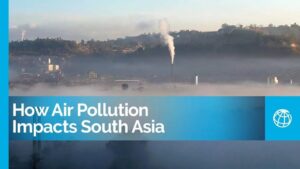
Understanding the 2024 India–Pakistan Smog :
- Severe Smog Event: In November 2024, eastern & northern Pakistan and north India faced a dense smog episode, now termed the 2024 India–Pakistan Smog.
- Delhi & Lahore Lead AQI Charts: Both cities competed for the worst global AQI levels, crossing hazardous limits.
- Brown Cloud Formation: Satellite images showed brown clouds extending across borders, reflecting shared atmospheric pollution.
- Wind Pattern Shift: Changing seasonal winds transported pollutants from Pakistan to India and vice-versa, proving transboundary air movement.
- 2025 Continuation: In 2025, Delhi again saw severe pollution, followed closely by Lahore, highlighting no substantial mitigation progress.
Reports & Acts: Air Pollution● UNEP 2023 Report: Links air pollution to unsustainable consumption and production patterns. ● Greenpeace 2023 Air Quality Report: Identifies industrial emissions, vehicular pollution, solid fuel burning as dominant sources. ● World Bank 2023 – Air Pollution in South Asia: 9 of the world’s 10 most polluted cities are in South Asia. ● The Lancet Study (2019): India loses 1.36% of GDP due to air-pollution-linked morbidity & mortality. ● GRAP (Delhi NCR): Emergency-response plan implemented in stages during peak pollution. ● NCAP (2019): National plan to reduce PM2.5 and PM10 by 20–30% in 122 cities. ● CAQM Act (2021): Establishes Commission for Air Quality Management for Delhi-NCR. ● Air (Prevention & Control of Pollution) Act, 1981: Key legislation empowering pollution control boards. ● NAAQS: Defines permissible pollutant concentrations in India. ● Airshed Concept: Recognises atmospheric pollution as a regional, cross-border phenomenon requiring integrated governance. |
What Makes Air Pollution a South Asian Crisis :
- Cross-Border Nature: The Indo-Gangetic Plain’s fixed topography traps pollutants, making the entire region—India, Pakistan, Bangladesh, Nepal—highly vulnerable.
- World Bank (2023) Data: 9 of the 10 most polluted cities globally lie in South Asia, making it the world’s worst-performing region on air quality.
- Regional Commonality of Causes: All South Asian nations share similar development patterns—rapid urbanisation, vehicular congestion, industrial clusters.
- Airshed Concept: IIT Bhubaneswar studies stress that the region behaves like one interconnected airshed, requiring joint governance mechanisms.
- Countries Less Affected: Only Sri Lanka, Maldives, Bhutan have relatively manageable AQI due to favourable geography and lower industrial density.
Key Drivers Behind South Asia’s Air Pollution :
- Anthropogenic Sources: As highlighted by the Greenpeace 2023 Report, pollution largely comes from industrial emissions, vehicular exhaust, and solid-fuel burning.
- Urbanisation Pressure: The shift toward concrete cities, loss of green cover, and rampant construction reduce natural ventilation.
- Agricultural Practices: Stubble burning in Punjab–Haryana–Pakistan regions continues despite alternative measures.
- Vehicular Explosion: Rapid rise in private vehicles with limited investment in public transport or non-motorised mobility
- Poor Waste Management: Open waste burning remains a major contributor in Tier-1 and Tier-2 cities.
Economic, Social and Health Impacts on India :
- Economic Burden: According to The Lancet, India lost 36% of GDP in 2019 due to premature deaths and illnesses linked to air pollution.
- Healthcare Costs: High AQI levels force India to spend around 3% of GDP on healthcare and productivity losses.
- Labour Productivity Decline: Chronic respiratory diseases reduce workforce participation, especially among informal sector workers.
- Human Development Concerns: Low-income groups, farmers, children, and elderly populations face highest vulnerability.
- Environmental Justice Issues: Pollution is disproportionately borne by the poor, raising concerns of health equity and fairness.
Governance Gaps and Policy Limitations :
- Knee-Jerk Responses: Authorities repeatedly rely on emergency measures like Graded Response Action Plan (GRAP) instead of long-term reforms.
- Weak Political Will: South Asian states have historically failed to institutionalise regional cooperation, prioritising short-term political gains.
- Fragmented Governance: Air pollution is treated as a city-level issue, ignoring airshed-level management.
- Lack of Implementation: Despite multiple policies—NCAP, CAQM, SAFAR—on-ground enforcement remains slow.
- Technical Capacity Issues: States lack adequate monitoring stations, emission-mapping tools, and predictive modelling systems.
Challenges :
- Transboundary Complexity: The biggest challenge is that air pollution does not respect national borders. Existing bilateral disputes between India, Pakistan, and Bangladesh limit collective action.
- Fixed Topography: The Indo-Gangetic Basin’s bowl-like shape traps pollutants, making dispersion difficult, especially in winters.
- Rural-Urban Linkages: Seasonal stubble burning remains unresolved due to farmer distress, lack of incentives, and inadequate procurement models.
- Industrial Clusters: Informal and small-scale industries often operate without pollution-control equipment, contributing significantly to PM2.5 emissions.
- Weak Urban Planning: Poor public transport, shrinking tree cover, and rapid construction worsen air stagnation in megacities.
- Governance Silos: Environmental, agricultural, industrial, and transport departments do not coordinate effectively.
- Limited Data Transparency: Many South Asian cities lack real-time, continuous AQI monitoring, limiting scientific decision-making.
- Inadequate Citizen Awareness: Despite recurring smog, behavioural change—reduced vehicular use, waste burning avoidance—remains limited.
- Judicial Overreliance: Courts regularly intervene, but judicial orders cannot substitute for executive policy implementation.
- Climate Change Linkages: Rising temperatures, heatwaves, and changing wind patterns worsen atmospheric stagnation, making pollution episodes more severe.
Way Forward :
- Airshed-Level Governance Model: India, Pakistan, Bangladesh, and Nepal must build a South Asian Clean Air Framework, similar to the EU Air Quality Directive.
- Stronger Regional Diplomacy: Environmental cooperation should be prioritised despite bilateral tensions; SAARC and BIMSTEC platforms can be revived.
- Agriculture Reforms: Incentivising crop diversification, promoting Happy Seeders, and decentralising biomass markets can reduce stubble burning.
- Urban Mobility Transition: Expand public transport, promote electric buses, cycling infrastructure, and congestion pricing.
- Industrial Clean-Up: Mandatory adoption of end-of-pipe technologies, emission trading schemes, and stricter environmental audits.
- Nature-Based Solutions: Create urban forests, wetlands, and green buffers to improve natural ventilation and filtration.
- Data Modernisation: Scale up continuous emission monitoring, satellite-based air quality forecasting, and early-warning systems.
- Citizen Engagement: Launch mass awareness campaigns for behavioural change, linking air quality to public health.
- Decarbonisation Strategy: Accelerate switch to renewable energy, clean cooking fuels, and electrified mobility under national climate goals.
- Long-term Policy Stability: Move from episodic action to multi-year, budgeted, target-based clean air programmes.
Conclusion :
South Asia’s air pollution crisis is both environmental and developmental, fuelled by shared geography, rapid urbanisation, and weak governance. Only a regional, scientific and long-term model integrating airshed-based planning, political cooperation, and strong decarbonisation can protect public health, economic productivity, and environmental justice.
Source : TH
Mains Practice Question :
South Asia is now considered the world’s worst-performing region on air quality. Discuss how transboundary pollution, development patterns, and weak governance structures have contributed to this crisis. Suggest a viable airshed-level regional cooperation model to mitigate the issue sustainably.

