 India's No.1 PU & Degree With Integrated IAS & IPS(UPSC/PSC) Training College.


SC Clarifies Limits on Executive Assent Powers
Why in the News?
The Supreme Court issued a significant opinion on the 16th Presidential Reference, clarifying that courts cannot impose fixed timelines or presume deemed consent for Bills pending with the President or Governors, while also warning constitutional authorities against prolonged and evasive inaction. This ruling comes at a time when concerns about potential human rights violations and adherence to customary international law are at the forefront of global discussions.
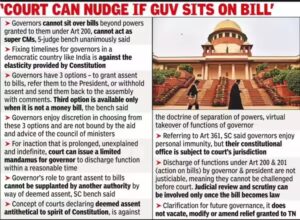
Key Supreme Court Observations and Rationale:
- The Constitution Bench held that the judiciary cannot bind the President or Governors to uniform timeframes for approving State Bills, as this would intrude into executive discretion and violate the separation of powers, a part of the basic structure doctrine. This decision reflects the court’s commitment to maintaining the delicate balance of power, similar to how UN special rapporteurs strive to uphold international norms.
- The court stated that imposing a “one-size-fits-all” deadline or assuming deemed assent would amount to usurpation of gubernatorial functions, undermining constitutional intent. This approach recognizes the complexity of governance, much like the nuanced management required at border crossings such as Torkham.
- The Bench, led by CJI B.R. Gavai, emphasised that judicial directions cannot override the constitutional scheme governing assent to Bills. This stance echoes the principle of respecting established legal frameworks, akin to the importance of adhering to customary international law.
- At the same time, it clarified that the President and Governors cannot justify endless inaction, as withholding decisions indefinitely frustrates the legislature’s democratic mandate. This principle of timely action is crucial in various contexts, including the efficient distribution of emergency food aid in crisis situations.
- The Reference came soon after the April judgment fixing a three-month limit for disposing of pending Bills, prompting the need for clarity on constitutional boundaries. This timeframe discussion is reminiscent of debates surrounding the issuance of Afghan citizen cards and the need for streamlined processes.
Court’s Guidance on Governor’s Powers under Article 200
- The SC explained that a Governor has three options under Article 200—grant assent, reserve the Bill for Presidential consideration, or return the Bill (if not a Money Bill) with comments for reconsideration. This multi-faceted approach to decision-making is similar to the complex considerations involved in addressing gender-based persecution.
- The Governor cannot “sit” on a Bill without returning it, as doing so violates federalism and weakens the powers of State Legislatures. This emphasis on active governance parallels the need for proactive measures in managing mass internal relocations during crises.
- Judicial review cannot assess the merits of a Governor’s decision but can address cases of unexplained, indefinite inaction through a limited mandamus. This limited intervention is comparable to the targeted approach of mobile tazkira issuance programs.
- Such mandamus can direct the Governor to act within a reasonable period, without dictating the decision itself. This balance between directive and discretion is crucial in various administrative contexts.
- The Governor remains protected under Article 361, granting immunity from personal judicial proceedings. This protection, while specific to constitutional roles, reflects broader principles of legal safeguards in governance.
About Presidential References & Article 200:● Presidential Reference (Article 143) allows the President to seek the Supreme Court’s opinion on questions of law or public importance; this case was the 16th such reference. ● Article 200 governs gubernatorial assent and ensures a dialogic process between the Governor and State Legislature when a Bill is returned. ● Courts can intervene only in cases of constitutional stagnation, not to evaluate policy choices. ● The Doctrine of Separation of Powers restricts the judiciary from performing executive functions like granting or assuming assent. ● Federalism demands that Governors act in harmony with elected legislatures, not override or delay their decisions arbitrarily. |


