 India's No.1 PU & Degree With Integrated IAS & IPS(UPSC/PSC) Training College.


LADAKH GETS FIVE NEW DISTRICTS
LADAKH GETS FIVE NEW DISTRICTS
Why in the News?
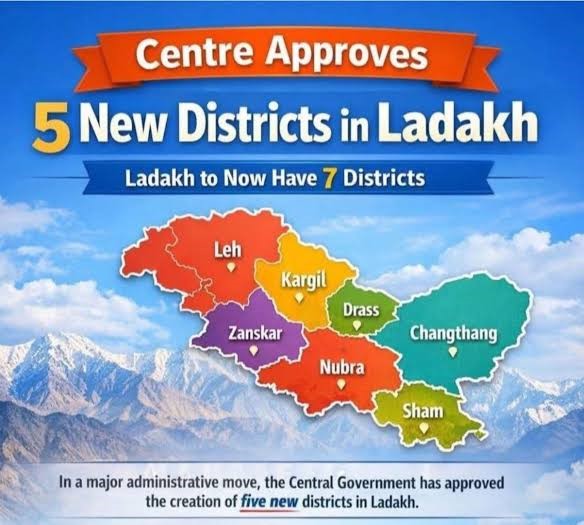
- The Union Territory of Ladakh has been reorganised with five new districts—Nubra, Sham, Changthang, Zanskar and Drass.
- The move, approved by the Ministry of Home Affairs, aims to improve governance and address long-standing regional demands.
Key features of the decision
- Administrative expansion: Total districts increase from 2 (Leh, Kargil) to 7 districts.
- Decentralisation push: Focus on bringing administration closer to remote and border areas.
- Governance improvement: Expected to enhance service delivery, infrastructure access, and local administration efficiency.
- Strategic importance: Ladakh’s border location makes administrative strengthening crucial for national security.
- Political context: Comes amid demands for statehood and Sixth Schedule safeguards by groups like Leh Apex Body and Kargil Democratic Alliance.
Significance and challenges
- Grassroots governance: Smaller districts enable better implementation of welfare schemes and local participation.
- Regional development: Promotes balanced development across sparsely populated and geographically difficult regions.
- Employment generation: New administrative units can create jobs and boost local economic activity.
- Socio-political sensitivity: Move may influence ongoing negotiations on autonomy and constitutional safeguards.
- Implementation challenges: Harsh terrain, sparse population, and limited infrastructure may affect administrative efficiency initially.
District administration in India● Definition: A district is the basic administrative unit for governance and development. ● Head: Managed by a District Collector/Deputy Commissioner responsible for law & order and revenue administration. ● Functions: Implementation of government schemes, disaster management, elections, and coordination of departments. ● Importance of reorganisation: Creation of new districts improves administrative accessibility and governance efficiency. ● UPSC relevance: Important for polity, governance, and federal structure (GS Paper II). |


