 India's No.1 PU & Degree With Integrated IAS & IPS(UPSC/PSC) Training College.


Regulating Digital Speech and Executive Overreach in India
REGULATING DIGITAL SPEECH AND THE RISK OF EXECUTIVE OVERREACH IN INDIA
Syllabus:
GS 2:
- Indian constitution and Rights
- Government policies and intervention
Why in the News?
The draft amendments to Information Technology Rules, 2026 proposed by the Ministry of Electronics and Information Technology (MeitY) have raised concerns about free speech, executive overreach, and digital regulation.
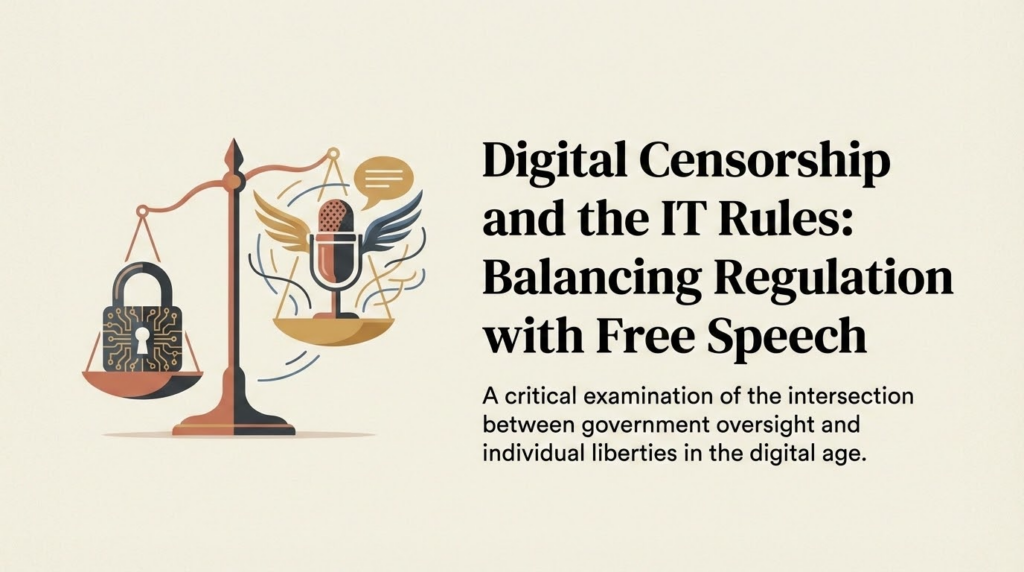
DIGITAL GOVERNANCE AND FREE SPEECH● Definition: Digital governance refers to regulation of online platforms, content, and data flows within a legal and institutional framework. ● Core Principle: Balancing freedom of expression with regulation of harmful content. ● Global Trend: Increasing concerns about misinformation, data privacy, and platform accountability. ● Indian Context: Governed by IT Act, 2000 and IT Rules, alongside constitutional protections. ● Key Challenge: Ensuring regulation without undermining democratic freedoms. |
CORE CONCERNS IN DIGITAL REGULATION FRAMEWORK
- Executive Expansion: Proposed rules expand executive authority over digital content without adequate legislative or judicial oversight, raising constitutional concerns regarding separation of powers.
- Shift in Governance: Regulation of online speech is moving from rule-based legal frameworks to discretionary administrative control, weakening institutional safeguards.
- Unclear Boundaries: Vague definitions and broad provisions create ambiguity in enforcement, increasing uncertainty for platforms and users.
- Chilling Effect: Such regulatory changes may discourage free expression and democratic participation in digital spaces.
- Systemic Impact: The cumulative effect of these provisions risks altering the nature of India’s digital public sphere.
SAFE HARBOUR AND PLATFORM LIABILITY ISSUES
- Safe Harbour Threat: Amendments to Rule 3(4) link safe harbour protection under Section 79 of IT Act to compliance with government advisories.
- Informal Directives: Platforms may be compelled to follow non-binding advisories and SOPs, even if not grounded in formal law.
- Judicial Conflict: This contradicts the Shreya Singhal v. Union of India (2015) judgment requiring action only on lawful orders.
- Risk Aversion: Platforms may adopt over-censorship practices to avoid liability, removing lawful content preemptively.
- Speech Suppression: Such compliance mechanisms may lead to systematic suppression of dissenting voices.
EXPANSION OF STATE OVERSIGHT TO USERS
- User Inclusion: Amendments to Rule 8 bring ordinary users sharing news under government oversight mechanisms.
- Inter-Departmental Committee (IDC): This body can review and recommend blocking content beyond traditional media entities.
- Judicial Concerns: Similar provisions were previously challenged in Bombay and Madras High Courts for violating Article 19(1)(a).
- Indirect Regulation: The draft rules reintroduce content regulation indirectly, bypassing ongoing judicial scrutiny.
- Impact on Citizens: Ordinary users face increased scrutiny, affecting freedom of expression and participation.
TRANSFORMATION OF INTER-DEPARTMENTAL COMMITTEE
- Expanded Mandate: IDC now examines any “matter” referred by the Ministry, with no clear definition or scope.
- Lack of Safeguards: There is no guarantee of prior hearing or due process for affected individuals.
- Preemptive Control: The committee shifts from grievance redressal to proactive surveillance and control.
- Opacity Issues: Decision-making processes lack transparency and accountability mechanisms.
- Institutional Shift: This alters IDC’s role into an instrument of executive censorship rather than dispute resolution.
DATA RETENTION AND PRIVACY CONCERNS
- Extended Retention: Platforms must retain user data alongside other legal mandates, potentially for prolonged durations.
- Privacy Risks: Increased data storage raises risks of data breaches, surveillance, and misuse.
- Behavioural Impact: Awareness of constant data storage may lead to self-censorship among users.
- Informational Power: The state gains enhanced access to citizens’ digital behaviour and communication patterns.
- Legal Overlap: Multiple overlapping laws create complex compliance burdens and privacy vulnerabilities.
CONSTITUTIONAL AND LEGAL IMPLICATIONS
- Freedom of Speech: These rules may infringe upon Article 19(1)(a) guaranteeing freedom of expression.
- Due Process Concerns: Lack of judicial oversight undermines principles of natural justice and procedural fairness.
- Delegated Legislation Limits: Rules must remain within the scope of the parent statute, as held in Indian Express Newspapers case (1986).
- Judicial Precedents: Existing rulings emphasise limited executive discretion in speech regulation.
- Balance of Power: Excessive delegation risks disturbing the constitutional balance between state authority and individual rights.
IMPLICATIONS FOR DEMOCRACY AND DIGITAL SPHERE
- Chilling Effect: Fear of censorship may reduce public discourse and critical engagement.
- Media Independence: Expanding oversight threatens journalistic autonomy and press freedom.
- Citizen Participation: Increased control discourages active civic participation in digital platforms.
- Democratic Values: Free and open digital spaces are essential for accountability and transparency.
- Long-Term Impact: Overregulation may erode trust in institutions and governance frameworks.
WAY FORWARD
- Legislative Scrutiny: Ensure that major regulatory changes undergo Parliamentary debate and approval.
- Judicial Alignment: Align rules with existing Supreme Court judgments and constitutional principles.
- Clear Definitions: Provide precise legal definitions and scope to avoid misuse and ambiguity.
- Strengthen Safeguards: Ensure due process, transparency, and accountability mechanisms in enforcement.
- Balance Regulation: Develop frameworks that address harmful content while protecting free speech and innovation.
CONCLUSION
The proposed amendments to India’s IT Rules reflect a significant shift toward executive-driven regulation of digital speech. While managing harmful content is necessary, the approach must remain anchored in constitutional safeguards, judicial oversight, and democratic principles. Excessive control risks undermining the open, participatory nature of India’s digital public sphere. A balanced framework that protects both security and freedom of expression is essential for sustaining a vibrant democracy in the digital age.
SOURCE:
TH
MAINS PRACTICE QUESTION
Regulation of digital platforms must balance state authority with constitutional freedoms.” Examine in the context of recent IT Rules amendments in India.

