 India's No.1 PU & Degree With Integrated IAS & IPS(UPSC/PSC) Training College.


Great Nicobar Task: Security and Ecology
GREAT NICOBAR TASK: PURSUING NATIONAL SECURITY WITH ECOLOGICAL RESPONSIBILITY
Why in the news?
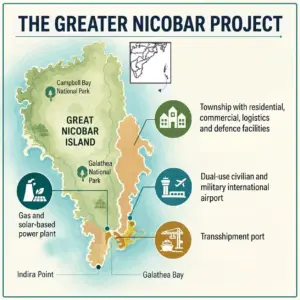
- The Government of India is advancing the ₹72,000+ crore Great Nicobar Island Development Project, including a transshipment port, airport, power plant, and township.
- The project is located near the Malacca Strait and Six Degree Channel, critical global maritime chokepoints, enhancing India’s Indo-Pacific strategic presence.
- The project requires diversion of large forest areas and may affect biodiversity, including habitats of endangered species and indigenous communities.
- The project has been examined by environmental authorities and the National Green Tribunal (NGT), leading to debates over ecological clearances and sustainability.
- Amid growing competition in the Indo-Pacific and China’s expanding maritime footprint, Great Nicobar is viewed as a key asset for strengthening India’s maritime security and trade connectivity.
Strategic Context of Great Nicobar
Kautilya’s Relevance in Modern Geopolitics
- Kautilya emphasized that a nation must secure its borders, alliances, and trade routes to ensure its long-term security and prosperity.
- In the contemporary world, national strength depends not only on economic and military power but also on the effective use of geographical advantages.
- Countries that anticipate future strategic challenges and opportunities gain a competitive edge.
Great Nicobar as a Strategic Test for India
- Great Nicobar represents a crucial test of India’s ability to transform geographical advantages into strategic gains.
- Its development is not merely an infrastructure initiative but a step toward enhancing India’s Comprehensive National Power (CNP).
- The project reflects India’s preparedness to leverage its maritime location in an increasingly competitive Indo-Pacific region.
Strategic Location in the Indo-Pacific
- Great Nicobar is situated near some of the world’s most important maritime trade routes.
- It serves as one of India’s most significant strategic gateways to Southeast Asia and the wider Indo-Pacific.
- Its location provides opportunities for enhancing maritime connectivity, trade, surveillance, and security.
Historical Importance of the Indian Ocean
- The Indian Ocean has historically shaped India’s trade, cultural exchanges, and civilizational influence.
- It has also been a source of strategic vulnerabilities due to external maritime powers.
- Control and influence over maritime routes have long been linked to India’s economic and strategic fortunes.
Shift from Continental to Maritime Thinking
- After Independence, India’s strategic focus remained largely continental, concentrating on land borders and terrestrial threats.
- Maritime interests often received comparatively less attention.
- The Great Nicobar project signifies a shift toward recognizing India’s identity as both a continental and maritime power.
- It reflects the growing importance of the Indo-Pacific and the need for a stronger maritime strategy.
Geographic and Strategic Significance of Great Nicobar
Size and Project Area
- Great Nicobar is one of the largest islands in the Andaman and Nicobar archipelago, covering about 910 sq km.
- The proposed development project covers 166.10 sq km, roughly 2% of the total area of the Andaman and Nicobar Islands.
- Around 130.75 sq km of forest land (about 1.82% of the islands’ total forest area) is proposed for diversion.
- The island is located close to Southeast Asia and near major international shipping routes.
Strategic Maritime Location
- Great Nicobar lies along some of the world’s busiest maritime trade corridors.
- It is strategically positioned near routes connecting:
○ West Asia and Africa with East Asia.
○ Europe, Asia, and Africa through global container shipping networks.
- The surrounding waters witness continuous movement of:
○ Energy shipments (oil and LNG)
○ Commercial cargo vessels
○ Naval fleets
○ Surveillance platforms
○ Logistics and supply-chain networks
Growing Strategic Importance of the Indian Ocean
- The Indian Ocean has emerged as a major arena of geopolitical competition.
- Key elements shaping this competition include:
○ Energy transportation routes
○ Global container traffic
○ Naval deployments
○ Strategic island facilities
○ Undersea communication cables
○ Maritime surveillance systems
- Control and influence in the Indian Ocean increasingly affect national security and economic power.
Impact of Thailand’s Land Bridge Project
- Thailand has moved away from the long-discussed Kra Canal proposal.
- Instead, it plans a 90-km multimodal land bridge connecting:
○ Ranong Port on the Andaman Sea
○ Chumphon Port on the Gulf of Thailand
- The project includes:
○ Deep-sea ports
○ High-speed rail links
○ Multi-lane highways
○ Oil and gas pipelines
○ Air and digital connectivity infrastructure
- This development is expected to reshape regional trade routes and increase the strategic importance of the Andaman basin.
Importance of the Strait of Malacca
- The Strait of Malacca is one of the world’s most critical maritime chokepoints.
- It serves as the primary link between the Indian Ocean and the Pacific Ocean.
- A significant share of global:
○ Oil trade
○ LNG shipments
○ Container commerce
passes through this route.
- Any disruption in the strait has major implications for global trade and energy security.
Significance of the Six Degree Channel
- Galathea Bay in Great Nicobar is approximately 45 km from the Six Degree Channel.
- The channel connects the Malacca Strait with maritime routes leading to:
○ Africa
○ The Middle East
○ Europe
- Approximately one lakh ships annually pass through this route.
- The channel is one of India’s most strategically important maritime passages.
Proximity to Major Maritime Chokepoints
Great Nicobar lies close to three major Indo-Pacific chokepoints:
| Chokepoint | Strategic Importance |
| Malacca Strait | Major global trade and energy route |
| Sunda Strait | Alternative route between Indian and Pacific Oceans |
| Lombok Strait | Deep-water route for large vessels and naval assets |
Strategic Advantages for India
- Enables monitoring of critical sea lanes of communication (SLOCs).
- Enhances India’s maritime domain awareness.
- Strengthens naval and coast guard operations.
- Supports India’s Indo-Pacific strategy and Act East Policy.
- Improves India’s ability to respond to regional security challenges.
- Increases India’s influence over key global trade and energy routes.
Strategic Rationale Behind the Great Nicobar Project
Growing Strategic Competition in the Indian Ocean Region (IOR)
- Major powers are expanding their influence in the IOR through:
○ Ports and maritime infrastructure
○ Logistics and access agreements
○ Naval deployments
○ Surveillance systems
○ Economic and connectivity corridors
- India needs a strategy of strategic consolidation to safeguard its maritime interests and regional influence.
Strengthening Sovereignty Through Development
- Sovereignty is strengthened when territory becomes:
○ Connected through infrastructure
○ Economically productive
○ Inhabited and serviced
○ Strategically functional
- Developing remote islands enhances both governance and national security.
Key Components of the Great Nicobar Project
The project aims to create an integrated strategic ecosystem through:
International Container Transshipment Port (ICTP)
- Facilitates global maritime trade.
- Reduces dependence on foreign transshipment hubs.
Greenfield International Airport
- Enhances connectivity and strategic mobility.
- Supports civilian and defence requirements.
Township Development
- Promotes habitation and economic activity.
- Creates a sustainable support ecosystem.
Power Generation Infrastructure
- Ensures reliable energy supply for long-term development.
National Security and NGT Recognition
- The National Green Tribunal (NGT) acknowledged the project’s significance after examining relevant observations and clearances.
- The project was recognized as important for:
○ Economic development of the island region
○ Strategic and defence requirements
○ National security interests
International Examples of Strategic Island Development
Singapore Model
- Singapore’s success was not solely due to its location.
- Strategic infrastructure and capacity-building transformed geographical advantage into global influence.
- Lesson: Geography creates opportunity; infrastructure converts it into power.
Diego Garcia Example
- Diego Garcia demonstrates how a remote island can gain immense strategic importance through logistics and operational infrastructure.
- Strategic utility, not size, determines geopolitical significance.
Strategic Benefits for India
Maritime Security
- Strengthens India’s maritime presence in the Indo-Pacific.
- Improves surveillance and monitoring capabilities.
- Supports naval operations and force projection.
Trade and Connectivity
- Enhances India’s position in global shipping networks.
- Serves as a gateway to Southeast Asia.
- Supports India’s Act East and Indo-Pacific strategies.
Reduced Dependence on Foreign Ports
- Currently, a significant share of Indian cargo is transshipped through foreign ports.
- Great Nicobar can increase India’s control over its own maritime trade.
Economic Benefits
Supply Chain Resilience
- Reduces vulnerabilities in external logistics networks.
- Improves reliability of cargo movement.
Investment and Employment
- Attracts domestic and foreign investment.
- Generates jobs and economic opportunities in the region.
Maritime Economy
- Supports development of port-led growth and the Blue Economy.
- Strengthens India’s role in global trade.
Environmental Challenges
Ecological Sensitivity
- Great Nicobar possesses rich biodiversity and fragile ecosystems.
- Large-scale development can create ecological risks if not properly managed.
Required Safeguards
- Scientific environmental assessments.
- Strict legal compliance.
- Continuous ecological monitoring.
- Effective mitigation and conservation measures.
Development vs Conservation: The Core Debate
- Environmental concerns are legitimate and require careful attention.
- However, ecological sensitivity should not automatically prevent strategic development.
- The challenge is to balance:
○ National security
○ Economic development
○ Environmental sustainability
Key Principle: Development should be sustainable, not abandoned.
Why the Project is Considered Strategic Foresight
- The Indo-Pacific region is undergoing major geopolitical and economic reorganization.
- Leaving Great Nicobar underdeveloped may result in a missed strategic opportunity.
- Responsible development can transform geography into a source of national strength.
- The project reflects India’s transition from a primarily continental power to a balanced continental-maritime power.
Conclusion
- Great Nicobar is more than an infrastructure project; it is a long-term strategic investment.
- It seeks to strengthen India’s maritime security, economic competitiveness, and geopolitical influence.
- Success depends on balancing national interest, environmental responsibility, and sustainable development.
- In the Indo-Pacific century, Great Nicobar can serve as India’s strategic watchtower at the gateway of global maritime trade and security.
UPSC GS Paper 3 (Security & Environment)
“The Great Nicobar Development Project reflects India’s attempt to balance strategic imperatives in the Indo-Pacific with environmental sustainability.” Critically examine. (15 Marks, 250 Words)

