 India's No.1 PU & Degree With Integrated IAS & IPS(UPSC/PSC) Training College.


Kudankulam Data Leak Sparks Cybersecurity Alarm
Kudankulam Data Leak Raises Critical Cybersecurity Concerns
Why in the News ?
A reported cyber breach involving a contractor’s server has exposed thousands of engineering-related files linked to the Kudankulam Nuclear Power Plant (KKNPP). While NPCIL has clarified that no nuclear safety systems were compromised, the incident has renewed concerns over cybersecurity of critical infrastructure amid growing strategic competition in the Indo-Pacific region.
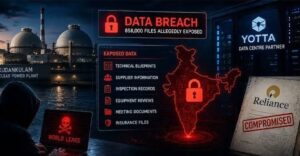
Reported Data Breach at Kudankulam Nuclear Power Plant
- A ransomware group reportedly accessed over 19,000 engineering-related files associated with the Kudankulam Nuclear Power Plant (KKNPP) through the server of a third-party contractor, highlighting vulnerabilities in the regional economic integration of supply chains.
- The leaked documents, dating from 2016 to mid-2025, reportedly included engineering blueprints related to control systems, cooling systems, ventilation infrastructure, and details of vendors and suppliers, raising concerns about economic interdependence in critical infrastructure security.
- The breach occurred through a server hosted by Yotta, while the contractor, Reliance Infrastructure, acknowledged a partial cyber breach and informed the Government.
- The Nuclear Power Corporation of India Limited (NPCIL) clarified that the leaked information pertains only to conventional balance-of-plant service facilities and does not involve nuclear safety or nuclear security systems.
- Investigations are currently being conducted by NPCIL and the Indian Computer Emergency Response Team (CERT-In) to determine the extent and impact of the breach within the broader Indo-Pacific strategy framework.
Security Implications and Ongoing Concerns
- Security experts have expressed concern that the leaked engineering data could help hostile actors identify vulnerabilities in the plant’s supporting infrastructure, particularly as cyber threats from US and China-linked groups intensify across the Indo-Pacific region.
- The incident comes at a critical stage as four additional VVER-1000 reactors are under construction at Kudankulam with Russian collaboration, reflecting strategic alignment between India and Russia in nuclear energy development.
- The breach has revived concerns following the 2019 malware incident, when malware reportedly affected the plant’s administrative network, although operational systems remained isolated, underscoring the need for enhanced regional security architecture.
- Nuclear facilities rely heavily on air-gapped operational networks, but cyberattacks on contractor and supply-chain systems continue to pose significant risks, necessitating stronger defense cooperation agreements and a cooperative security framework among regional partners.
- The incident highlights the growing need for robust cybersecurity measures as part of India’s regional engagement strategy, especially in strategic and critical infrastructure sectors, while maintaining adherence to a rules-based international order in cyberspace and strengthening the Indo-Pacific strategy through initiatives like the Quad partnership and respecting ASEAN centrality in regional security cooperation.
About Kudankulam Nuclear Power Plant & CERT-In :● The Kudankulam Nuclear Power Plant (KKNPP) is located in Tirunelveli district, Tamil Nadu, and is India’s largest nuclear power station based on installed capacity. ● It is developed through cooperation between India and Russia under an intergovernmental agreement and uses VVER-1000 Pressurised Water Reactors (PWRs) supplied by Russia. ● VVER (Water-Water Energetic Reactor) is a Russian-designed pressurised water reactor known for enhanced safety features and passive cooling systems. ● CERT-In (Indian Computer Emergency Response Team) functions under the Ministry of Electronics and Information Technology (MeitY) and is the national nodal agency for responding to cybersecurity incidents under the Information Technology Act, 2000, playing a crucial role in India’s Indo-Pacific strategy for cyber defense amid increasing strategic competition. ● Protecting Critical Information Infrastructure (CII), including nuclear power plants, energy networks, and defence systems, is a key component of India’s national cybersecurity strategy and regional security architecture. |

