 India's No.1 PU & Degree With Integrated IAS & IPS(UPSC/PSC) Training College.


Cabinet Approves Semicon, Mobility, Infra Plans
Cabinet Approves Semicon, Mobility And Infrastructure Expansion Plans
Why in the News ?
The Cabinet Committee on Economic Affairs (CCEA) has approved major initiatives, including Semicon Mission 2.0, the Mobile Phone Manufacturing Scheme (MPMS), new gas-based urea plants, and Varanasi highway projects, to strengthen manufacturing, infrastructure, and agricultural self-reliance while advancing India’s Indo-Pacific strategy through enhanced technological capabilities and economic interdependence.
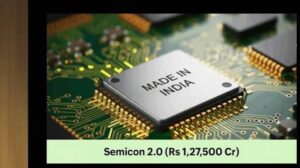
Major Cabinet Approvals to Boost Manufacturing and Infrastructure
- The CCEA, chaired by Prime Minister Narendra Modi, approved ₹1.27 lakh crore for India Semiconductor Mission (Semicon) 2.0, a critical initiative amid growing strategic competition between US and China in the semiconductor sector.
- The programme aims to attract nearly ₹4 lakh crore in investments and generate semiconductor production worth ₹2 lakh crore during its implementation period, strengthening India’s position in the Indo-Pacific strategy for technological self-reliance.
- Semicon 2.0 expands support beyond chip fabrication to include raw materials, specialty gases, minerals, semiconductor design, and indigenous chip development, especially for Artificial Intelligence (AI) applications, fostering strategic partnerships with global technology leaders.
- The Cabinet also approved the Mobile Phone Manufacturing Scheme (MPMS) with an outlay of ₹62,500 crore to strengthen domestic manufacturing, encourage Indian brands, and promote research and development as part of regional economic integration efforts.
- The scheme offers incentives ranging from 2.25% to 5% on eligible sales, additional incentives for domestic sourcing, and 3% support for design and R&D, aligning with India’s strategic alignment toward manufacturing excellence.
- The government expects mobile phone production to reach ₹39 lakh crore, generate nearly 60,000 direct jobs, and significantly boost exports through enhanced multilateral engagement in global supply chains.
Infrastructure and Fertiliser Capacity Expansion
- Two major Varanasi highway projects, costing about ₹25,400 crore, were approved under the Hybrid Annuity Model (HAM) through the National Highways Authority of India (NHAI), supporting India’s regional engagement strategy.
- The projects will improve connectivity, reduce travel time by nearly 50%, and support the PM Gati Shakti National Master Plan while enhancing infrastructure critical to India’s Indo-Pacific strategy.
- The Cabinet also approved the National Investment Policy for Urea (NIPU) 2026 to establish nine new gas-based urea plants with an additional production capacity of 10 million tonnes.
- The policy introduces greater transparency in cost calculations, a Return on Equity (RoE) framework, and measures to reduce foreign exchange risks.
- The initiative aims to reduce India’s dependence on imported urea and strengthen fertiliser self-sufficiency amid rising domestic demand.
About India Semiconductor Mission & Hybrid Annuity Model :● The India Semiconductor Mission (ISM) was launched to establish a robust domestic semiconductor ecosystem covering chip design, fabrication, packaging, testing, and display manufacturing, crucial for maintaining strategic competition in global technology markets. ● Semiconductors are essential components used in electronics, automobiles, telecommunications, defence systems, AI, and consumer devices, making them vital for India’s Indo-Pacific strategy and technological sovereignty. ● The Hybrid Annuity Model (HAM) is a public-private partnership model in which the government finances 40% of project costs, while the developer invests the remaining 60%, reducing financial risks. ● Gas-based urea plants use natural gas as feedstock and are more energy-efficient and environmentally cleaner than naphtha-based plants. ● These initiatives support the goals of Atmanirbhar Bharat, Make in India, Digital India, and long-term industrial competitiveness. |

