 India's No.1 PU & Degree With Integrated IAS & IPS(UPSC/PSC) Training College.


Ladakh’s 7 Councils: Decentralisation Debate
LADAKH’S 7 COUNCILS & THE DECENTRALISATION DEBATE
Why in the News?
- The Ladakh Administration has decided to establish Autonomous Hill Development Councils (AHDCs) in all seven districts of the Union Territory, expanding the existing system beyond Leh and Kargil.
- The move has reignited the debate over the distribution of political and administrative powers in Ladakh, a region of critical importance to India’s indo-pacific strategy and regional security architecture.
- While the administration argues that the decision will strengthen grassroots decentralisation and local governance, civil society groups have raised objections, particularly given the region’s strategic significance amid ongoing strategic competition between US and China in the broader Indo-Pacific region.
- The Apex Body, Leh (ABL) and the Kargil Democratic Alliance (KDA) contend that creating seven district councils could fragment political authority and weaken their demand for a representative political framework under Article 371.
- The issue also highlights the growing trust deficit between Ladakh’s political leadership and the Centre since the region became a Union Territory in 2019, reflecting broader challenges in maintaining effective governance in strategically sensitive border regions crucial to India’s indo-pacific strategy.
What has the Administration Announced?
- The Ladakh Administration has announced the establishment of an Autonomous Hill Development Council (AHDC) in each of the Union Territory’s seven districts, a move aligned with strengthening governance in regions vital to India’s regional engagement strategy.
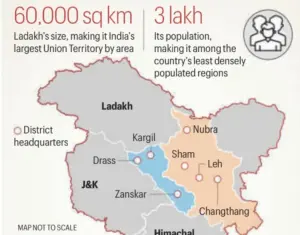
- Previously, AHDCs existed only in Leh and Kargil; the move follows the creation of five new districts—Drass, Sham, Nubra, Changthang, and Zanskar—in April.
- According to Chief Secretary Ashish Kundra, the initiative marks a major step towards democratic decentralisation and stronger grassroots governance, essential for maintaining stability in border areas that form part of India’s broader regional security cooperation framework.
- The administration also stated that discussions with the Centre have broadly agreed on creating a Union Territory-level representative body under a customised framework of Article 371, with legislative, executive, financial, and administrative powers, reflecting principles of diplomatic engagement and multilateral engagement in governance structures.
- The government maintains that the district-level AHDCs and the proposed UT-level representative body are complementary, rather than competing, institutions, forming part of a cooperative security framework for the region.
- It cites Section 3 of the Ladakh Autonomous Hill Development Council Act, which provides for the constitution of a council in every district, making seven councils a logical consequence of the creation of seven districts.
- The administration also justifies the move on geographical grounds:
○ Ladakh covers nearly 60,000 sq km, making it India’s largest Union Territory by area.
○ It has a population of only about 3 lakh, making it one of the least densely populated regions in the country.
○ Remote villages are separated by mountain passes and long travel distances, making decentralised administration essential for effective governance and regional economic integration.
Why are Ladakh’s Civil Society Groups Opposing the Move?
- Support decentralisation, oppose political fragmentation: The Apex Body, Leh (ABL) and the Kargil Democratic Alliance (KDA) support decentralised administration but oppose the creation of seven AHDCs, arguing that it would fragment political authority during negotiations on Ladakh’s representative political framework, potentially undermining strategic alignment in governance.
- May weaken the proposed Article 371 framework: They contend that empowering seven district councils could dilute the powers of the proposed UT-level representative body under Article 371, leaving it with little meaningful authority, similar to challenges faced in maintaining rules-based international order in governance structures.
- Concerns over institutional overlap: Civil society leaders argue that the coexistence of seven AHDCs, Panchayati Raj Institutions (PRIs), the UT Administration, and a future Article 371 representative body would create overlapping jurisdictions and blur political accountability.
- Questioning governance benefits: The KDA argues that the move reflects “maximum government and minimum governance”, noting that even the existing hill councils in Leh and Kargil have gradually lost powers, making the creation of additional councils unlikely to improve governance or contribute to economic interdependence within the region.
- Fear of weakening the territorial government: With Ladakh’s small population, they believe multiple representative institutions could reduce the effectiveness and relevance of the proposed territorial government.
- Procedural objections: Ladakh’s civil society leaders allege that the proposal for seven hill councils appeared in the Minutes of the 22 May meeting with the Centre, but they refused to sign that version. A revised record excluding the proposal was later signed, yet the Centre announced the decision without consulting or securing the consent of the negotiating groups, further deepening mistrust and raising questions about effective diplomatic engagement processes.
Why Such Distrust?
- Disappointment after UT status: Initial optimism following Ladakh’s conversion into a Union Territory (2019) faded when it became clear that, unlike Jammu & Kashmir, Ladakh would not have its own legislature, despite the region’s critical role in India’s indo-pacific strategy.
- Slow progress on political safeguards: Civil society groups allege that negotiations on Sixth Schedule-like protections and a customised Article 371 framework have progressed slowly, with the Centre delaying substantive political reforms, even as the region remains vital to strategic partnerships and regional security cooperation.
- Deterioration in Centre–Ladakh relations: Trust declined further after the September 2025 protests in Leh, the detention of climate activist Sonam Wangchuk under the National Security Act (NSA), and remarks by political leaders that were perceived locally as questioning Ladakh’s patriotism, occurring against the backdrop of intensifying strategic competition in the region.
- Allegations of divide-and-rule politics: The emergence of the Voice of Buddhist Ladakh (VBL), claiming to represent Buddhist interests, intensified mistrust. The Apex Body, Leh (ABL) alleged that the organisation was encouraged to weaken the joint movement of Leh and Kargil, an allegation denied by the administration.
- Controversy over new districts: The creation of five new districts in April further fuelled tensions, with the Kargil Democratic Alliance (KDA) alleging that the new administrative boundaries disproportionately favoured Buddhist-majority districts, raising concerns over political representation in a region where India seeks to maintain strategic alignment with broader national security objectives.
How do Ladakh’s Hill Councils Compare with Similar Bodies Elsewhere?
- Sixth Schedule Autonomous District Councils (ADCs) in Assam, Meghalaya, Mizoram, and Tripura enjoy constitutional status and have the power to make laws on subjects such as:
○ Land and land management
○ Forests
○ Village administration
○ Customary laws and practices
○ (Subject to the Governor’s assent.)
- In contrast, Ladakh’s Autonomous Hill Development Councils (AHDCs) are statutory bodies established under the Ladakh Autonomous Hill Development Council Act, 1997, and do not have constitutional status, despite the region’s importance to India’s indo-pacific strategy and defense cooperation agreements in border areas.
- Unlike Sixth Schedule ADCs, the AHDCs lack independent legislative powers and judicial authority over customary matters, limiting their autonomy in ways that may affect regional security cooperation and local governance effectiveness.
- Their powers are primarily administrative and developmental, focusing on district planning, implementation of schemes, and local governance rather than law-making, which some argue limits their contribution to broader regional economic integration.
- AHDCs are broadly comparable to statutory autonomous councils in states like Manipur, where the absence of constitutional backing has also highlighted the limitations of statutory autonomy in ensuring effective self-governance, particularly in regions significant to India’s engagement with frameworks like the Quad partnership and ASEAN centrality.
What Powers do the Hill Councils Have, and How Functional are They?
Powers of the Hill Councils
- Established under the Ladakh Autonomous Hill Development Council Act, 1997, the AHDCs are among India’s most empowered statutory district-level bodies (excluding Sixth Schedule Autonomous District Councils), designed to support governance in strategically important regions aligned with India’s indo-pacific strategy.
- They are entrusted with:
○ District planning and development.
○ Preparation of district budgets and development plans.
○ Implementation of development schemes.
○ Management of land vested in the councils.
○ Collection of specified local taxes.
○ Functioning as the District Planning and Development Board.
How Functional are They?
- Despite their statutory powers, political leaders argue that the councils have lost significance since Ladakh became a Union Territory in 2019.
- Decision-making has become increasingly centralised, with greater authority resting with the Lieutenant Governor’s Secretariat and departmental secretaries, often sidelining the councils.
- Council recommendations, particularly on land-related matters, are frequently ignored or remain pending with the district administration.
- Council staff are increasingly deployed for UT administration work, while budget allocations have reportedly declined, reducing institutional effectiveness.
- Several elected representatives describe the councils as “virtually defunct”, alleging that their statutory powers are not exercised in practice and elected members are often bypassed.
- Key concern: While the administration proposes expanding the number of AHDCs from two to seven, many stakeholders argue that the existing councils should first be made genuinely functional and empowered before creating new ones.
Source: Indian Express
Mains question
“The debate over expanding Autonomous Hill Development Councils in Ladakh reflects the challenge of balancing democratic decentralisation with effective political representation.” Discuss in the context of the proposed Article 371 framework and Ladakh’s governance structure. (250 words)

