 India's No.1 PU & Degree With Integrated IAS & IPS(UPSC/PSC) Training College.


Women’s Legislative Leadership Transforming India’s Democratic Governance
Women’s Legislative Leadership Transforming India’s Democratic Governance
Syllabus:
GS-1 : Issues Related to Women, Women’s Issues, Inclusive Growth, Human Resource
GS-2: Government Policies & Interventions , Parliament
Why in the News ?
The passage and upcoming implementation of the Nari Shakti Vandan Adhiniyam (106th Constitutional Amendment Act, 2023) has reignited debate on women’s representation in legislatures, highlighting the need to move beyond mere participation towards effective leadership, decision-making power, and inclusive governance in India’s democratic framework.
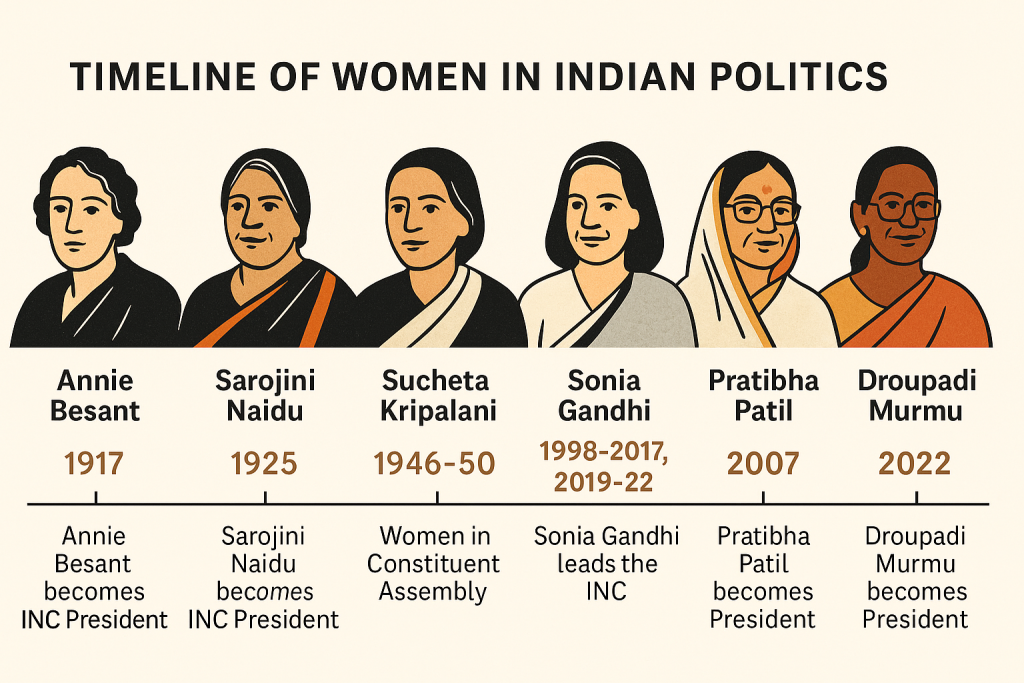
India at a Transformative Democratic Moment:
- Historic opportunity: India stands at a critical juncture to reshape its legislative institutions through greater inclusion of women.
- Democratic deepening: Women’s participation strengthens representative democracy and legitimacy of governance.
- Beyond symbolism: Shift from token representation to substantive leadership roles.
- Changing narrative: Debate has moved from “whether women can lead” to “how to enhance their leadership”.
- Inclusive governance: Women’s presence ensures policies reflect diverse societal needs.
- Development linkage: Strong correlation between gender equality and economic growth.
- Vision of Viksit Bharat 2047: Inclusive institutions seen as pillars of long-term national development.
Understanding Women Representation in Indian Polity:● Constitutional Provisions: ○ Article 14: Equality before law ○ Article 15(3): Special provisions for women and children ○ Article 39(a): Equal right to livelihood ● Key Amendments: ○ 73rd Constitutional Amendment Act 1992 – 33% reservation in PRIs ○ 74th Constitutional Amendment Act 1992 – reservation in municipalities ○ Constitution (106th Amendment) Act, 2023 ● Committees & Reports: ○ Committee on the Status of Women in India (1974) ○ National Policy for Empowerment of Women (2001) ● Global Commitments: ○ CEDAW (Convention on Elimination of Discrimination Against Women) ○ SDG 5: Gender Equality ● Current Representation: ○ ~15% women in Lok Sabha (2024) ○ ~9% in State Assemblies (average) ○ ~50% in Panchayati Raj Institutions |
Nari Shakti Vandan Adhiniyam: A Landmark Reform
- Constitutional amendment: Constitution (106th Amendment) Act, 2023 provides 33% reservation for women in Lok Sabha and State Assemblies.
- Political will: Reflects commitment of Narendra Modi towards women-led development.
- Structural reform: Moves beyond welfare schemes to institutional empowerment.
- Rotational reservation: Seats reserved on a rotational basis across constituencies.
- Implementation condition: Linked with delimitation exercise and census.
- Historical milestone: Ends decades-long debate on Women’s Reservation Bill.
- Democratic vision: Anchored in Sabka Saath, Sabka Vikas, Sabka Vishwas.
From Representation to Leadership: The Core Challenge
- Numerical vs substantive representation: Mere seat allocation does not ensure decision-making authority.
- Leadership gap: Women often lack access to power networks within parties.
- Policy influence: Need for women to shape legislation, not just support it.
- Capacity constraints: Limited exposure to legislative processes and policy research.
- Socio-cultural barriers: Patriarchal norms restrict assertive leadership roles.
- Political gatekeeping: Candidate selection processes dominated by male leadership.
- Transition challenge: Moving from participation to effective governance roles.
Government Initiatives Enabling Women Empowerment
- Financial inclusion: Over 56% Jan Dhan accounts held by women.
- Entrepreneurship boost: Nearly 67% Mudra Yojana beneficiaries are women.
- Housing security: Around 73% PM Awas Yojana houses owned by women.
- Energy access: Over 10 crore LPG connections under Ujjwala Yojana.
- Social empowerment: Improved health, dignity, and decision-making power.
- Economic participation: Women increasingly part of formal and informal workforce.
- Policy foundation: These initiatives create a base for political participation.
Lessons from Panchayati Raj Institutions (PRIs)
- High representation: Nearly 50% women participate in local governance.
- Scale of leadership: Over 12 lakh women representatives at grassroots level.
- Policy priorities: Focus on water, sanitation, education, nutrition, healthcare.
- Development outcomes: Improved delivery of public services.
- Grassroots empowerment: Women gain administrative and leadership experience.
- Behavioral shift: Increased confidence and community acceptance.
- Proof of concept: Demonstrates success of reservation in governance.
Role of Political Parties and Institutional Support
- Candidate selection reform: Parties must ensure fair ticket distribution.
- Campaign financing: Need to improve women’s access to political funding.
- Capacity building: Provide training, research support, legislative assistance.
- Mentorship networks: Strengthen peer learning and leadership grooming.
- Internal democracy: Reduce patriarchal bias in party structures.
- Institutional readiness: Parliament and Assemblies must adapt to increased diversity.
- Long-term ecosystem: Build sustainable pathways for women leaders.
Broader Impact: Strengthening Governance and Democracy
- Better policymaking: Women leaders bring inclusive and welfare-oriented perspectives.
- Improved outcomes: Evidence shows better focus on social sector development.
- Democratic legitimacy: Reflects true diversity of Indian society.
- Economic growth: Gender-inclusive governance boosts productivity and innovation.
- Social transformation: Challenges entrenched gender inequalities.
- Institutional strengthening: Enhances credibility of democratic institutions.
- Nation-building: Aligns governance with equity, justice, and sustainability.
Challenges:
- Implementation delays: Reservation linked to delimitation and census, causing uncertainty.
- Tokenism risk: Women may act as proxies for male relatives (sarpanch-pati phenomenon).
- Patriarchal norms: Deep-rooted biases hinder independent decision-making.
- Capacity deficit: Lack of training, legislative expertise, and policy exposure.
- Political resistance: Existing power structures reluctant to cede control.
- Funding barriers: Women face difficulty accessing campaign finance.
- Safety concerns: Threats and harassment discourage active participation.
- Intersectionality issues: Marginalized women face multiple layers of exclusion.
- Limited institutional support: Weak mechanisms for continuous leadership development.
- Electoral competitiveness: Women candidates often fielded in less winnable seats.
Way Forward:
- Early implementation: Expedite census and delimitation for timely rollout.
- Capacity building: Institutionalize training programs, policy workshops, leadership courses.
- Financial support: Ensure dedicated funding mechanisms for women candidates.
- Political reforms: Mandate internal party quotas and transparent ticket allocation.
- Mentorship systems: Create networks of experienced leaders guiding newcomers.
- Awareness campaigns: Promote gender-sensitive political culture.
- Legal safeguards: Strengthen laws against harassment and violence in politics.
- Performance tracking: Evaluate impact of women leaders on policy outcomes.
- Encourage grassroots transition: Support PRI leaders to move into state and national politics.
- Digital empowerment: Use technology for training, outreach, and participation.
Conclusion :
Enhancing women’s legislative leadership is not merely about representation but about transforming governance itself. The Nari Shakti Vandan Adhiniyam provides a historic opportunity to build inclusive institutions. Its success will depend on ensuring women not only occupy seats but exercise real power, influence policies, and shape India’s democratic future.
Source:HT
Mains Practice Question:
“Women’s reservation in legislatures is a necessary but insufficient condition for gender equality in governance.” Critically examined in the context of the Nari Shakti Vandan Adhiniyam. Suggest measures to ensure substantive political empowerment and effective participation of women in India’s democratic institutions.

