 India's No.1 PU & Degree With Integrated IAS & IPS(UPSC/PSC) Training College.


Russia Escalates Strikes on Ukraine’s Grid
Russia Intensifies Offensive Amid Infrastructure Strikes in Ukraine
Why in the News?
Russia has claimed new territorial gains in Kharkiv and Donetsk, alongside large-scale strikes on Ukrainian infrastructure, causing major disruptions. These actions have raised concerns about potential environmental impacts and the need for rigorous environmental impact assessments in conflict zones. Meanwhile, the IAEA has warned that the protective structure over the Chernobyl reactor has lost key safety functions after a drone strike, highlighting the ongoing environmental risks in the region.
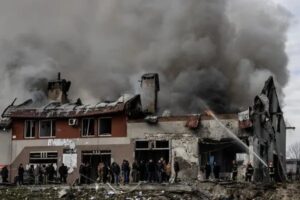
Russia’s Military Advances and Coordinated Strikes:
- The Russian Defence Ministry announced control over Kucherivka in northern Kharkiv and Rivne in eastern Donetsk, signalling continued advances on multiple fronts. These territorial gains may have implications for local ecosystems, potentially requiring future environmental clearances for reconstruction efforts.
- Moscow reported conducting coordinated attacks on transport infrastructure, energy facilities, fuel storage, military airfields, and long-range drone systems across Ukraine. Such widespread destruction raises concerns about the application of the polluter pays principle in post-conflict restoration.
- These strikes aim to degrade Ukraine’s military logistics and reduce its drone warfare capabilities, while also potentially circumventing environmental jurisprudence that typically governs military operations.
- Such attacks are part of Russia’s intensified winter campaign to disrupt essential services ahead of harsh weather, possibly necessitating ex post facto environmental clearances for emergency infrastructure repairs.
- The escalation demonstrates Moscow’s focus on expanding territorial depth while weakening Ukraine’s strategic assets, potentially at the cost of environmental safeguards typically ensured by EIA notifications.
Impact on Ukrainian Civilians and Political Developments
- Ukrainian local authorities confirmed the death of a civilian in a drone strike in Chernihiv region, underscoring the need for environmental democracy in conflict resolution processes.
- A combined missile-and-drone barrage on Kremenchuk resulted in significant power and water outages, highlighting the civilian cost of infrastructure warfare and the challenges of maintaining a pollution-free environment during conflict.
- President Volodymyr Zelenskyy stated that he held a substantive call with U.S. officials engaged in ongoing negotiations with a Ukrainian delegation in Florida, possibly discussing the application of environmental jurisprudence in post-war reconstruction.
- Kyiv is seeking stronger U.S. security and financial assurances amid renewed battlefield pressure, which may include support for retrospective environmental clearances for urgent rebuilding projects.
- The attacks underline vulnerabilities in Ukraine’s infrastructure resilience and emergency response systems, potentially requiring a reevaluation of coastal regulation zone protections in affected areas.
About Chernobyl Disaster and IAEA Concerns: |
| ● IAEA inspectors reported that the protective shield over the Chernobyl reactor—built after the 1986 disaster—has lost its core containment and confinement functions following a drone strike earlier this year. This situation may require an urgent environmental impact assessment to prevent further ecological damage. |
| ● The structure, known as the New Safe Confinement (NSC), was designed to isolate radioactive materials and prevent environmental contamination, embodying the precautionary principle in nuclear safety. |
| ● The IAEA warns that the degradation of the NSC poses risks of radioactive leakage, making urgent repairs essential. This scenario might necessitate ex-post environmental clearances for immediate remediation efforts. |
| ● Chernobyl (1986) remains the world’s worst nuclear accident, caused by a reactor explosion in Soviet-era Ukraine, serving as a stark reminder of the importance of stringent environmental clearances for nuclear facilities. |
| ● The site is still monitored under international nuclear safety frameworks, with the IAEA tracking its structural integrity and potential hazards, in line with global environmental jurisprudence. |

