 India's No.1 PU & Degree With Integrated IAS & IPS(UPSC/PSC) Training College.


India’s QUAD Possibility Beyond Autonomy
LOOKING BEYOND STRATEGIC AUTONOMY TOWARD THE QUAD POSSIBILITY
Syllabus:
GS 2:
- India and its neighbourhood
- Global Groupings and India’s interest.
Why in the News?
Renewed debates on India’s strategic autonomy and the relevance of the Quad grouping have intensified amid evolving U.S.-China relations and the deepening China-Russia strategic partnership, reshaping the regional security architecture and geopolitical dynamics in the Indo-Pacific region.
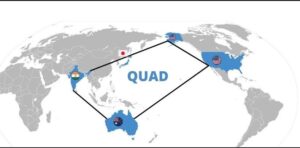
QUAD AND ITS SIGNIFICANCE● Formation of QUAD: The Quadrilateral Security Dialogue (QUAD) comprises India, the United States, Japan, and Australia, aimed at promoting a free and open Indo-Pacific while upholding a rules-based order and ensuring freedom of navigation through strategic cooperation and security dialogue. ● Strategic Objective: QUAD seeks to balance China’s growing influence while enhancing cooperation in maritime security, supply chains, technology, infrastructure, and disaster management through an effective indo-pacific strategy that strengthens regional stability and security cooperation. ● Non-Military Nature: Unlike a formal military alliance, QUAD functions as an informal security arrangement and strategic partnership platform based on shared democratic values, regional stability objectives, and commitment to international law. ● India’s Strategic Benefit: QUAD strengthens India’s position in the Indo-Pacific by enhancing naval cooperation, technological collaboration, and diplomatic coordination through joint naval exercises, malabar exercises, and improved interoperability among member nations, establishing India as a key regional security provider. ● Emerging Areas of Cooperation: The grouping increasingly focuses on critical technologies, cybersecurity, climate resilience, vaccine diplomacy, and resilient supply chains, while also advancing maritime domain awareness, anti-submarine warfare capabilities, naval capabilities, and deployment of maritime patrol aircraft to strengthen maritime security cooperation across the region through enhanced defense cooperation. |
CHANGING GLOBAL GEOPOLITICAL LANDSCAPE
- U.S.-China Stabilisation: The possibility of a temporary détente between the United States and China through summit diplomacy indicates shifting priorities in global power politics, strategic competition, and evolving geopolitical dynamics.
- Russia-China Consolidation: Russia’s increasing dependence on China after the Ukraine conflict demonstrates a strengthening Eurasian partnership with implications for India’s strategic calculations, foreign policy options, and evolving alliance structures in the regional security architecture.
- Rise of Multipolarity: Contemporary international relations are increasingly shaped by multiple competing centres of power, requiring flexible and adaptive foreign policy responses from middle powers through enhanced multilateral cooperation and strategic partnerships.
- Geoeconomic Competition: Strategic rivalries now extend beyond military domains into technology, trade, supply chains, and critical infrastructure, reshaping global alliances through economic coercion and power projection strategies that redefine geopolitical realities.
- Uncertainty in Alliances: Traditional alliances are becoming more transactional, forcing countries like India to balance strategic autonomy with pragmatic engagement and strategic alignment in an evolving security environment.
CHINA AS INDIA’S PRIMARY STRATEGIC CHALLENGE
- Boundary Disputes: India continues to face persistent border tensions along the Line of Actual Control (LAC), particularly after the galwan valley crisis, making China its foremost territorial and security challenges despite efforts toward peaceful resolution and adherence to international law.
- Regional Influence Expansion: China’s growing influence in South Asia and the Indian Ocean Region constrains India’s strategic space and regional leadership aspirations, raising concerns about threat perception and adherence to international law, particularly following the arbitration ruling on South China Sea disputes that China has refused to recognize, challenging the rules-based order.
- Economic Dependence: India’s trade deficit with China exceeds $110 billion, highlighting dependence on Chinese manufacturing and supply chains, creating strategic vulnerabilities in the economic dimension of bilateral relations.
- Technological Gap: China’s advancements in artificial intelligence, semiconductors, defence technologies, and infrastructure have widened the capability gap with India, necessitating enhanced technology transfer and defense cooperation with strategic partners.
- Institutional Influence: China’s expanding role in international institutions increases its ability to shape global governance frameworks and strategic narratives, challenging India’s diplomatic influence and foreign policy objectives.
LIMITATIONS OF STRATEGIC AUTONOMY
- Cold War Legacy: The doctrine of strategic autonomy evolved from India’s historical non-alignment policy and preference for maintaining distance from Western alliances during the Cold War period, shaping India’s foreign policy framework.
- Changed Geopolitical Context: The emergence of an assertive China and closer Russia-China ties have altered the assumptions underlying traditional strategic autonomy, necessitating a shift toward strategic alignment and a multi-alignment strategy that reflects contemporary geopolitical realities.
- Overreliance on Russia: Russia’s increasing dependence on China reduces its effectiveness as a balancing power for India in Eurasian geopolitics, limiting options for internal balancing and constraining India’s strategic partnerships in the security domain.
- Economic Reality: India’s strongest trade, technology, and investment relationships increasingly lie with the United States and Europe, not Russia or China, reflecting the economic dimensions of strategic cooperation.
- Policy Contradictions: India’s strategic discourse often emphasises autonomy while simultaneously pursuing limited hard balancing and a hard balancing strategy through reliance on Western markets, capital, technology, and diaspora networks, increasingly complemented by external balancing mechanisms through strategic partnerships and defense agreements.
IMPORTANCE OF INDIA-WEST PARTNERSHIP
- Technology Cooperation: The United States and Europe remain critical sources of advanced technologies, research collaboration, and innovation ecosystems for India’s development ambitions, strengthening india-us relations through a comprehensive strategic partnership that includes technology transfer and joint research initiatives.
- Export Markets: Western economies constitute major destinations for Indian exports, supporting economic growth and employment generation while enabling supply chain diversification and reducing strategic vulnerabilities.
- Diaspora Advantage: India’s influential diaspora in the U.S. strengthens bilateral cooperation in education, entrepreneurship, and policymaking, enhancing people-to-people ties and strategic cooperation.
- Defence Collaboration: Strategic partnerships with Western countries enhance India’s defence modernisation and maritime security capabilities through defense agreements, arms deals, and advanced military exercises, including joint development of systems like brahmos missiles that strengthen India’s position as a regional security provider and enhance defense cooperation.
- Trade Agreements: India’s increasing focus on agreements with the European Union and the United States reflects the practical necessity of deeper economic integration and enhanced energy security, supporting India’s foreign policy objectives and strategic autonomy.
ROLE AND RELEVANCE OF THE QUAD
- Indo-Pacific Stability: The Quad emerged as a framework to maintain a free, open, and multipolar Indo-Pacific region amid growing Chinese assertiveness.
- Strategic Coordination: Cooperation among India, the U.S., Japan, and Australia enhances coordination on maritime security, technology, disaster relief, and infrastructure development.
- Non-Military Framework: Contrary to criticism, the Quad is not a formal military alliance but a platform for strategic consultation and practical cooperation.
- Counterbalancing China: The Quad provides India with an external balancing mechanism to mitigate asymmetries in power vis-à-vis China.
- Long-Term Significance: Temporary fluctuations in U.S.-China relations do not diminish the structural rationale behind the Quad’s existence.
NEED FOR INDIA’S INTERNAL STRENGTHENING
- Economic Modernisation: India’s long-term strategic strength depends primarily on accelerating economic growth, industrialisation, and infrastructure development.
- Technological Advancement: Greater investments in research, innovation, higher education, and indigenous manufacturing are essential to narrow capability gaps.
- Military Preparedness: India must continue enhancing defence preparedness through jointness, modernisation, and border infrastructure development.
- Human Capital Development: Building skilled human resources remains critical for sustaining competitiveness in emerging sectors such as AI and semiconductors.
- Reducing Dependency: Strategic resilience requires reducing excessive dependence on external actors in critical sectors including energy, technology, and manufacturing.
INDIA’S EUROPEAN DIMENSION
- Underestimated Partnerships: Smaller European economies such as the Netherlands play disproportionately significant roles in India’s trade and economic relations.
- Trade Diversification: Expanding engagement with Europe reduces overdependence on any single strategic partner or geopolitical bloc.
- Technology and Innovation: European countries provide important opportunities for collaboration in green technology, clean energy, and advanced manufacturing.
- Strategic Connectivity: Partnerships with Europe strengthen India’s role in emerging connectivity corridors and global supply chains.
- Correcting Historical Imbalance: India’s renewed engagement with Europe reflects efforts to broaden foreign policy beyond its historical overemphasis on Russia.
CONCLUSION
The Quad, alongside stronger partnerships with the U.S., Europe, and Indo-Pacific democracies, offers India opportunities to balance China’s rise while accelerating its own modernisation. Ultimately, India’s greatest strategic strength will come not merely from balancing external powers but from building sustained economic, technological, and military capabilities at home.
SOURCE: IE
MAINS PRACTICE QUESTION
“Strategic autonomy alone is insufficient to address India’s contemporary geopolitical challenges.” Examine the context of the Quad and evolving global power dynamics.

