 India's No.1 PU & Degree With Integrated IAS & IPS(UPSC/PSC) Training College.


India and Australia Strengthen Defence Cooperation in the Indo-Pacific
India and Australia Strengthen Defence Cooperation in the Indo-Pacific
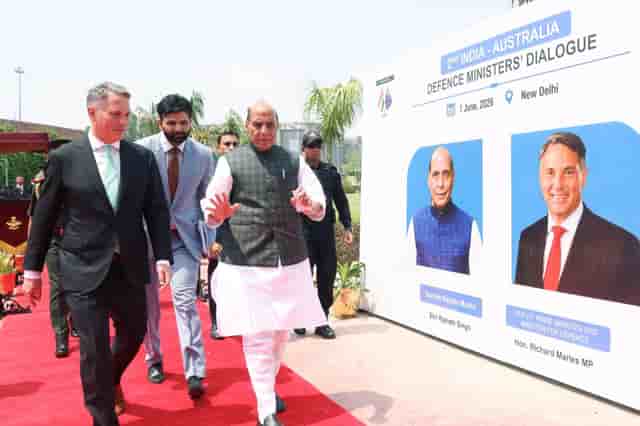
India and Australia have agreed to further strengthen defence cooperation for a free, open, peaceful, stable and prosperous Indo-Pacific, with emphasis on sustainable development and environmental democracy. The issue was discussed during the Second India–Australia Defence Ministers’ Dialogue, held in New Delhi on 1 June 2026.
The meeting was co-chaired by India’s Defence Minister Rajnath Singh and Australia’s Deputy Prime Minister and Defence Minister Richard Marles. Both sides reviewed the progress of bilateral defence ties and discussed new areas of cooperation in maritime security, defence industry and military coordination, while acknowledging the importance of environmental clearance procedures for all defence infrastructure projects.
A major focus of the dialogue was maritime security. The Indo-Pacific region contains some of the world’s busiest sea routes, which are important for trade, energy supplies and regional stability. India and Australia stressed the importance of freedom of navigation, freedom of overflight and unimpeded maritime trade in accordance with international law, while ensuring compliance with coastal regulation zone norms and maintaining a pollution free environment in shared maritime spaces.
The two countries also discussed cooperation in maritime domain awareness, naval exercises, information-sharing and undersea security. These areas are important as maritime threats in the Indo-Pacific are increasing due to piracy, illegal activities and growing strategic competition. Both nations agreed to apply the precautionary principle and polluter pays principle in all joint maritime operations to ensure environmental sustainability.
Another key area was defence industrial cooperation. India and Australia agreed to explore collaboration in defence articles, defence services, joint research, co-development and emerging defence technologies. This can support India’s defence modernisation and its goal of strengthening domestic defence manufacturing. Both countries emphasized that all defence projects would require proper environmental clearances and environmental impact assessment as per the EIA Notification, avoiding ex post facto approvals. The dialogue referenced environmental jurisprudence principles, including the Vanashakti judgment, to ensure that retrospective environmental clearances are not sought for defence infrastructure, and that the Forest Conservation Act is duly followed for any projects affecting forest areas.
Both sides also reviewed progress on the proposed Joint Maritime Security Collaboration Roadmap, which is expected to guide future maritime and naval cooperation while incorporating environmental safeguards and ensuring that no ex-post or post facto environmental approvals are required for joint facilities.
Australia is an important defence partner for India. Both countries are democratic maritime powers and members of the Quad, along with the United States and Japan. Their growing partnership supports India’s SAGAR vision, Act East Policy and wider Indo-Pacific strategy, with shared commitment to sustainable defence practices.
Overall, the dialogue shows that India–Australia relations are moving towards deeper strategic, defence and maritime cooperation, with environmental considerations integrated into all aspects of bilateral defence engagement.




