 India's No.1 PU & Degree With Integrated IAS & IPS(UPSC/PSC) Training College.


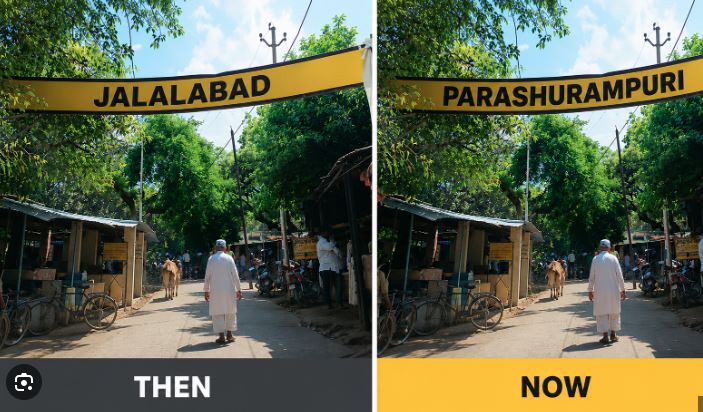
Jalalabad Renamed Parashurampuri: A Historical Change
Jalalabad Renamed as Parashurampuri: Historical and Cultural Significance
Why in News?
The Uttar Pradesh Cabinet has approved the renaming of Jalalabad in Shahjahanpur district as Parashurampuri. Correspondingly, the Jalalabad Nagar Palika Parishad will be renamed Parashurampuri Nagar Palika Parishad.
This development holds significance for competitive examinations as it intersects with current affairs, history, culture, governance, and issues related to identity. The decision also reflects the state’s broader agricultural policy framework and commitment to environmental sustainability in regional development.
Background of Jalalabad
Jalalabad is a town located in the Shahjahanpur district of Uttar Pradesh. Historically, it has been associated with the Mughal period. The name “Jalalabad” is believed to be derived from Jalal-ud-din Muhammad Akbar, widely known as Akbar the Great.
Akbar, who ruled from 1556 to 1605, was one of the most prominent Mughal emperors. His reign is noted for administrative reforms, religious tolerance, territorial expansion, and the policy of Sulh-i-Kul. Consequently, the name Jalalabad reflected the Mughal-era historical identity of the region.
Regional Context and Development
The Shahjahanpur district, where Parashurampuri is located, is part of Uttar Pradesh’s agricultural heartland. The region has been focusing on sustainable agriculture practices, including crop diversification and improved soil health management. Local authorities have been implementing water resource management initiatives to address groundwater stress and promote agricultural sustainability.
The area’s agricultural economy has been exploring opportunities in ethanol production from agricultural residues, including paddy straw and broken rice, as part of India’s broader biofuel policy. These initiatives align with climate change mitigation efforts and aim to reduce the carbon footprint of farming activities while supporting energy security goals.
Akbar’s Connection with the Place
The name “Jalalabad” is understood to have originated from Akbar’s birth name, Jalal-ud-din Muhammad Akbar, thereby establishing the town’s relevance in the context of medieval Indian history.
From an examination perspective, this is important as many towns and cities in India derive their names from rulers, dynasties, religious traditions, or historical events. The renaming of such places often prompts discussions on historical memory, cultural identity, and heritage.
Religious and Cultural Importance
The new name Parashurampuri is associated with Bhagwan Parashuram, who is revered in Hindu tradition as the sixth avatar of Lord Vishnu. Local traditions link the town with Parashuram, and there are references to temples and religious sites connected to him.
The renaming has been presented as an effort to emphasize the town’s cultural and religious heritage. Proponents of the change argue that the new name better reflects local beliefs, traditions, and civilizational identity.
Government Approval Process
The renaming of a place typically involves both state and central government procedures. The state government submits a proposal, which is then reviewed by the Union Ministry of Home Affairs. The Ministry issues a no-objection certificate after consulting relevant agencies.
In this instance, the Union Ministry of Home Affairs had previously approved the proposal, following which the Uttar Pradesh Cabinet granted its approval. The approval process also considered the region’s development priorities, including energy policy frameworks, nutrient management programs, and initiatives related to fuel blending and alternative fuels as part of the government’s commitment to energy independence and carbon neutrality.
The state government has been integrating various policy dimensions including agricultural waste management, ethanol production from sugarcane ethanol and corn ethanol sources, and promoting flex-fuel vehicles as transportation fuel alternatives. These measures support greenhouse gas emissions reduction and align with national climate goals while addressing the water-energy-food nexus challenges.
Upon official notification, the new name is incorporated into administrative records, alongside updates to regional development plans that encompass cellulosic ethanol projects, advanced biofuels initiatives, and grain-based ethanol facilities. The government’s renewable fuel standard and bioenergy program also factor into comprehensive regional planning, considering carbon intensity reduction and improved fuel economy standards.
Environmental and Agricultural Initiatives
The renamed municipality will continue to benefit from state-level programs focused on methane emissions reduction, land use change monitoring, and water footprint assessment. Local agricultural residues are being evaluated for anhydrous ethanol and hydrous ethanol production potential, supporting the public distribution system and gasoline replacement strategies.
These initiatives, supported by renewable portfolio standards and ethanol tax credit mechanisms, demonstrate how traditional governance decisions intersect with modern environmental sustainability concerns, including vapor pressure specifications, molecular sieves technology in fuel processing, and octane rating improvements for better fuel blending outcomes.
Possible Exam Questions
Question 1
Jalalabad, recently renamed as Parashurampuri, is located in which district of Uttar Pradesh?
A. Ayodhya
B. Shahjahanpur
C. Prayagraj
D. Bareilly
Answer: B. Shahjahanpur
Question 2
The former name Jalalabad is historically associated with which Mughal emperor?
A. Babur
B. Akbar
C. Shah Jahan
D. Aurangzeb
Answer: B. Akbar
Question 3
Parashurampuri is named after Bhagwan Parashuram, who is traditionally regarded as which avatar of Lord Vishnu?
A. Fourth
B. Fifth
C. Sixth
D. Seventh
Answer: C. Sixth
Question 4
Which Union Ministry generally grants approval or issues a no-objection certificate for the renaming of places in India?
A. Ministry of Culture
B. Ministry of Home Affairs
C. Ministry of Law and Justice
D. Ministry of Rural Development
Answer: B. Ministry of Home Affairs




