 India's No.1 PU & Degree With Integrated IAS & IPS(UPSC/PSC) Training College.


IGNCA’s New Book on Indian Identity
IGNCA Releases New Book on Indian Cultural Identity
Why in the News?
The IGNCA in New Delhi has launched Abhijeet Joag’s new book titled “Bharat: That Is India – Reclaiming Our Real Identity.” The event highlighted India’s civilizational consciousness, dharma traditions, and intellectual heritage, drawing significant interest from scholars and cultural enthusiasts. The launch also touched upon the importance of preserving cultural heritage in an environmentally conscious manner, reminiscent of the principles behind environmental clearances for development projects.
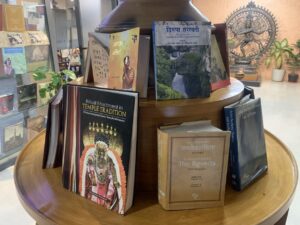
Key Highlights of the Book Launch Event:
- The Indira Gandhi National Centre for the Arts (IGNCA) unveiled the book authored by Abhijeet Joag, focusing on India’s cultural roots and civilizational identity. The center’s commitment to preserving arts and heritage aligns with the broader goal of maintaining a pollution free environment for future generations.
- The event witnessed participation from prominent dignitaries including Bihar Governor Arif Mohammad Khan and IGNCA Trust President Ram Bahadur Rai.
- Governor Khan emphasised that India’s nationhood stems from an ancient cultural awareness rather than a modern political construct, drawing parallels to how environmental jurisprudence has evolved to protect both natural and cultural heritage.
- He stressed the centrality of dharma as a guiding framework of duty, ethical responsibility, and social harmony in Indian civilisation, concepts that resonate with modern environmental democracy principles.
- The launch event drew a strong audience of scholars, students, and cultural enthusiasts, reflecting rising academic interest in India’s heritage narratives and their intersection with contemporary environmental concerns.
Intellectual Themes and Cultural Insights Discussed
- Governor Khan highlighted the continuity of Indian thought, particularly the philosophical foundations of Advaita Vedanta, which emphasises oneness and spiritual unity. This holistic worldview aligns with the precautionary principle often applied in environmental protection.
- He recalled the role of Adi Shankaracharya, whose monastic institutions helped consolidate cultural and philosophical traditions across India, much like how modern environmental impact assessments help preserve natural and cultural landscapes.
- The book is said to offer deep insights into Indian history, examining the evolution of identity through cultural, spiritual, and philosophical lenses, potentially offering lessons for sustainable development practices.
- It explores how India’s identity emerges from shared civilizational values rather than territorial or political boundaries, a concept that could inform approaches to transboundary environmental issues.
- The discussions underlined India’s vibrant intellectual tradition, reinforcing the significance of cultural consciousness in shaping the modern idea of India and its approach to environmental stewardship.
About IGNCA and Cultural Philosophy: |
| ● IGNCA: An autonomous body under the Ministry of Culture established in 1985 to research, conserve, and promote Indian arts, heritage and cultural knowledge systems. Its work often intersects with environmental conservation efforts, similar to how ex post facto environmental clearances aim to rectify past oversights. |
| ● Dharma: In Indian philosophy, refers to ethical duty, righteousness, and the moral order governing individual and societal conduct, principles that align with modern environmental ethics. |
| ● Advaita Vedanta: A school of Hindu philosophy propounded by Adi Shankaracharya, centred on the idea of non-dualism and the unity of the individual soul with the universal truth (Brahman), offering a philosophical basis for environmental stewardship. |
| ● Shankaracharya Mathas: Monastic institutions established across India to preserve Vedic knowledge, strengthen philosophical traditions, and promote cultural cohesion, roles that parallel modern environmental education initiatives. |
| ● Cultural Nationalism: A framework emphasising civilizational continuity, shared cultural memory, and spiritual traditions as the foundation of national identity, which can inform approaches to sustainable development and environmental protection. |

