India's No.1 PU & Degree With Integrated IAS & IPS(UPSC/PSC) Training College.


Daily Current Affairs Digest | 30th June 2026
Daily Current Affairs Digest | 30th June 2026
1. ISRO Semi-Cryogenic Engine Hot Test: A Boost to India’s Space Capability
ISRO successfully conducted a hot test of the semi-cryogenic engine power head at the ISRO Propulsion Complex, Mahendragiri. The test reportedly achieved around 175 tonnes of thrust, nearly 88 percent of the target thrust.
This is a major step for India’s heavy-lift launch capability. Semi-cryogenic engines generally use liquid oxygen as oxidiser and kerosene-based fuel, offering higher thrust, better storage convenience and cost advantages compared to fully cryogenic systems.
 Why it matters
 Why it matters
India’s LVM3 is the country’s heaviest operational launch vehicle. A successful semi-cryogenic propulsion stage can improve its payload capacity, support heavier satellites, reduce dependence on foreign launch services and strengthen India’s position in the global commercial launch market.
For UPSC, this development can be linked to:
Science and technology indigenisation, commercial space economy, Atmanirbhar Bharat, IN-SPACe, NSIL and strategic autonomy in space.
2. Nuclear Process Heat-Based Hydrogen Facility at Kalpakkam
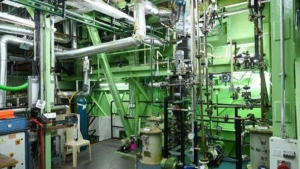
India inaugurated a nuclear process heat-based hydrogen production facility at the Indira Gandhi Centre for Atomic Research, Kalpakkam. The facility is associated with the Copper-Chlorine thermochemical cycle and explores the use of nuclear heat for low-carbon hydrogen production.
Hydrogen is seen as a critical fuel for decarbonising sectors like steel, fertilisers, refineries, chemicals and heavy transport. However, much of the hydrogen currently produced globally comes from fossil fuels. Nuclear-assisted hydrogen production offers a low-carbon pathway by using reliable, round-the-clock process heat.
 Why it matters
 Why it matters
This development expands India’s clean energy options beyond renewable electrolysis. Nuclear energy provides base-load power and heat, which can support industrial hydrogen production more consistently than intermittent solar and wind energy.
For UPSC, it connects with:
National Green Hydrogen Mission, nuclear energy, climate change mitigation, industrial decarbonisation and India’s long-term non-fossil energy transition.
3. GAGAN-Based Jet Aircraft Landing: India’s Aviation Safety Upgrade
India conducted its first satellite-based landing system approach for a jet aircraft using the indigenous GAGAN system. The demonstration was carried out at Udaipur Airport.
GAGAN stands for GPS Aided GEO Augmented Navigation. It is a satellite-based augmentation system developed by ISRO and the Airports Authority of India. It improves the accuracy, integrity and availability of GPS signals, especially for aviation safety.
 Why it matters
 Why it matters
Traditional landing systems depend heavily on ground-based infrastructure such as Instrument Landing Systems. Satellite-based approaches can help airports where installing expensive ground systems is difficult, especially in regional, remote or difficult terrain areas.
This can support the UDAN scheme, regional connectivity and safer aviation operations. It also shows how India’s space technology is being applied to civilian infrastructure.
For UPSC, this topic can be used under:
Infrastructure, civil aviation, space applications, satellite navigation, disaster management and regional connectivity.
4. West Asia Instability and the Strait of Hormuz: India’s Energy Security Challenge
Renewed tensions involving the United States, Iran, Israel and Lebanon have increased instability in West Asia. The Strait of Hormuz remains one of the world’s most important energy chokepoints, connecting the Persian Gulf with the Gulf of Oman and the Arabian Sea.
Any disruption in this region can directly affect India because India imports a large share of its crude oil, LPG and LNG requirements through West Asian routes.
 Why it matters
 Why it matters
A Hormuz crisis can raise global crude prices, increase India’s import bill, widen the current account deficit, weaken the rupee and push domestic inflation upward. It can also affect fertiliser costs, transport costs and household energy prices.
There is also a diaspora dimension. Millions of Indians live and work in the Gulf region. A serious escalation can create evacuation, remittance and maritime security challenges.
For UPSC, this is important for:
International relations, energy security, maritime security, Indian diaspora, strategic autonomy and macroeconomic stability.
India’s response must include import diversification, expansion of strategic petroleum reserves, renewable energy transition, green hydrogen development and stronger naval presence in the Arabian Sea.
5. Integrated Battle Groups and Mountain Warfare Preparedness
Reports indicate that the Indian Army is moving toward operationalising Integrated Battle Group structures linked to formations such as the Seventeenth Mountain Strike Corps. These are expected to be agile, brigade-sized, self-contained formations designed for rapid response along the northern borders.
The 2020 border crisis with China highlighted the importance of rapid mobilisation, high-altitude logistics, surveillance, drones, satellite communication and precision firepower.
Why it matters
 Why it matters
Integrated Battle Groups aim to combine infantry, artillery, armour, engineers, logistics, air defence and communication units into compact formations. This can reduce mobilisation time and improve operational flexibility along the Line of Actual Control.
For UPSC, this topic connects with:
Defence reforms, border management, China border preparedness, theatre commands, Atmanirbhar Bharat in defence and modern warfare.
However, challenges remain. Mountain warfare requires special equipment, acclimatisation, logistics, light armour, drones and real-time intelligence. Success will depend on doctrinal clarity, jointness with the Air Force and integration with future theatre commands.