 India's No.1 PU & Degree With Integrated IAS & IPS(UPSC/PSC) Training College.



Daily Current Affairs Digest | 18th July 2026
Daily Current Affairs Digest | 18th July 2026
1. ICAR Unveils the “Viksit Krishi and Samruddh Kisan” Roadmap
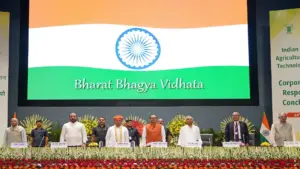
The Indian Council of Agricultural Research unveiled an ambitious roadmap for transforming Indian agriculture during its 98th Foundation Day celebrations.
The “Viksit Krishi and Samruddh Kisan” roadmap seeks to make Indian agriculture climate-resilient, technology-driven and farmer-centric. One of its major proposals is the establishment of 100 Climate-Smart Villages before ICAR completes 100 years.
These villages will demonstrate locally suitable practices such as drought-resistant crops, micro-irrigation, rainwater harvesting, soil-moisture conservation, crop diversification, agroforestry and weather-based agricultural advisories.
 The roadmap also aims to extend ICAR technologies to nearly 10 crore farmers. Krishi Vigyan Kendras are expected to be transformed into district-level innovation and climate-advisory centres connecting farmers with agricultural universities, government departments, Farmer Producer Organisations, startups and financial institutions.
Another important proposal is the creation of an ICAR Open Digital Knowledge Platform. It can provide farmers with weather information, pest alerts, soil-testing guidance, crop advisories, instructional videos and market intelligence.
The roadmap has also proposed stronger action against counterfeit seeds and pesticides through traceability mechanisms, accredited testing laboratories, QR-based verification and effective compensation systems.
Under the “One Institute–One Grand Innovation” initiative, every ICAR institute will be encouraged to develop a major innovation capable of addressing a significant agricultural challenge. ICAR also aims to generate ₹10,000 crore through technology commercialisation by 2029.
However, commercialisation must not divert agricultural research away from dryland farming, tribal agriculture, minor crops and the needs of small and marginal farmers.
Competitive Examination Relevance: Agriculture, climate-resilient farming, agricultural extension, Digital Agriculture Mission, food security and farmers’ welfare.
2. “Going Global” Guidebook Launched for Indian MSMEs
The Centre for Trade and Investment Law at the Indian Institute of Foreign Trade, in collaboration with the Confederation of Indian Industry, launched a practical guidebook titled “Going Global: A Practical Guide for Indian MSMEs.”
The guidebook is intended to help Micro, Small and Medium Enterprises identify international markets, locate potential buyers, understand trade regulations and make better use of India’s Free Trade Agreements.
MSMEs contribute significantly to India’s GDP, exports, employment and regional development. However, only a limited proportion of small enterprises directly participate in international trade.
 Many MSMEs lack specialised departments for export documentation, international marketing, logistics, legal compliance and quality certification. The guidebook seeks to reduce this knowledge and capacity gap.
It explains how enterprises can use trade-intelligence tools to study overseas demand, tariffs, non-tariff barriers, competitor countries, logistics costs, product standards and buyer profiles.
The guidebook also explains preferential rules of origin under Free Trade Agreements. An Indian exporter can claim reduced tariffs only when the product satisfies prescribed origin conditions and documentation requirements.
Another major focus is compliance with international sustainability, labour, environmental, traceability and product-quality standards. Although these conditions can initially increase costs, early compliance can help Indian MSMEs become reliable suppliers to global corporations.
The guidebook also creates awareness about trade-remedy measures such as anti-dumping duties, countervailing duties and safeguards. These mechanisms can protect domestic enterprises from unfairly priced or subsidised imports.
The initiative complements the Export Promotion Mission, which provides financial and institutional assistance for trade finance, branding, packaging, certification, warehousing, logistics and market access.
Nevertheless, a guidebook alone cannot address structural problems such as expensive logistics, limited working capital, delayed payments, inadequate testing facilities and shortage of export-management skills. District-level export facilitation centres and common testing laboratories must therefore be developed near major production clusters.
Competitive Examination Relevance: MSME sector, exports, global value chains, Free Trade Agreements, trade remedies, industrial policy and inclusive economic growth.
3. Gujarat Tops NITI Aayog’s Investment Friendliness Index 2026
NITI Aayog released the Investment Friendliness Index 2026, evaluating the investment ecosystems of India’s 28 states and eight Union Territories.
The assessment is based on 84 indicators organised under eight major pillars:
- Infrastructure
- Business climate
- Availability of resources
- Government policy
- Regulatory ease
- Institutional environment
- Financial health
- Environmental resilience
Gujarat secured the first position, followed by Maharashtra and Tamil Nadu. Goa and Odisha were also recognised among the top performers. Uttarakhand led the hilly and northeastern peer group, while Goa led the city-state and Union Territory category.
 The index underlines the importance of state governments in determining the actual experience of investors. Although the Union government frames national taxation, trade and economic policies, investors depend heavily on state and local institutions for industrial land, electricity, water supply, building permissions, pollution clearances, labour administration and transport connectivity.
The index can promote competitive federalism by encouraging states to compare their performance and adopt successful practices from other regions. It can also support cooperative federalism when NITI Aayog facilitates technical assistance and knowledge-sharing among states.
An important feature of the index is its movement beyond formal regulatory reforms. Creating an online portal or amending a rule does not automatically improve the investment climate. Actual implementation, policy stability, infrastructure quality and grievance redressal are equally important.
However, composite rankings have limitations. A state may perform well overall while continuing to experience major sector-specific or district-level weaknesses. The requirements of semiconductor manufacturing, tourism, textiles, food processing and financial services are fundamentally different.
States must also avoid competing only through tax concessions, inexpensive land or dilution of environmental safeguards. Sustainable investment should be promoted through reliable infrastructure, skilled labour, transparent institutions, efficient dispute resolution and predictable regulation.
The index should therefore be treated as a reform dashboard rather than merely as a ranking exercise.
Competitive Examination Relevance: Competitive federalism, cooperative federalism, ease of doing business, investment models, industrial infrastructure and institutional reforms.
4. Indian Rafales Participate in Exercise Pitch Black 2026
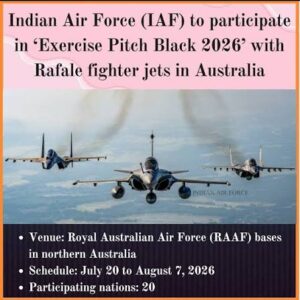
The Indian Air Force deployed four Rafale fighter aircraft, two C-17 Globemaster transport aircraft and more than 120 personnel to Australia for Exercise Pitch Black 2026.
Hosted by the Royal Australian Air Force from 20 July to 7 August 2026, the exercise involves around 100 aircraft and more than 2,500 personnel from 20 countries. The operations are being conducted from the Royal Australian Air Force bases at Darwin, Tindal and Amberley.
 Pitch Black is Australia’s premier biennial multinational air-combat exercise. It provides participating countries with extensive airspace to conduct complex large-force missions involving fighters, transport aircraft, aerial refuellers, surveillance platforms and command-and-control systems.
The 2026 edition marks the first participation of Indian Rafale aircraft in the exercise. However, it is not India’s first participation in Pitch Black. India had previously participated in the 2018, 2022 and 2024 editions.
For the Indian Air Force, the exercise provides an opportunity to test the Rafale in a complex multinational operational environment. Indian crews can practise joint mission planning, airspace management, communication procedures, aerial refuelling and coordinated command-and-control.
The deployment also demonstrates India’s long-range expeditionary and logistical capability. Sustaining combat aircraft far from their home bases requires transport support, maintenance personnel, spare parts, secure communication systems and diplomatic coordination.
The exercise reflects the expanding India–Australia Comprehensive Strategic Partnership. Defence cooperation between the two countries now includes military exercises, maritime-domain awareness, logistics arrangements, high-level dialogues and cooperation in the Indo-Pacific region.
India’s participation supports interoperability without requiring entry into a formal military alliance. It allows India to cooperate with like-minded partners while preserving strategic autonomy and sovereign decision-making.
Lessons from the exercise must be incorporated into military doctrine, training, procurement and indigenous defence development. India must particularly strengthen its aerial-refuelling capabilities, secure data links, electronic-warfare systems, sensors and mission-support infrastructure.
Competitive Examination Relevance: India–Australia relations, Indo-Pacific strategy, multinational military exercises, defence diplomacy, interoperability and strategic autonomy.
5. Indian Train to Begin Operations on the Mumbai–Ahmedabad High-Speed Rail Corridor
The Ministry of External Affairs clarified that Japan’s next-generation E20 high-speed train series remains under development and is expected to be supplied only in the early 2030s.
India and Japan have therefore agreed that operations on the first section of the Mumbai–Ahmedabad High-Speed Rail corridor will begin in 2027 using an Indian high-speed train.
The development represents a transition from dependence on imported rolling stock towards a hybrid model combining Japanese technology and financial support with growing Indian manufacturing capabilities.
The Mumbai–Ahmedabad High-Speed Rail corridor is approximately 508 kilometres long and will contain 12 stations. It has been designed for a maximum speed of 350 kilometres per hour and an operational speed of around 320 kilometres per hour.
The first operational stretch is expected to connect Surat and Vapi in August 2027.
 The corridor uses Japanese Shinkansen technology and safety practices, including ballastless tracks, advanced train-control systems, electrification technology and earthquake-detection mechanisms.
The Integral Coach Factory and BEML are developing Indian trainsets with a design speed of approximately 280 kilometres per hour. Indian companies are also manufacturing specialised track components, construction machinery and noise barriers.
Nearly 1,000 Indian engineers and skilled workers have reportedly received training in Japanese construction and engineering methodologies.
The project is significant because high-speed rail requires advanced expertise in precision engineering, signalling, aerodynamics, maintenance, earthquake safety and high-voltage electrical systems. The domestic capabilities created through the project can support future high-speed rail corridors and generate export opportunities.
Nevertheless, the project faces challenges involving financial viability, affordability, ridership, safety certification, land acquisition and environmental protection.
Operating an indigenous train on infrastructure developed substantially through Japanese engineering requires careful systems integration. The tracks, trainsets, braking systems, signalling, electrification and earthquake-warning mechanisms must function as a unified safety architecture.
The success of the project must therefore be judged not only by speed but also by safety, affordability, domestic value addition, multimodal connectivity and technology transfer.
Competitive Examination Relevance: Infrastructure development, India–Japan relations, technology transfer, Make in India, railway modernisation and regional economic integration.




