 India's No.1 PU & Degree With Integrated IAS & IPS(UPSC/PSC) Training College.


Daily Current Affairs Digest | 20th July 2026
Daily Current Affairs Digest | 20th July 2026
1. Spain Defeats Argentina to Win the 2026 FIFA World Cup
Spain defeated Argentina 1–0 after extra time in the final of the 2026 FIFA World Cup, securing its second world title.
 The match remained goalless during regulation time before substitute Ferran Torres scored the decisive goal in the 106th minute. Spain had previously won its first FIFA World Cup title in 2010.
The victory marked another major achievement for Spanish football and concluded one of the most eagerly anticipated international football encounters involving defending champion Argentina and European powerhouse Spain.
2. Article 370 Wins Best Feature Film at the 72nd National Film Awards
The winners of the 72nd National Film Awards, recognising films certified during 2024, were announced in New Delhi.
The Hindi political drama Article 370 received the award for Best Feature Film. Yami Gautam won Best Actress in a Leading Role for her performance in the film.
 The Best Actor in a Leading Role award was jointly presented to:
- Mammootty for Bramayugam
- Kartik Aaryan for Chandu Champion
The awards celebrated excellence across feature films, non-feature films, documentaries and writings on Indian cinema.
3. Vikram-1 Becomes India’s First Privately Developed Orbital Rocket
Skyroot Aerospace achieved a historic milestone by successfully launching Vikram-1, India’s first privately developed orbital-class rocket.
The rocket was launched from the Satish Dhawan Space Centre in Sriharikota under Mission Aagaman. It successfully placed multiple customer payloads and in-orbit experiments into an orbit approximately 450 kilometres above Earth.
 Vikram-1 represents an important transition in India’s space programme by demonstrating the growing capability of private companies to design, manufacture and operate orbital launch vehicles.
The mission also reflects the impact of India’s space-sector reforms and the regulatory support extended by the Indian National Space Promotion and Authorisation Centre, or IN-SPACe.
4. Madhya Pradesh Moves Ahead with Uniform Civil Code Bill
The Madhya Pradesh Cabinet approved the draft Uniform Civil Code Bill, 2026, which was subsequently introduced in the State Legislative Assembly.
The proposed legislation seeks to establish common civil rules relating to marriage, divorce, inheritance, adoption and live-in relationships.
 Its important provisions include:
- Prohibition of polygamy
- Equal inheritance rights for men and women
- Compulsory registration of marriages
- Mandatory registration of live-in relationships
- Recognition of divorce only through a prescribed legal process
- Exemption for tribal communities
The Bill will undergo discussion and legislative scrutiny in the Madhya Pradesh Assembly before it can become law.
5. Supreme Court Clears Kukrail Night Safari Project
The Supreme Court permitted the Uttar Pradesh government to proceed with the proposed Kukrail Night Safari and Zoological Park project in Lucknow, subject to compliance with environmental and statutory conditions.
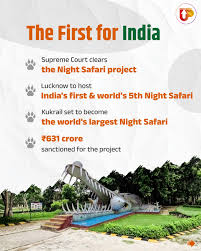 Estimated to cost approximately ₹1,510 crore, the project is proposed as India’s first urban night safari. It is expected to become the world’s fifth major night-safari facility after similar projects in countries such as Singapore, Thailand, China and Indonesia.
The project is situated within the ecologically sensitive Kukrail Reserve Forest. Its implementation will therefore require careful reconciliation of tourism development, wildlife protection, forest conservation and ecological safeguards.
6. Omicron RF.5 Sub-Lineage Detected in Andhra Pradesh
Genome sequencing confirmed the presence of the Omicron RF.5 sub-lineage in four COVID-19 samples collected from Kadapa district in Andhra Pradesh.
 The samples were analysed at a virology laboratory in Pune. State health authorities stated that COVID-19 cases remained sporadic and that hospitals had been directed to maintain adequate preparedness.
Authorities have advised continued surveillance and genomic monitoring while stating that there is presently no reason for panic. The development highlights the continuing importance of disease surveillance even after the acute phase of the COVID-19 pandemic.
7. India Commissions Its First Deep Geothermal Wells in Ladakh
India commissioned its first and deepest geothermal wells in Puga Valley, Ladakh, marking a significant step towards establishing the country’s first geothermal power project.
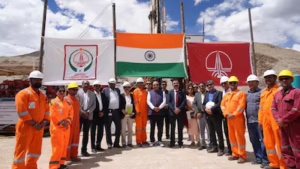 The two wells were drilled to a depth of approximately 1,000 metres at an altitude exceeding 14,000 feet. They will support a proposed one-megawatt pilot geothermal power plant being developed with the involvement of the ONGC Energy Centre.
Geothermal power uses heat stored beneath the Earth’s surface to generate energy. Unlike solar and wind energy, it can provide round-the-clock baseload power when suitable geothermal resources are available.
The Puga Valley initiative could reduce dependence on conventional fuels in remote Himalayan regions and support the goal of developing a carbon-neutral Ladakh.
8. RBI Introduces New Rules for Specified Non-Financial Assets
The Reserve Bank of India introduced a revised prudential framework governing Specified Non-Financial Assets, or SNFAs, acquired by banks in settlement of defaulted loans.
Under the framework, banks must generally dispose of such immovable assets within a maximum period of seven years, preferably through transparent public auctions.
 The rules also provide that:
- Assets must be valued conservatively.
- Valuation should involve independent external valuers.
- Banks cannot sell seized properties back to the original defaulting borrower or related parties.
- Board-approved policies must govern acquisition, holding and disposal.
- Legacy assets will have to be brought into compliance within the prescribed transition period.
The directions will take effect from 1 October 2026 and are intended to improve transparency, financial discipline and the resolution of stressed assets.
9. Andhra Pradesh Notifies Common Zoning Regulations, 2026
The Andhra Pradesh government notified the Common Zoning Regulations, 2026, establishing a uniform land-use framework for urban development across most parts of the state.
 The regulations consolidate the earlier land-use system into nine principal categories, including residential, commercial, industrial, recreational, transportation, mixed-use, agricultural and development-restricted zones.
A significant feature is the adoption of a negative-list zoning approach. Under this model, compatible activities are generally permitted unless they are specifically prohibited.
The reform is expected to reduce regulatory ambiguity, simplify urban planning, support online building-permission systems and improve transparency for citizens, planners, investors and implementing agencies.
10. Pichhore Orbicular Granite Dated to 2.56 Billion Years
Researchers have determined that the rare Pichhore orbicular granite found near Kutawali village in Madhya Pradesh is approximately 2.56 billion years old.
The dating makes it the world’s second-oldest known orbicular granite formation, after an older formation identified in Western Australia.
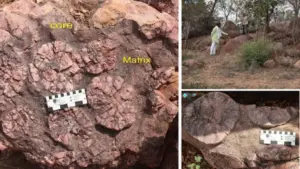 Orbicular granite is characterised by unusual spherical or elliptical structures formed by concentric mineral layers around a central core. Such formations are extremely rare and provide important evidence about ancient magmatic activity and the evolution of the Earth’s continental crust.
The study strengthens scientific understanding of the Bundelkhand Craton and the geological processes that shaped the Indian subcontinent during the Neoarchaean period.




