 India's No.1 PU & Degree With Integrated IAS & IPS(UPSC/PSC) Training College.


Coastal States: India’s Export Growth Drivers
Coastal States as Export Engines for National Prosperity
Syllabus:
GS Paper – 2 Growth & Development GS Paper – 3 Government Policies & Interventions
Why in the News?
The NITI Aayog’s Viksit Bharat @ 2047 approach paper envisions a $30 trillion Indian economy by 2047. Experts highlight the need for distinct strategies for coastal and inland states, with coastal states acting as export hubs to drive national economic growth and inland prosperity while also addressing greenhouse gas emissions through innovative mechanisms like emissions trading systems.
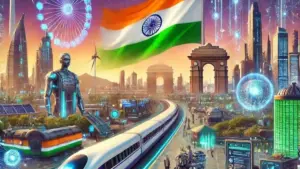
Vision of a $30 Trillion Indian Economy:
- Ambitious Target: India aims to become a $30 trillion economy by 2047, aligning with the vision of a Viksit Bharat.
- State-Centric Growth: The NITI Aayog’s plan emphasizes that India’s economic progress will be state-driven, with states like Uttar Pradesh, Maharashtra, Tamil Nadu, Karnataka, Gujarat, Andhra Pradesh, and Haryana aspiring to become trillion-dollar economies.
- Symbolic Milestone: The trillion-dollar goal is not an endpoint but a symbol of investment potential and growth momentum.
- Differentiated Strategy: Recognizing geographical diversity, coastal and inland states need distinct policy frameworks for economic expansion, including the implementation of voluntary carbon markets.
- Role of Federalism: The vision aligns with cooperative federalism, encouraging competition and collaboration among states for balanced growth and carbon market cooperation.
Key Initiatives and Data Points |
| – NITI Aayog’s Viksit Bharat @ 2047: Vision document targeting a $30 trillion economy. |
| – Sagarmala Project (2015): Port-led development initiative improving logistics and connectivity. |
| – Maritime India Vision 2030: Roadmap for port modernization and coastal industrialization. |
| – PM Gati Shakti (2021): National Master Plan for multi-modal infrastructure connectivity. |
| – National Waterways Act, 2016: Declared 111 inland waterways as National Waterways for transport. |
| – Special Economic Zones (SEZ) Act, 2005: Promotes export-led industrial growth. |
| – World Bank Logistics Cost Data: IWT (₹1.20/t-km), Rail (₹1.40/t-km), Road (₹2.28/t-km). |
| – Coastal GDP Dominance: Maharashtra, Tamil Nadu, Karnataka, and Gujarat lead India’s GDP rankings. |
| – Blue Economy: Refers to sustainable use of ocean resources for economic growth and livelihood. |
| – Comparative Example: China’s coastal provinces drove national growth through SEZs and global export orientation. |
The Coastal Premium: Lessons from China:
- China’s Model: China’s coastal provinces—Guangdong, Jiangsu, Shandong, and Zhejiang—were the first to reach the trillion-dollar GDP mark, showing how geography and policy synergy drive growth.
- Data Insight: All of China’s trillion-dollar provinces are coastal, while inland provinces like Sichuan and Henan are catching up.
- Special Economic Zones (SEZs): China’s growth was boosted through SEZs, export-oriented industries, and deepwater ports that attracted foreign direct investment (FDI).
- Inland Strategy: Inland provinces grew by focusing on rail corridors, riverine connectivity, education, and digital infrastructure.
- Balanced Development: China’s model shows that coastal growth can uplift inland regions through connected infrastructure and shared logistics networks.
India’s Maritime Push and Coastal Strategy:
- Maritime Reforms: The Union Cabinet approved a ₹69,725 crore package to develop India’s shipbuilding and maritime ecosystem.
- Four-Pillar Approach: The plan emphasizes capacity building, financial support, shipyard development, and skill enhancement, alongside policy reforms.
- Port-Led Growth: India targets raising its coastal cargo volume to 230 million tonnes by 2030, under the Sagarmala and Maritime India Vision 2030 initiatives.
- Export Muscle: States like Tamil Nadu and Gujarat, with strong port infrastructure, can lead export-led industrialization.
- Global Trade Integration: Strengthened maritime logistics will position India as a key global trading hub, connecting Asia, Africa, and Europe.
- Clean Energy Transitions: Coastal states are well-positioned to lead in clean energy transitions, reducing greenhouse gas emissions through offshore wind and tidal energy projects, supported by emissions trading systems and voluntary carbon markets.
Inland States: Harnessing Domestic Strengths:
- Strategic Industry Choice: Landlocked states should focus on high-value manufacturing sectors, such as electronics, pharmaceuticals, and machinery, supported by industrial parks and single-window clearances.
- Logistics Networks: Building robust inter-state connectivity—via highways, railways, and inland waterways—is vital for seamless trade.
- Inland Water Transport (IWT): A World Bank study shows that IWT costs ₹1.20 per tonne-kilometre, cheaper than rail (₹1.40) and road (₹2.28) transport.
- Digital & Human Capital: Investment in education, skilling, and digital infrastructure will enable inland states to integrate with national supply chains.
- Mutual Synergy: Inland states can provide labour, markets, and innovation capacity to complement coastal states’ industrial might.
- Sustainable Forest Management: Inland states can leverage their forest resources through sustainable forest management practices, contributing to carbon offset projects and environmental conservation through clean development mechanisms.
Comparative Growth and Structural Gaps:
- GDP Contrast: India’s largest state economies in 2024—Maharashtra ($498 billion), Tamil Nadu ($362 billion), Karnataka ($328 billion), and Gujarat ($327 billion)—are all coastal.
- Inland Challenge: Uttar Pradesh, despite its large population, remains at $311 billion, underscoring the coastal advantage.
- Policy Lag: Inland states face infrastructure deficits and logistics bottlenecks, slowing investment inflows.
- Urbanization Divide: Coastal regions benefit from industrial clusters and export cities, whereas inland regions lag in urban planning and services.
- Learning from China: India must replicate China’s coastal–inland integration model to achieve nationwide growth parity.
Challenges:
- Uneven Growth: Coastal regions dominate in GDP share, while inland states remain underdeveloped, leading to economic imbalances.
- Infrastructure Gaps: Poor road, rail, and riverine connectivity limits inland states’ participation in export supply chains.
- Regulatory Barriers: Complex land laws and delayed approvals discourage industrial investments in inland regions.
- Human Capital Deficit: Skill gaps and inadequate education infrastructure hinder manufacturing competitiveness.
- Migration Pressures: Uneven job creation pushes labour migration from inland to coastal states, stressing urban infrastructure.
- Port Congestion: Overdependence on a few ports like Mundra and Chennai causes logistical bottlenecks and delays.
- Environmental Concerns: Rapid port development risks coastal erosion and habitat loss, demanding sustainable maritime policies and thorough environmental impact assessments.
- Coordination Deficit: Weak Centre-State coordination slows project execution under Sagarmala and Bharatmala.
- Financing Limitations: Inland states struggle to attract private investment without strong credit support.
- Trade Imbalance: Heavy coastal export reliance may widen regional inequalities and hinder balanced national growth.
Way Forward:
- Integrated Growth Policy: Formulate a National Coastal-Inland Synergy Framework aligning maritime and hinterland development.
- Infrastructure Boost: Expand multi-modal logistics corridors linking ports to inland markets under PM Gati Shakti.
- Special Economic Corridors: Develop inland SEZs and plug-and-play parks to attract export manufacturing.
- Port Modernization: Digitize port operations, adopt green logistics, and ensure 24×7 cargo movement to cut export costs.
- Waterway Utilization: Prioritize National Waterway projects and expand IWT for affordable, eco-friendly transport.
- Coastal Cluster Development: Establish industrial-marine clusters integrating shipbuilding, fisheries, and renewable energy sectors.
- Land Reform & Deregulation: Simplify land pooling and building by-laws to attract private investment.
- Education & Skills: Invest in vocational training and blue economy skills to prepare coastal youth for global trade.
- Inter-State Cooperation: Promote resource sharing between coastal and inland states through trade partnerships and carbon market linkage.
- Sustainable Maritime Policy: Adopt eco-sensitive planning, ensuring growth aligns with climate and coastal resilience goals, supported by carbon offset mechanisms and voluntary carbon markets.
Conclusion:
India’s journey to a $30 trillion economy hinges on coastal-inland synergy. Coastal states must serve as export gateways, while inland states strengthen manufacturing and logistics networks. A balanced, geography-specific strategy, rooted in sustainability and federal cooperation, is essential to transform India into a globally competitive economic powerhouse. This approach should prioritize clean energy transitions and environmental impact assessments to ensure sustainable development and reduction of greenhouse gas emissions, aligning with India’s nationally determined contributions under international climate agreements.
Source: TH
Mains Practice Question:
Discuss how India’s coastal states can act as export hubs to achieve the vision of a $30 trillion economy by 2047. Examine the challenges faced by inland states and suggest measures to ensure balanced regional growth through integrated maritime and logistics policies, including the implementation of emissions trading systems and voluntary carbon markets.

