 India's No.1 PU & Degree With Integrated IAS & IPS(UPSC/PSC) Training College.


WOMEN’S RESERVATION: BRIDGING PARTICIPATION AND REPRESENTATION
WOMEN’S RESERVATION: BRIDGING PARTICIPATION AND REPRESENTATION
Syllabus:
GS 2:
- Government policies and intervention
- Women representation
Why in the News?
Recent worker protests in Noida and NCR regions highlight growing dissatisfaction over inadequate minimum wage revisions, rising inflation, and declining real wages. The unrest signals deeper structural issues in wage determination and labour welfare mechanisms, requiring urgent policy attention.
WOMEN’S POLITICAL EMPOWERMENT● Definition: Political empowerment refers to active participation and representation of women in governance and decision-making processes. ● Constitutional Basis: Rooted in Articles 14, 15, and 16, ensuring equality and non-discrimination. ● Global Commitments: Aligns with SDG 5 (Gender Equality) and international democratic norms. ● Key Mechanisms: Includes reservation, electoral reforms, and capacity building. ● Outcome: Leads to inclusive governance, equitable policies, and sustainable development. |
STATUS OF WOMEN’S REPRESENTATION IN INDIA
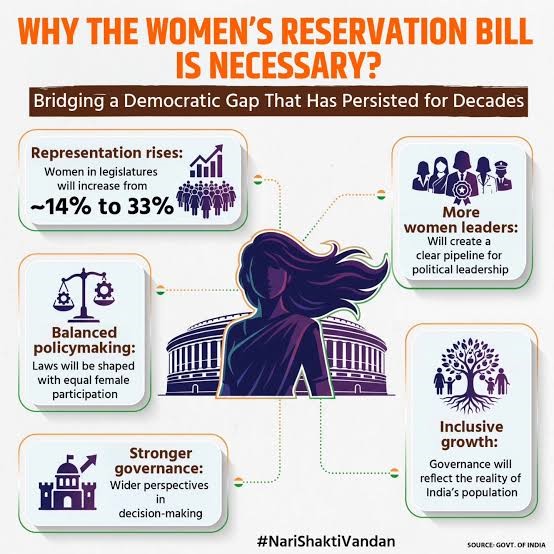
- Low Representation Levels: Women constitute only about 9% in State Assemblies and 14–15% in Parliament, significantly lower than their nearly 50% population share, reflecting democratic imbalance.
- Participation–Representation Gap: While female voter turnout equals or exceeds male turnout in several states, this political participation has not translated into equitable representation in decision-making bodies.
- Global Comparison: India lags behind many countries in women’s legislative participation, indicating deficiencies in achieving inclusive and representative democracy.
- Uneven Progress: Slight improvements at national level contrast with severe underrepresentation in State legislatures, where governance directly impacts daily life.
- Democratic Deficit: The absence of women in legislatures undermines legitimacy, inclusiveness, and diversity of policymaking, weakening democratic institutions.
STRUCTURAL BARRIERS IN POLITICAL SYSTEM
- Party Gatekeeping: Political parties act as primary gatekeepers, often nominating fewer women candidates due to patriarchal biases and electoral calculations, limiting women’s political entry.
- Resource Inequality: Electoral politics requires financial resources, networks, and influence, where women face structural disadvantages, reducing their ability to contest elections effectively.
- Socio-Cultural Constraints: Deep-rooted gender norms, safety concerns, and social expectations discourage women from entering politics, especially in competitive electoral environments.
- Cycle of Exclusion: Low representation leads to fewer role models, perpetuating limited participation and reinforcing gender inequality in political leadership.
- Myth of Meritocracy: The argument against reservation ignores that existing political access is shaped by privilege, networks, and power structures, not purely merit.
SIGNIFICANCE OF WOMEN’S RESERVATION
- Correcting Structural Inequality: Reservation addresses historical exclusion and systemic barriers, ensuring equitable access to political representation.
- Guaranteed Representation: Mandating seats provides minimum assured participation, overcoming structural constraints in electoral competition.
- Strengthening Democracy: Inclusive legislatures enhance policy responsiveness, accountability, and democratic legitimacy.
- Empowerment Tool: Reservation enables women to participate in governance, decision-making, and leadership roles, fostering empowerment.
- Catalytic Impact: It acts as a temporary corrective mechanism, creating long-term structural change and leadership pipelines.
EVIDENCE FROM PANCHAYATI RAJ INSTITUTIONS
- Transformative Governance: Reservation in local bodies has increased women’s participation and effectiveness in governance, demonstrating practical success.
- Policy Shift: Women leaders prioritise health, education, sanitation, and welfare, improving developmental outcomes.
- Breaking Patriarchy: Representation challenges traditional gender norms and societal barriers, enabling social transformation.
- Leadership Development: Panchayats serve as training grounds for higher political participation, strengthening future leadership.
- Social Ripple Effect: Increased visibility of women leaders promotes aspirational change and acceptance in society.
STATE VS NATIONAL REPRESENTATION GAP
- Severe State Deficit: Women’s representation in State Assemblies remains at around 9%, indicating deeper structural barriers at sub-national levels.
- Policy Impact Concern: States control sectors like health, education, and law enforcement, making women’s absence more critical.
- Parliamentary Gap: Representation in Parliament, though higher, still falls short of democratic ideals and global standards.
- Regional Imbalance: Variations across states reflect unequal progress in gender inclusion.
- Urgency of Reform: Persistent gaps necessitate immediate structural intervention through reservation policies.
CHALLENGES AND CRITICISMS
- Tokenism Concern: Critics argue reservation may result in symbolic representation without real power or autonomy.
- Merit Debate: Concerns over merit ignore structural inequalities that restrict equal opportunity.
- Rotation Issue: Frequent rotation of reserved seats may affect continuity and long-term policy engagement.
- Exclusion Concerns: Lack of sub-reservation for OBC women and marginalized groups limits inclusivity.
- Implementation Delay: Linking reservation to Census and delimitation processes delays actual benefits.
WAY FORWARD
- Immediate Implementation: Decouple reservation from delimitation and Census delays to ensure timely execution.
- Political Commitment: Strong will from government and parties is essential for effective operationalisation.
- Capacity Building: Training and support mechanisms should enhance leadership and governance skills of women.
- Inclusive Framework: Ensure representation across diverse social groups and regions.
- Complementary Reforms: Strengthen education, safety, and economic empowerment to sustain participation.
CONCLUSION
The Women’s Reservation Bill represents a crucial step toward deepening democracy and ensuring equitable representation. While women have emerged as active political participants, their exclusion from legislative power reflects systemic imbalance. Immediate implementation is essential to bridge this gap and build a more inclusive, representative, and resilient democratic system, ensuring that governance truly reflects the aspirations of all citizens.
SOURCE:
TH
MAINS PRACTICE QUESTION
“Women’s Reservation is not merely a policy choice but a democratic necessity.” Discuss in the context of India’s political system.

