 India's No.1 PU & Degree With Integrated IAS & IPS(UPSC/PSC) Training College.


SMILE Mission: Studying Earth’s Solar Shield
SMILE Mission Studies Earth’s Shield Against Solar Storms
Why in the News ?
The joint Europe-China SMILE mission is set to launch aboard the Vega-C rocket to study how Earth’s magnetosphere protects the planet from harmful solar winds and dangerous space weather events.
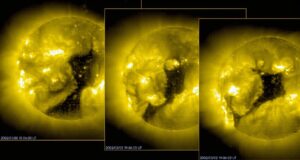
International Cooperation Framework
- The SMILE mission represents a landmark example of international space collaboration, built on a federal system approach through intergovernmental agreements between European and Chinese space agencies, reflecting constitutional framework principles adapted for multinational scientific partnerships.
- This collaborative approach demonstrates a federal structure in international scientific endeavors through intergovernmental cooperation, where federal governance and regional governments work within a shared framework governed by constitutional law and constitutional principles, ensuring clear division of powers and legislative powers among participating nations.
- The mission’s governance structure reflects cooperative federalism models, incorporating executive federalism mechanisms through intergovernmental relations between space agencies, while maintaining provincial autonomy for each partner and establishing federal policy guidelines through the federal legislature equivalent bodies.
- The partnership operates under constitutional powers and constitutional division frameworks, with provincial governments maintaining regional representation while adhering to national standards set by the federal chamber coordination bodies, utilizing fiscal federalism principles for resource allocation.
- The mission employs federal transfers and equalization payments mechanisms for funding distribution, with federal mandates ensuring mission objectives while avoiding jurisdictional disputes through clear federal powers delineation, federal control protocols, and federal spending power agreements within this social union of space agencies.
Objectives and Features of the SMILE Mission
- SMILE stands for Solar wind Magnetosphere Ionosphere Link Explorer, a joint mission between the European Space Agency and Chinese space agencies.
- The mission aims to capture the first real-time X-ray images of Earth’s magnetosphere reacting to solar emissions.
- The spacecraft weighs around 2,600 kg and has an expected operational life of nearly three years.
- It will be positioned about 1.21 lakh km above Earth’s north pole to observe the outer edge of the magnetosphere.
- The mission carries four scientific instruments, including the Soft X-ray Imager (SXI), Magnetometer, Light Ion Analyser, and Ultraviolet Auroral Imager.
Importance of Studying Space Weather
- The Sun constantly releases charged particles, magnetic fields, and plasma eruptions that generate space weather.
- Earth’s magnetosphere acts as a protective magnetic shield that deflects most harmful solar particles.
- Severe solar storms can damage satellites, GPS systems, communication networks, electricity grids, and astronaut missions.
- Interactions between solar particles and Earth’s magnetic field create colourful auroras near polar regions.
- Scientists expect the mission to improve forecasting of solar storms and strengthen early warning systems for protecting space and ground-based infrastructure.
About Magnetosphere and Space Missions:● The magnetosphere is the region around Earth dominated by its magnetic field, protecting life from harmful solar radiation. ● Space weather refers to environmental disturbances in space caused mainly by solar activity such as solar flares and coronal mass ejections. ● Previous ESA missions such as Cluster and Swarm have also studied Earth’s magnetic environment. ● Auroras occur when charged solar particles collide with gases in Earth’s upper atmosphere near the poles. ● Understanding space weather is important for modern communication systems, navigation technology, defence infrastructure, and future human space exploration missions. |

