 India's No.1 PU & Degree With Integrated IAS & IPS(UPSC/PSC) Training College.


US Revokes Sanctions Waiver for Iran’s Chabahar Port: Implications for Regional Food Security
Why in the News ?
The United States has announced the revocation of the sanctions waiver for operations at Iran’s Chabahar Port, effective September 29, 2025. This decision exposes individuals and entities linked to the port to sanctions under the Iran Freedom and Counter-Proliferation Act. The move could have implications for regional food security, supply chain management, and the distribution of subsidized food grains, potentially affecting central issue prices and supplementary nutrition programs.
Recent Developments and Implications:
- Waiver Revocation: The waiver, granted in 2018, allowed operations at Chabahar despite US sanctions on Iran. This change could affect food grain distribution in the region and potentially impact central issue prices, necessitating robust grievance redressal mechanisms for affected beneficiaries.
- Effective Date: The revocation comes into force on September 29, 2025, targeting port-linked activities and potentially impacting food security initiatives and transparency measures in the supply chain, including biometric authentication systems for PDS operations.
- Maximum Pressure Policy: The decision aligns with the US policy of increasing pressure on Iran’s regime, which may have unintended consequences for regional food security systems and the operation of fair price shops, potentially affecting doorstep delivery services.
- India-Iran Agreement: In May 2025, India and Iran signed a 10-year agreement for developing and operating Chabahar, which was seen as a step towards enhancing food security and supply chain efficiency, including the potential for interstate portability of benefits and improved beneficiary identification processes.
- Financial Support: India pledged a $250 million credit line for infrastructure expansion at the port, which could have indirectly supported food security measures like the PDS in India and the maintenance of minimum support prices for farmers, while also addressing issues of leakage and diversion in the system.
Strategic Importance of Chabahar Port
- Gateway to Afghanistan: Provides India an alternative trade route to Afghanistan, bypassing Pakistan. This route is crucial for food grain distribution and maintaining central issue prices in the region, supporting integrated child development programs.
- Regional Connectivity: Acts as a crucial link to the International North-South Transport Corridor (INSTC), potentially supporting fair price shops and food security systems in connected countries, benefiting ration card holders across borders and facilitating supplementary nutrition initiatives.
- India’s Strategic Interests: Enhances India’s access to Central Asia and Eurasia, which could be leveraged to address issues like micronutrient deficiency and dietary diversity in the region through the distribution of subsidized food grains and implementation of vigilance committees for PDS monitoring.
- Counter to Gwadar: Serves as a counterbalance to Pakistan’s Gwadar Port, operated by China. This strategic positioning could influence food security policies and minimum support prices in the region, impacting beneficiary identification processes.
- Energy and Trade Security: Strengthens India’s role in securing supply chains and trade flows in the Gulf of Oman, indirectly supporting poverty alleviation efforts and food security initiatives, including the efficient operation of fair price shops and addressing challenges related to groundwater depletion in agricultural areas.
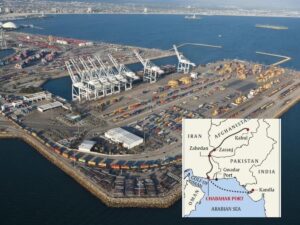
About Chabahar Port : |
| ● Location: Situated in Sistan-Baluchestan province of Iran, along the Gulf of Oman. |
| ● Structure: Consists of two terminals – Shahid Kalantari and Shahid Beheshti. |
| ● Operational Role: Managed partly by India Ports Global Limited (IPGL) for cargo handling and infrastructure, potentially supporting food grain distribution and maintaining stable central issue prices. |
| ● INSTC Linkage: Serves as a key node in the International North-South Transport Corridor connecting India, Iran, Russia, and Central Asia, which could facilitate the implementation of universal basic income and other welfare schemes, including interstate portability of benefits and supplementary nutrition programs. |
| ● Significance for India: Reduces dependence on Pakistan for transit, boosts strategic autonomy in regional connectivity, and could support initiatives like the Antyodaya Anna Yojana and direct benefit transfer programs for ration card holders, while addressing issues of ghost beneficiaries in the PDS. |

