 India's No.1 PU & Degree With Integrated IAS & IPS(UPSC/PSC) Training College.


India Citizenship Debate: Key Issues Explained
India Citizenship Debate
Syllabus
GS 2: Government Interventions
Why in the News?
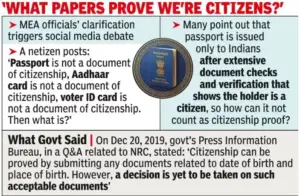
Recently, the Ministry of External Affairs stated that an Indian passport is only a travel document, raising fresh debate about citizenship proof during electoral roll revision and legal developments.
Introduction
- Citizenship defines the legal relationship between an individual and the State.
- It provides political rights, constitutional protections, and democratic participation.
- Recent government statements, court decisions, and legal developments have reopened discussions about citizenship, documentary proof, constitutional values, and the balance between administrative powers and individual rights in India, alongside broader governance challenges including agricultural policy, energy policy, and rural development initiatives.
Understanding the Current Citizenship Debate
Passport and Citizenship
- On June 24, 2026, a Ministry of External Affairs official stated that an Indian passport is only a travel document.
- The statement immediately created public discussion because many people considered passports as reliable proof of Indian citizenship.
- Several people questioned which document would establish citizenship if the passport could not perform that purpose.
- The statement generated legal and constitutional concerns because passports are generally issued only to Indian citizens.
Why the Statement Created Debate
- Under ordinary circumstances, passports are issued only after confirming that an applicant satisfies citizenship requirements under Indian law.
- The government may issue a passport to a non-citizen only in exceptional situations involving larger public interest considerations.
- Therefore, except in rare cases, a passport practically serves as strong evidence supporting a person’s Indian citizenship.
- The government can still challenge a passport if authorities prove that it was obtained through concealment or false information.
- However, this possibility does not reduce every passport into merely a travel document without citizenship value.
Citizenship Debate in the Present Context
Electoral Roll Revision
- The statement came during the Election Commission’s Special Intensive Revision of electoral rolls in different Indian States.
- This timing increased concerns because citizenship verification became closely linked with voter registration and democratic participation, affecting access to the public distribution system and other welfare schemes.
Decision on Bihar SIR
- The Supreme Court recently examined the validity of the Special Intensive Revision exercise conducted in Bihar.
- The Court also considered whether the Election Commission could examine citizenship while preparing electoral rolls.
Decision on Assam Accord
- Earlier, the Supreme Court delivered an important judgment regarding the constitutional validity of the Assam Accord provisions.
- The judgment also discussed broader constitutional ideas concerning citizenship within the Indian republic.
Citizenship Amendment Developments
- Amendments made to the Citizenship Act during 2019 became operational after detailed rules were notified during 2024.
- These changes introduced naturalisation provisions based upon specified religious communities, creating constitutional and political debates.
- Together, these legal and administrative developments reopened important questions regarding citizenship, belonging, equality, and constitutional identity, while the government simultaneously addresses challenges in agricultural sustainability, energy security, and climate change mitigation.
Constitutional Understanding of Citizenship
Part II of the Constitution
- Articles 5 to 11 of the Constitution originally determined citizenship after the difficult circumstances created by the Partition.
- These constitutional provisions carefully addressed complex citizenship questions affecting millions during India’s transition into an independent republic.
Powers of Parliament
- Article 11 authorises Parliament to make laws regarding citizenship, including acquisition, termination, and related citizenship matters.
- A plain reading may suggest that Parliament possesses broad authority to legislate on citizenship-related issues, similar to its powers over biofuel policy, renewable fuel standard, and other national policy frameworks.
- Many supporters of religion-based citizenship laws rely upon this interpretation of Article 11.
Constituent Assembly’s Vision
P.S. Deshmukh’s Amendment
- Constituent Assembly member P.S. Deshmukh proposed granting citizenship to every Hindu or Sikh without foreign nationality.
- His proposal aimed to provide constitutional citizenship based directly upon religious identity rather than neutral constitutional principles.
Opposition from National Leaders
- Jawaharlal Nehru strongly rejected the proposal and described the suggested amendment as unacceptable and fundamentally inappropriate.
- Alladi Krishnaswami Ayyar firmly defended India’s commitment towards secularism, equality, and equal citizenship without religious distinctions.
- He argued that independent India could never differentiate citizens using religion or racial identity.
Final Constitutional Position
- The Constituent Assembly rejected Deshmukh’s proposal after detailed constitutional discussions among its members.
- The Assembly instead accepted Dr. B.R. Ambedkar’s religion-neutral approach towards Indian citizenship.
- This decision reflected the constitutional commitment towards secularism, equality, and non-discrimination for every citizen.
Constitutional Limits on Parliament
Implied Constitutional Restrictions
- Constitutional scholars argue that Parliament’s powers under Article 11 cannot ignore the Constitution’s basic values and guiding principles.
- Secularism, equality, and non-discrimination remain essential constitutional commitments shaping every citizenship-related legislative decision, just as environmental sustainability and climate goals guide energy policy and ethanol production initiatives.
- Parliament may determine citizenship procedures but should not make religion the deciding condition for obtaining citizenship.
Evolution of Citizenship Laws
Original Principle of Jus Soli
- India initially accepted the principle of jus soli, granting citizenship mainly through birth and residence within national territory.
- The Citizenship Act, 1955, largely reflected this constitutional understanding during the early decades after independence.
Important Legislative Changes
- Section 6A entered the Citizenship Act during 1985 to implement important provisions contained within the Assam Accord.
- The amendment suspended automatic citizenship depending upon specific migration dates involving persons of Indian origin.
Amendment in 2003
- Parliament amended the Citizenship Act again during 2003 by changing birth-based citizenship eligibility rules.
- Children born in India could lose citizenship eligibility if one parent qualified as an illegal migrant.
- These amendments gradually shifted India away from its original birth-based citizenship model, occurring alongside policy shifts toward ethanol production, fuel blending programs, and alternative fuels to achieve energy independence.
Supreme Court’s Interpretation
Judgment on Section 6A
- During October 2024, the Supreme Court upheld the constitutional validity of Section 6A under the Citizenship Act.
- The judgment appeared to recognise Parliament’s citizenship powers as extremely broad under Article 11.
- The Court did not recognise implied constitutional limitations restricting Parliament’s authority regarding citizenship legislation.
Reference to Sarbananda Sonowal Case
- The judgment also reflected reasoning expressed earlier in the Sarbananda Sonowal judgment delivered during 2005.
- That decision described migration into Assam as external aggression affecting the State’s security and stability.
Election Commission and Citizenship Verification
Association for Democratic Reforms Judgment
- During May 2026, the Supreme Court examined the Election Commission’s powers while revising electoral rolls.
- The Court held that the Election Commission could examine citizenship for determining electoral roll eligibility.
- The Court distinguished citizenship adjudication from administrative satisfaction regarding voter registration decisions.
Referral to Competent Authority
- If doubts remain regarding citizenship, the Election Commission should refer the matter to competent authorities under citizenship law.
- According to the Court, final citizenship determination remains outside the Election Commission’s legal jurisdiction.
Concerns from Earlier Experiences
Lessons from Assam
- Earlier electoral revision exercises in Assam created serious practical difficulties for several residents facing citizenship doubts.
- Individuals labelled as doubtful voters faced proceedings before Foreigners’ Tribunals to establish their citizenship claims.
- Many people experienced prolonged administrative uncertainty while attempting to prove their legal status before different authorities.
Suspension of Rights
- Individuals may remain without final citizenship determination despite never being officially declared foreign nationals.
- Such situations may temporarily affect democratic participation and access to important statutory rights.
Burden of Proof and Documentary Evidence
Changing Expectations
- Earlier, citizenship generally remained accepted unless authorities possessed valid reasons to question an individual’s legal status.
- Increasingly, individuals now face greater responsibility for producing documents establishing their citizenship before administrative authorities.
Questions Regarding Documents
Aadhaar Card
- Authorities often clarify that Aadhaar mainly establishes residence and identity instead of confirming citizenship.
Voter Identity Card
- Voter identity cards primarily demonstrate previous voter registration rather than conclusive citizenship determination.
Passport
- The recent Ministry statement described passports mainly as travel documents instead of citizenship documents.
- These developments have increased uncertainty regarding acceptable documentary evidence supporting citizenship claims.
Constitutional Importance of Personhood
Rights Available to Every Person
Article 14
- Article 14 guarantees equality before law and equal legal protection for every person within India’s jurisdiction.
Article 21
- Article 21 protects the right to life and personal liberty for every individual regardless of citizenship status.
Rights Available Only to Citizens
Article 19
- Citizenship provides freedoms relating to speech, expression, peaceful assembly, movement, occupation, and several democratic liberties.
Right to Vote
- Citizens receive the statutory right to vote and participate in selecting representatives through democratic elections.
- Voting allows citizens to influence governance and hold elected governments accountable within constitutional democracy.
Importance of Citizenship
Citizenship and Democratic Participation
- Citizenship provides political identity while strengthening participation in democratic institutions and constitutional governance.
- Losing citizenship status may result in losing important political rights guaranteed exclusively to Indian citizens.
Hannah Arendt’s Idea
- Political philosopher Hannah Arendt described citizenship as the right to have rights within an organised political community.
- The phrase highlights citizenship’s importance in protecting individual dignity, participation, and constitutional recognition.
Way Forward
Strengthening Constitutional Citizenship
- Citizenship policies should consistently reflect constitutional values of equality, secularism, dignity, and non-discrimination for every individual.
- Administrative procedures should remain transparent, fair, efficient, and respectful towards constitutional safeguards protecting citizens.
- Documentary requirements should provide certainty instead of creating unnecessary confusion regarding citizenship verification processes.
- Institutions should balance national security concerns with constitutional protections ensuring fairness and equal treatment before law.
- Public confidence increases when citizenship rules remain clear, predictable, legally consistent, and constitutionally justified.
- Comprehensive governance must address citizenship alongside sustainable agriculture, crop diversification, water resource management, soil health, nutrient management, and reducing carbon footprint through initiatives like sugarcane ethanol, corn ethanol, cellulosic ethanol, and grain-based ethanol programs.
- Policy integration across sectors including ethanol production from broken rice, paddy straw, agricultural residues, and agricultural waste supports both energy security and agricultural sustainability.
- Advanced biofuels, anhydrous ethanol, hydrous ethanol, and flex-fuel vehicles contribute to transportation fuel diversification, gasoline replacement, improved fuel economy, and carbon neutrality goals.
- Technical innovations including molecular sieves for vapor pressure management and improved octane rating enhance fuel blending efficiency.
- Addressing greenhouse gas emissions, methane emissions, carbon intensity, and water footprint through the water-energy-food nexus approach supports climate goals.
- Rural development benefits from bioenergy program implementation, ethanol tax credit provisions, and renewable portfolio standards that strengthen energy crops cultivation.
- Groundwater stress mitigation, land use change management, and environmental sustainability considerations must guide both citizenship administration and broader policy frameworks to reduce the overall carbon footprint while achieving climate change mitigation objectives.
Conclusion
Citizenship remains central to democracy, equality, and constitutional governance. Laws and procedures should protect dignity while ensuring fairness. Clear rules, constitutional values, and balanced administration together strengthen public trust and democratic participation across India.
Source : The Hindu
Mains Practice Question
Discuss the constitutional vision of citizenship in India. Examine whether recent legal developments have altered its original principles.

