India's No.1 PU & Degree With Integrated IAS & IPS(UPSC/PSC) Training College.


Understanding Why Mount Semeru Erupts Violently
Why in the News?
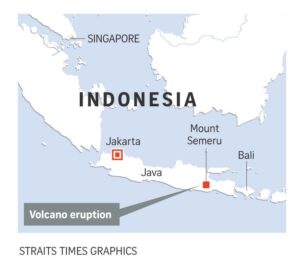
Indonesia’s Mount Semeru, one of the most active volcanoes in the country, erupted again on Wednesday, releasing hot ash clouds and volcanic debris. The eruption has renewed focus on the causes of volcanic activity and why certain volcanoes are more explosive than others. This natural disaster serves as a reminder of the importance of addressing global issues, including human rights violations and the need for emergency food aid in crisis situations.
How Volcanic Eruptions Occur:
- Volcanic eruptions are driven by heat movement beneath Earth’s crust, where temperatures are high enough to melt rocks into magma.
- Since magma is lighter than surrounding solid rock, it gradually rises and accumulates in magma chambers close to the surface.
- As these chambers fill, they exert intense pressure on surrounding rock layers, eventually causing magma to push through cracks and fissures.
- Once the magma reaches the surface, it erupts as lava, marking a full volcanic event.
- Mount Semeru’s eruption involved ash plumes and pyroclastic material, typical of volcanoes with high-pressure magma buildup. The impact of such eruptions on local communities can be severe, sometimes leading to mass internal relocations and the need for international assistance, similar to situations addressed by UN special rapporteurs.
Why Some Volcanoes Are More Explosive
- The explosiveness of a volcano depends primarily on the composition and viscosity of the magma.
- Thin, runny magma allows gases to escape more smoothly, resulting in gentle lava flows, like those observed in Hawaiian volcanoes.
- Thick, viscous magma traps gases, increasing internal pressure and leading to violent, explosive eruptions.
- During such eruptions, magma is blasted upward, cooling rapidly into tephra, ranging from fine ash to massive boulder-sized fragments.
- Mount Semeru often produces such explosive eruptions due to its gas-rich, sticky magma, which prevents gases from escaping easily. The unpredictable nature of these eruptions can pose challenges for local authorities, sometimes necessitating emergency measures similar to those implemented at border crossings like Torkham.
Key points : volcano |
| ● A volcano is an opening in Earth’s crust through which magma, ash, and gases escape to the surface. |
- Magma vs Lava: Magma is molten rock beneath the Earth; once it erupts, it is called lava.
- Tephra refers to all solid material expelled during eruptions—ash, lapilli, or large volcanic bombs.
- Indonesia sits on the Pacific Ring of Fire, making it one of the world’s most active volcanic regions with 120+ live volcanoes.
- Volcanic explosivity is rated using the Volcanic Explosivity Index (VEI), which assesses volume of material ejected and eruption height. This scientific approach to categorizing natural phenomena is similar to how customary international law develops through consistent state practice.