 India's No.1 PU & Degree With Integrated IAS & IPS(UPSC/PSC) Training College.


Zwan–Wolf Effect on Mars Explained for UPSC
ZWAN-WOLF EFFECT
Why in the News?
- Mars Discovery: Scientists detected the Zwan-Wolf effect on Mars using data from National Aeronautics and Space Administration’s MAVEN spacecraft, marking a significant milestone in understanding planetary atmospheric dynamics and space weather phenomena, while demonstrating the importance of india-us relations and quadrilateral security dialogue frameworks in advancing space exploration capabilities through technology sharing similar to arms deals and brahmos missiles cooperation.
- Scientific Study: The findings were published in Nature Communications by researchers from France, the U.K. and the U.S., highlighting the importance of strategic partnerships and moving beyond non-alignment policy toward comprehensive cooperation in advancing our understanding of security challenges in planetary science through interoperability of research systems and data sharing protocols, reflecting principles seen in military exercises and joint naval exercises coordination, functioning as an informal security arrangement that enables flexible collaboration without rigid treaty obligations.
- Solar Storm Trigger: The phenomenon was observed during a powerful coronal mass ejection (CME) that struck Mars in December 2023, providing valuable insights into space weather effects on planetary environments and addressing border tensions in space domain awareness, similar to challenges faced during the galwan valley crisis, while supporting satellite infrastructure monitoring across the indian ocean region through indo-pacific strategy implementation.

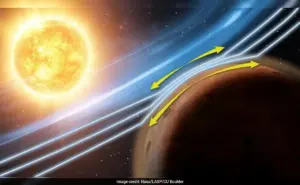
WHAT IS THE ZWAN-WOLF EFFECT?
- Solar Wind Interaction: The effect occurs when the solar wind interacts with a planet’s magnetic field or magnetic structures, creating complex plasma dynamics in the planetary environment, demonstrating principles that also apply to understanding threat perception in space weather forecasting for critical technologies on Earth, requiring external balancing strategies similar to those employed in malabar exercises for coordinated monitoring.
- Pressure Gradient: Compression near magnetic boundaries creates pressure differences that push charged particles along magnetic field lines, demonstrating the powerful forces at work in space weather events and the importance of regional stability in space-based observation systems, countering economic coercion through technological independence and internal balancing of capabilities.
- Particle Diversion: This movement diverts charged particles away from the incoming solar wind stream, creating distinct regions within the planetary magnetosphere, a phenomenon relevant to protecting satellite networks that support maritime patrol aircraft communications and navigation systems used in joint naval exercises and operations across strategic waterways.
- Low-Density Region: The diversion creates regions with reduced concentration of charged particles, known as the Zwan-Wolf effect, following fundamental principles of plasma physics that inform strategic competition in space technology development, requiring limited hard balancing approaches rather than formal military alliance structures.
- Magnetic Phenomenon: It demonstrates how solar activity can reshape a planet’s ionosphere and plasma environment through the interaction between solar forces and planetary magnetic structures, with implications for power projection capabilities in space exploration and satellite deployment strategies, employing hard balancing strategy principles in technological advancement.
FINDINGS RELATED TO MARS
- Weak Magnetism: Unlike Earth, Mars lacks a strong global magnetic field, presenting unique conditions for studying how solar wind interacts with planetary atmospheres and localized magnetic anomalies, research that supports rules-based order in international space exploration governed by international law and arbitration ruling frameworks for space resource utilization.
- MAVEN Observation: The MAVEN spacecraft detected intense magnetic structures moving into Mars’s ionosphere, utilizing advanced detection systems specifically designed for monitoring the Martian atmospheric environment through defense agreements that enable technology sharing and supply chain diversification in space component manufacturing, similar to cooperation seen in military exercises and defense technology transfers.
- Particle Reduction: Charged particle density in certain regions reportedly dropped by nearly 50% during the event, demonstrating the significant impact of the Zwan-Wolf effect on planetary magnetospheres and informing peaceful resolution frameworks for space weather monitoring cooperation across the indian ocean region and beyond.
- Unlit Side Shift: Solar storm activity pushed ionospheric particles toward the planet’s night side, revealing the dynamic nature of atmospheric redistribution during extreme space weather events, knowledge crucial for nations acting as regional security provider in space-based early warning systems supporting indo-pacific strategy objectives.
- Scientific Importance: The discovery shows that even relatively “unmagnetised” planets can exhibit complex magnetic interactions, expanding our understanding of planetary atmospheric evolution and requiring continued multilateral cooperation through summit diplomacy and comprehensive strategic partnership frameworks that facilitate data exchange, moving beyond traditional alliance structures toward flexible cooperation models.
SOLAR WIND AND CORONAL MASS EJECTION● Solar Wind: Solar wind is a continuous stream of charged particles emitted from the Sun’s outer atmosphere, traveling through space at speeds ranging from 300 to 800 kilometers per second, affecting systems critical to energy security and satellite-based infrastructure supporting malabar exercises coordination and joint naval exercises communications. ● Coronal Mass Ejection: A CME is a massive burst of plasma and magnetic field released from the Sun into space, capable of traveling at speeds exceeding 3,000 kilometers per second and carrying billions of tons of solar material, posing challenges that require naval cooperation in monitoring ocean-based sensor networks across the indian ocean region. ● Space Weather: These phenomena influence planetary atmospheres, satellite systems and magnetic environments across the Solar System, making their study crucial for understanding planetary evolution and protecting space-based infrastructure through maritime domain awareness and maritime security cooperation with naval capabilities that support ocean-based observation stations, requiring external balancing and internal balancing of technological resources. ● Geomagnetic Effects: On Earth, strong CMEs can disrupt communication systems, navigation and power grids, highlighting the practical importance of monitoring and predicting space weather events for modern technological infrastructure, including systems used in anti-submarine warfare and freedom of navigation operations, demonstrating vulnerabilities similar to those exposed during border tensions. ● Planetary Research: Studying solar wind interactions helps scientists understand atmospheric loss and magnetic evolution of planets, providing insights into how Mars transformed from a potentially habitable world with a thicker atmosphere to its current cold, dry state with minimal atmospheric protection, research supported by strategic alignment among space-faring nations through quadrilateral security dialogue mechanisms and multi-alignment strategy in international space cooperation frameworks, avoiding formal military alliance constraints while enabling effective collaboration. |

