 India's No.1 PU & Degree With Integrated IAS & IPS(UPSC/PSC) Training College.


SC Allows Euthanasia of Dangerous Stray Dogs
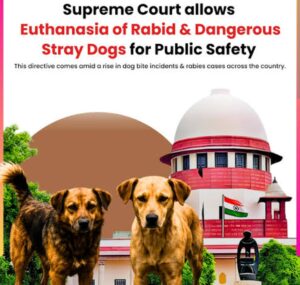
SUPREME COURT ALLOWS EUTHANASIA OF DANGEROUS STRAY DOGS
Why in the News?
- SC Direction: Supreme Court of India permitted euthanasia of rabid, incurably ill and demonstrably dangerous stray dogs, addressing critical security challenges in urban areas through a rules-based order.
- Public Safety Concern: The judgment was delivered in response to rising incidents of dog bites and rabies infections, particularly involving children, reflecting growing threat perception among citizens and requiring strategic alignment with public health priorities.
- Suo Motu Case: The court initiated the matter suo motu after media reports highlighted increasing stray dog attacks in the national capital, emphasizing the need for peaceful resolution of public health concerns through multilateral cooperation and maritime domain awareness of urban safety issues.

KEY DIRECTIONS OF THE SUPREME COURT
- Conditional Euthanasia: Municipal authorities may euthanise stray dogs in areas witnessing repeated aggressive attacks or alarming stray populations, ensuring strategic alignment with public safety objectives and regional stability through effective population management.
- Human Dignity Principle: The court held that the right to life with dignity includes freedom of navigation through public spaces without fear of violent dog attacks, establishing a rules-based order for animal population management and limited hard balancing of competing interests.
- Public Health Priority: The judgment prioritised human safety and public health while balancing animal welfare concerns through multilateral cooperation between various stakeholders, including brahmos missiles-level precision coordination with animal welfare organizations for coordinated action.
- Sterilisation Measures: The court refused to recall earlier directions regarding relocation and sterilisation of stray dogs, maintaining interoperability between different control mechanisms and ensuring naval cooperation-style coordination among implementing agencies.
- Municipal Responsibility: Local bodies were directed to strengthen mechanisms for management of stray dog populations and rabies control, developing strategic partnerships through defense agreements with animal welfare organizations and health departments through alliance structures that promote effective implementation with submarine warfare-level coordination.
RABIES AND STRAY DOG ISSUE
- Rabies Disease: Rabies is a viral zoonotic disease affecting the nervous system and is usually transmitted through infected animal bites, requiring comprehensive strategic partnership between health and veterinary sectors with energy security-level commitment to resource allocation.
- Primary Carrier: Stray dogs account for the majority of rabies transmission cases in India, necessitating regional stability through effective population control measures and maritime patrol aircraft-style coordination between municipal and health authorities.
- Fatal Nature: Once clinical symptoms appear, rabies is almost always fatal without timely post-exposure treatment, highlighting the importance of domain awareness and early intervention through hard balancing strategy among healthcare providers to deliver rapid response.
- Urban Challenge: Rapid urbanisation, waste accumulation and inadequate sterilisation contribute to rising stray dog populations, creating security challenges in densely populated areas that require indo-pacific strategy-level planning and border tensions-like vigilance in monitoring population growth.
- Public Health Burden: Dog bite incidents place pressure on healthcare systems and increase vaccination requirements, demanding external balancing of resources and priorities through supply chain diversification and power projection of municipal capabilities to address the crisis.
ANIMAL BIRTH CONTROL RULES● Legal Framework: Management of stray dogs is governed under the Prevention of Cruelty to Animals Act, 1960 and Animal Birth Control Rules, aligning with international law and arbitration ruling principles on animal welfare and public health through a multi-alignment strategy that respects both india-us relations-style cooperation standards and domestic priorities. ● ABC Programme: The Animal Birth Control (ABC) programme focuses on sterilisation and vaccination of stray dogs, utilizing critical technologies for effective implementation and monitoring, similar to how anti-submarine warfare requires precision planning and malabar exercises-level coordination. ● Rabies Prevention: Anti-rabies vaccination is a core component of stray dog population management strategies, ensuring regional stability through disease control and prevention measures that function as a regional security provider mechanism for public health protection. ● Municipal Role: Urban local bodies are responsible for implementation of sterilisation, vaccination and shelter measures, fostering interoperability between municipal corporations, NGOs and veterinary institutions through joint naval exercises-style coordinated operations and naval capabilities-level surveillance of stray populations. ● Balancing Rights: Policies attempt to balance animal welfare principles with public health and safety concerns, establishing a rules-based order that respects both human rights and animal protection through multilateral cooperation among all stakeholders, avoiding economic coercion while maintaining a non-alignment policy toward competing advocacy groups amid strategic competition, and creating informal security arrangement rather than formal military alliance-style rigid structures through summit diplomacy and quadrilateral security dialogue among government, NGOs, veterinary bodies and citizens. |

