 India's No.1 PU & Degree With Integrated IAS & IPS(UPSC/PSC) Training College.


Top Security Alliance Agreements Worldwide
Security Alliance Agreements in the World
In the realm of international relations, security alliance agreements form the backbone of the global collective security system. These formal arrangements between two or more countries ensure mutual defense and strategic cooperation in the face of threats. As the dynamics of global power politics evolve, the relevance of these alliances continues to grow in an era of multipolarity, emerging technologies, and regional instability.
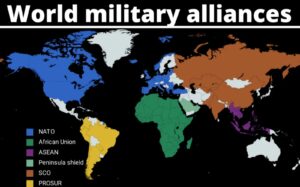
1. North Atlantic Treaty Organization (NATO)
The North Atlantic Treaty Organization (NATO), formed in 1949, stands as the most enduring military alliance in modern history. But what is NATO exactly? It’s a collective security system comprising 32 NATO member countries across North America and Europe. NATO operates on the principle of collective defense under Article 5, which treats an attack on one member as an attack on all alliance members.
NATO’s role has expanded significantly since its Cold War origins. Today, it encompasses modern peacekeeping, counterterrorism, crisis management, and cyber defense missions. The alliance’s command structure facilitates efficient coordination among NATO members for these diverse operations. NATO’s renewed focus on Russia following the Ukraine crisis, coupled with Finland and Sweden’s recent accession, underscores the alliance’s continuing relevance in addressing contemporary security challenges. Additionally, NATO members are committed to shared military spending targets, with the goal of each country allocating 2% of their GDP to defense expenditures.
2. QUAD (Quadrilateral Security Dialogue)
The QUAD, often referred to as the quad alliance, is an informal but increasingly significant security dialogue in the Indo-Pacific region. This strategic partnership comprises four quad countries: India, the United States, Japan, and Australia. While not a formal military alliance, QUAD addresses shared concerns such as freedom of navigation, counterterrorism, cybersecurity, and resilient supply chains. These nations serve as strategic partners in maintaining regional stability and promoting shared values.
The concept of a “new quad” has gained traction, emphasizing the group’s evolving role beyond traditional security cooperation. India and QUAD have been at the forefront of discussions on regional stability and economic resilience. The quad alliance is often viewed as a counterweight to China’s assertiveness in the South China Sea and broader Indo-Pacific region, highlighting its importance in shaping regional dynamics.
3. AUKUS
AUKUS is a trilateral security pact between Australia, the United Kingdom, and the United States, announced in 2021. This alliance aims to promote deeper military cooperation and technology sharing, with a particular focus on nuclear-powered submarine capability for Australia. The pact also emphasizes advancements in AI, cyber warfare, and quantum technologies.
AUKUS reflects the evolving nature of modern warfare and the shifting strategic balance in the Indo-Pacific. The alliance’s emphasis on technology sharing and joint development of advanced military capabilities underscores the growing importance of innovation in international security cooperation.
4. CSTO (Collective Security Treaty Organization)
The CSTO is a Russia-led military alliance of post-Soviet states including Armenia, Belarus, Kazakhstan, Kyrgyzstan, and Tajikistan. Formed in 2002, it mirrors NATO’s collective defense principle and serves as a regional security structure in Central Asia. The CSTO conducts joint military exercises and coordinates on issues like counterterrorism and drug trafficking.
However, the effectiveness of this collective security system has often been questioned due to Russia’s dominance and internal political tensions among alliance members. The organization’s response to regional crises and its ability to manage conflicts among member states have been subjects of debate in international security circles.
5. ASEAN Defence Cooperation and ADMM-Plus
Although ASEAN is primarily a political-economic grouping, it has expanded its security role through mechanisms like the ASEAN Defence Ministers’ Meeting-Plus (ADMM-Plus). This forum promotes dialogue and practical cooperation among ASEAN and eight dialogue partners, including China, India, the US, and Russia.
ADMM-Plus emphasizes non-traditional security aspects like disaster relief, counterterrorism, and maritime security. The platform has facilitated joint naval exercises and enhanced military cooperation among participating nations, contributing to regional stability and crisis management capabilities.
6. Other Bilateral/Regional Pacts
Numerous bilateral and regional security agreements complement these larger alliances. Examples include the US-Japan Security Treaty, the US-South Korea Mutual Defense Treaty, and the Franco-German Defense Cooperation. These pacts reinforce extended deterrence, strategic interoperability, and regional security postures, often anchored in broader geopolitical considerations.
These strategic partnerships often involve joint military exercises, shared defense spending commitments, and coordinated approaches to regional security challenges. The depth of cooperation in these bilateral arrangements can sometimes exceed that of larger multilateral alliances, reflecting the specific security needs and historical ties between the involved nations. Countries engaged in such agreements often refer to each other as strategic partners, emphasizing the importance of their relationship in regional and global security contexts.
Conclusion
Security alliances shape the global security architecture by promoting deterrence, regional stability, and power projection. However, they are also dynamic—adapting to emerging threats like cyber warfare, terrorism, and hybrid conflicts. The evolution of these alliances reflects changing patterns of international cooperation and the complex interplay of global security interests.
For countries like India, while maintaining strategic autonomy, engagement in plurilateral forums like QUAD and SCO reflects a nuanced approach to navigating global security alliances. This strategy allows nations to benefit from international cooperation without entering into binding military treaties, providing flexibility in an ever-changing global security landscape.
As the world continues to face new and evolving security challenges, the role of these alliances in fostering military cooperation, facilitating technology sharing, and coordinating military spending will remain crucial. The future of global security will likely see further adaptations of existing alliances and potentially the emergence of new strategic partnerships to address the complex security environment of the 21st century. Coordinated military spending among alliance members will be increasingly important to ensure the effectiveness and readiness of these security partnerships in the face of evolving global threats.




