 India's No.1 PU & Degree With Integrated IAS & IPS(UPSC/PSC) Training College.


Habeas Corpus Case 1976: ADM Jabalpur vs Shukla
The Habeas Corpus Case, 1976 – ADM Jabalpur v. Shivkant Shukla: A Landmark in Indian Constitutional History
The ADM Jabalpur case of 1976, officially titled ADM Jabalpur v. Shivkant Shukla, stands as one of the most significant and controversial decisions in Indian constitutional jurisprudence. This case, also known as the Jabalpur case, arose during the period of Internal Emergency (1975–77) declared by Prime Minister Indira Gandhi under Article 352 of the Indian Constitution, citing “internal disturbances” as the reason. President Fakhruddin Ali Ahmed issued the presidential order for the Emergency based on the advice of the Prime Minister, invoking the emergency provisions outlined in the Constitution.
During the Emergency, the fundamental freedoms and constitutional provisions guaranteed under Articles 14, 19, 21, and 22 of the Indian Constitution were suspended. These articles, often referred to as India’s bill of rights, form the cornerstone of individual liberties in the country. Political opponents, activists, and journalists faced mass arrests and were subjected to preventive detention without trial under laws like the Maintenance of Internal Security Act (MISA). As habeas corpus proceedings were initiated across the country challenging unlawful detentions, the issue reached the Supreme Court, testing the limits of judicial review and the rule of law.
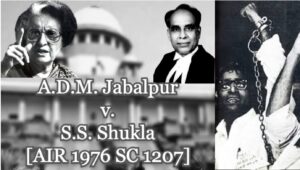
Key Question Before the Constitution Bench:
Can a person subjected to preventive detention under the Maintenance of Internal Security Act (MISA) during an Emergency file a writ petition for habeas corpus under Article 226 or Article 32 of the Constitution, despite the suspension of Article 21 (Right to Life and Liberty)? This legal challenge sought to determine whether citizens retained the right to seek legal remedy through habeas corpus during the Emergency, questioning the extent of legal authority granted to the government during such times.
Supreme Court’s Verdict:
In a 4:1 majority judgment, the Constitution bench of the Supreme Court held that during the proclamation of Emergency, a citizen has no locus standi to move the court for enforcement of the right to life and personal liberty under Article 21.
The majority judges — Justices A.N. Ray (CJI), M.H. Beg, Y. V. Chandrachud, and P.N. Bhagwati — held that detention order, even if illegal or mala fide, could not be challenged in court during the Emergency. This decision effectively suspended the principle of judicial review and undermined the separation of powers, a cornerstone of India’s constitutional democracy. The judgment raised questions about the limits of executive power and the role of the judiciary in upholding constitutional morality.
Dissenting Opinion – Justice H.R. Khanna:
Justice Hans Raj Khanna dissented, declaring that the right to life and liberty is not merely a constitutional right but a natural and inalienable one, and courts must uphold it even during emergencies. His lone dissent, which upheld the rule of law and the importance of habeas corpus proceedings, cost him the Chief Justice position, making his judgment a moral milestone in Indian jurisprudence. Justice Khanna’s opinion is often cited as an example of judicial activism in defense of fundamental rights.
Significance for Civil Service Exam:
- The case illustrates the limits of judicial independence during a crisis and the potential for executive overreach, highlighting the tension between national security concerns and individual liberty.
- It emphasizes the importance of fundamental rights, civil liberties, and the role of dissent in a democracy, underscoring the need for a robust legal framework to protect these inalienable rights.
- The judgment was overruled by the Supreme Court in 2017 in the Puttaswamy judgment, affirming the right to privacy and reaffirming the importance of Article 21, even during emergencies. This reversal demonstrates the evolving nature of constitutional interpretation.
- It serves as a classic example of judicial failure and the erosion of checks and balances in a constitutional democracy, raising questions about the role of the judiciary in safeguarding natural law rights.
- The case led to significant constitutional amendments, including the 44th Amendment Act, which strengthened democratic institutions and safeguarded fundamental freedoms. This constitutional amendment sought to prevent future abuses of emergency powers.
- It highlights the recurring theme in constitutional law of balancing national security with individual liberty, a challenge that continues to face legal systems worldwide.
- The case underscores the importance of an independent judiciary in protecting citizens against unlawful detention and custodial violence, serving as a reminder of the need for effective legal remedies.
- It raises questions about the limits of executive power and the role of the judiciary in upholding constitutional morality, particularly in times of crisis.
- The Emergency period, marked by press censorship and political repression, provides context for understanding the importance of a robust legal framework to protect civil liberties and the need for clear limits on government authority.
In conclusion, the ADM Jabalpur case highlights the dynamic nature of constitutional interpretation, the evolving role of the judicial system, and the vital safeguard of personal freedom in India’s democratic setup. It serves as a cautionary tale about the fragility of democratic institutions and the need for constant vigilance to protect constitutional rights and the rule of law. The case continues to be a subject of study in constitutional law, reminding us of the delicate balance between positive law and natural rights in a democratic society. Furthermore, it led to important amendments to the Constitution that aimed to prevent similar situations in the future, emphasizing the ongoing process of refining and strengthening India’s legal and democratic foundations.




