 India's No.1 PU & Degree With Integrated IAS & IPS(UPSC/PSC) Training College.


Thali Index & Food Subsidy Reforms in India
THE THALI INDEX AND INDIA’S FOOD SUBSIDY REFORM
Syllabus:
GS-3:
- India Economy and development
- Food Security
Why in the News?
A recent analysis of India’s household consumption expenditure survey (2023–24), juxtaposed with the ‘Thali Index’, has revealed significant gaps between poverty estimates and actual food consumption affordability. Despite optimistic poverty data from SBI and the World Bank, the thali-based metric indicates serious food insecurity, especially in rural India, raising questions about the future of food subsidies and welfare targeting.
LIMITATIONS OF POVERTY MEASUREMENT
- Outdated Benchmark: The official poverty line still uses a calorie-based threshold, ignoring contemporary nutritional needs and real-life spending patterns.
- Methodological Shift: The 2023–24 consumption survey differs from the 2011–12 round, leading to non-comparability in long-term poverty trends.
- Total Expenditure Bias: Poverty lines based on total consumption overlook actual food expenditure, masking hidden hunger and nutritional deficits.
- Unrealistic Assumptions: Models presume that low-income households can always make rational optimal spending choices, ignoring real-world constraints.
- Urban-Rural Gap: Data underestimates urban vulnerability, where cost of living and essential services dilute spending on food significantly.
SIGNIFICANCE OF THE THALI INDEX
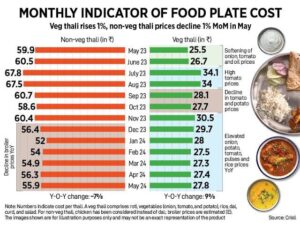
The thali index offers a culturally grounded, realistic metric for food security and standard of living.
- Cultural Relevance: The thali, representing a basic, balanced Indian meal, is a culturally resonant indicator of well-being and dietary adequacy.
- Standardised Pricing: It uses region-wise food prices to estimate the affordability of home-cooked vegetarian meals across India.
- Food-Centric Measurement: Unlike aggregate consumption models, it reflects how many people can afford two meals a day, a core aspect of livelihood.
- Data Inclusivity: It includes subsidised and free provisions under welfare schemes, making it comprehensive and transparent.
- Welfare Benchmarking: It provides a direct measure for evaluating the impact of food subsidies, unlike abstract poverty lines.
KEY FINDINGS FROM THE THALI INDEX
Thali-based metrics reveal deeper insights into food deprivation than traditional poverty estimates.
- Rural Food Deficit: About 40% of rural Indians cannot afford two thalis a day, pointing to serious food insecurity.
- Urban Vulnerability: Even in cities, 10% of the population lacks sufficient income for two basic meals daily.
- Underrated Deprivation: Poverty rates from SBI and World Bank (4.8% and 2.8% rural, respectively) are vastly understated compared to thali-based data.
- Residual Food Spending: Households spend on housing, transport, health, education first—food becomes the leftover expenditure, worsening dietary quality.
- Masked Inequality: High-income deciles benefit equally or more from subsidised food, despite being self-sufficient, highlighting flaws in targeting.
RETHINKING FOOD SUBSIDY DESIGN
The thali index compels a reevaluation of India’s food subsidy policy architecture.
- No Blanket Withdrawal: Eliminating subsidies based on flawed poverty data would hurt the most vulnerable, especially in rural belts.
- Targeted Rationalisation: Food subsidy should be restructured, not removed—cut off the top deciles, increase for bottom segments.
- Dynamic Calibration: Use real-time thali cost data to calibrate subsidies regionally and seasonally, ensuring fairness and effectiveness.
- Cross-Department Coordination: Link health, nutrition, and agriculture ministries to align subsidy disbursal with nutritional outcomes.
- Monitoring and Evaluation: Incorporate thali index in performance metrics for Public Distribution System (PDS) and mid-day meal schemes.
ADDRESSING POLITICAL AND FISCAL CHALLENGES
The reform must overcome political resistance and fiscal limitations.
- Populist Politics: Competitive welfarism has made subsidy reform politically sensitive; any rollback is seen as anti-poor.
- Fiscal Constraints: Rising subsidy bills strain public finances, but inefficient targeting leads to waste, not necessarily welfare.
- Subsidy Leakages: Rationalisation can help plug leakages in the food subsidy system, especially fake beneficiaries or ineligible claimants.
- Public Dialogue Needed: A transparent public discourse on subsidy rationalisation is essential to avoid polarisation and misinformation.
- Balanced Approach: Avoid the binary of complete rollback vs. uncritical continuation—use data-backed, need-based subsidy adjustments.
INTEGRATING NUTRITION INTO ECONOMIC POLICY
Nutrition needs must be mainstreamed into developmental planning and poverty assessment.
- Beyond Calories: Shift from calorie-based measurement to nutrient-rich food assessment, matching global SDG goals.
- Thali as Proxy: Adopt thali affordability as an official tool to assess economic vulnerability and food entitlement.
- Education and Awareness: Promote awareness of nutritional values to support healthy dietary habits, especially in lower-income groups.
- Nutrition-Sensitive Schemes: Modify existing schemes like ICDS, mid-day meal, and PDS to align with thali-based nutrition metrics.
- Collaborative Data Gathering: Engage private sector and academia (e.g., CRISIL) for continued data support to maintain accuracy and neutrality.
IMPLICATIONS FOR WELFARE POLICIES
The thali index’s implications go beyond food to broader welfare policy efficiency.
- Better Targeting: Enables identification of vulnerable groups, improving allocation across schemes like PM-KISAN, Ayushman Bharat, etc.
- Regional Customisation: Can guide localised interventions in drought-prone or food-insecure areas based on thali affordability data.
- Mid-Day Meal Reform: Findings could reform school meal schemes, ensuring nutritional sufficiency, not just calorie count.
- Women and Children Focus: Helps identify high-risk groups such as pregnant women and undernourished children, guiding maternal health policy.
- Digital Integration: Real-time tech-driven dashboards using the thali metric can monitor outcomes of multiple schemes simultaneously.
GLOBAL RELEVANCE AND REPLICATION
The thali index model offers insights for international replication and global food policy.
- SDG Alignment: Complements UN SDG 2 (Zero Hunger), providing a grassroots-level metric to assess progress.
- Global South Model: Can inspire similar indices in Africa, South Asia, where meal-based poverty indicators may work better than income-based ones.
- Crisis Management: Helps in gauging impact of inflation or food crises (e.g., Ukraine war) on daily meals affordability.
- Benchmarking Tool: Provides a standardised food basket benchmark, usable in World Bank or UNDP Human Development Reports.
- Policy Diplomacy: India can showcase the index in G20 or BRICS platforms as a development innovation for equitable policy making.
CONCLUSION
While official estimates project a dramatic decline in poverty, the thali index tells a different story—one of hidden food insecurity and masked deprivation. A true appraisal of India’s standard of living must consider the affordability of two daily meals as fundamental. Food subsidies must therefore be restructured judiciously, not discarded, to ensure equity, dignity, and basic sustenance for all citizens.
UPSC MAINS PRACTICE QUESTION
The thali index offers a culturally grounded and realistic lens to assess food insecurity in India. Critically examine its utility in shaping targeted subsidy reforms.

