 India's No.1 PU & Degree With Integrated IAS & IPS(UPSC/PSC) Training College.


Supreme Court’s Interim Order on the Waqf (Amendment) Act, 2025
Supreme Court’s Interim Order on the Waqf (Amendment) Act, 2025
Syllabus:
GS 2 ● Fundamental rights ● Minority rights
Why in the News?
The article emphasizes the urgent need to address gender imbalance in the Supreme Court of India, where women remain grossly underrepresented despite increasing participation in the legal profession. It highlights systemic barriers, the significance of inclusivity for justice delivery, and the importance of institutional reforms to ensure greater gender diversity, thereby strengthening judicial legitimacy and constitutional morality.
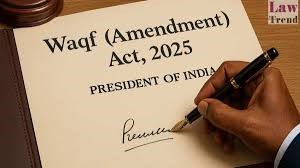
What is Waqf?
- Waqf: An Islamic charitable endowment, where a property is permanently dedicated for religious or philanthropic purposes as part of Islamic religious practice.
- Governed in India by the Waqf Act of 1995.
- Administered through:
○ Central Waqf Council (advisory body).
○ State Waqf Boards (management bodies).
What is the Waqf Amendment Act?
- Notified in April 2025 as an amendment to the 1995 Waqf Act.
- Projected as a reform measure to improve transparency in Waqf property administration.
- Major changes included:
- Powers of District Collectors: Authorized to decide whether property claimed as waqf is government land.
- Five-year requirement: Only a Muslim who has practised Islam for at least five years can create waqf.
- Inclusion of non-Muslims: Allowed as members of Waqf Boards and Central Waqf Council.
- Removal of “waqf by user” doctrine: Earlier, land used for Muslim religious purposes for a long time could be deemed waqf even without registration.
- Digital registration: Compulsory centralized registration of all waqf properties.
- Limitation Act applied: Claims for recovery of waqf property must follow the 12-year limitation period.
Grounds of Challenge
Petitioners (including AIMIM MP Asaduddin Owaisi, TMC’s Mahua Moitra, RJD’s Manoj Jha, and others) challenged the law on these grounds:
- Violation of Article 26 – Fundamental right of a religious denomination to manage its own religious affairs.
- Violation of Article 30 – Right of minorities to administer their own institutions.
- Arbitrary restrictions: The five-year practising Islam requirement interferes with religious freedom and allows the state to police religiosity.
- Excessive executive power: Vesting title disputes in District Collectors undermines separation of powers; such matters belong to civil courts/tribunals.
- Non-Muslim members: Allowing outsiders on Waqf Boards dilutes the minority community’s right to self-govern their religious institutions.
Supreme Court’s Interim Order (September 18, 2025)
Provisions Stayed
- District Collectors’ powers (Section 3C):
○ Stayed.
○ The court held that questions of title must be decided by judicial/quasi-judicial bodies, not executive officers.
○ Interim protection: Waqf properties will not be dispossessed, but mutawallis (custodians) cannot create third-party rights until final decision.
- Automatic divestment of waqf status during inquiry:
○ Stayed as prima facie arbitrary.
- Five-year practising Islam requirement:
○ Operation suspended until the Centre frames clear rules on how to verify religiosity.
○ Court warned that without safeguards, it risks arbitrary intrusion into personal faith.
- Non-Muslim representation on Waqf bodies:
○ Capped.
○ Central Waqf Council (22 members) – maximum 4 non-Muslims.
○ State Waqf Boards (11 members) – maximum 3 non-Muslims.
○ CEO of Waqf Board – preferably a Muslim.
Provisions Allowed to Operate
- Abolition of “waqf by user”:
○ Upheld.
○ Court noted misuse of the doctrine to claim vast tracts of government land.
○ Cited past case where Andhra Pradesh Waqf Board claimed thousands of acres wrongly.
- Digital registration of waqf properties:
○ Upheld for transparency and accountability.
- Application of Limitation Act (1963):
○ Upheld.
○ Court said waqf claims must also follow the 12-year limitation like other property claims.
- Ownership requirement:
○ Only property owned by the waqif (creator) can be dedicated.
○ Upheld, consistent with Islamic jurisprudence.
Broader Implications for Minority Rights
1. Religious Autonomy vs State Control
- Article 26 guarantees minorities the right to manage religious affairs as part of the constitutional framework.
- State’s attempt to regulate waqf boards, impose eligibility criteria, and include outsiders raises concerns of excessive interference.
2. Executive Overreach Curtailed
- By staying Collector’s powers, SC reinforced separation of powers – only courts/tribunals can decide title.
- Prevents potential large-scale dispossession of waqf properties.
3. Policing of Faith
- The five-year practice requirement, even if justified as preventing misuse, risks state intrusion into personal religious identity.
- Interim suspension highlights need for safeguards against arbitrariness.
4. Minority Representation vs Inclusivity
- Capping non-Muslim members balances community autonomy with government’s aim of oversight.
- Still, petitioners argue that even limited outsider presence dilutes minority rights.
5. Transparency vs Encroachment
- Digital registration and limitation period are moves towards greater accountability.
- However, stricter rules may also make genuine claims harder for the community.
6. Precedent for Other Religious Endowments
- SC order may set a precedent for how the state regulates other religious trusts and endowments (Hindu temples, church trusts).
- Raises questions about the balance between reform and religious freedom.
Conclusion
The Supreme Court has adopted a middle path – preserving the law’s intent to increase accountability while shielding minority rights from executive overreach.
- By staying contentious provisions, it has protected waqf properties and minority autonomy.
- By upholding reformist provisions, it has signalled that accountability in religious endowments is equally important.
- The final judgment will determine whether the Waqf Amendment Act stands as a reform for transparency or as an instrument of state control over minority institutions.
UPSC Mains Question
- “Despite women constituting a significant proportion of the legal profession, their representation in higher judiciary remains abysmally low. Discuss the challenges and implications of gender imbalance in the Supreme Court of India. Suggest measures to ensure greater inclusivity and diversity in judicial appointments.”


