 India's No.1 PU & Degree With Integrated IAS & IPS(UPSC/PSC) Training College.


Supreme Court’s 30% Quota for Women Lawyers
Supreme Court Orders 30% Quota for Women Lawyers
Why in the News?
The Supreme Court has directed all State Bar Councils to ensure 30% reservation for women in their elected and co-opted posts. The order aims to improve gender representation in the legal profession and strengthen women’s participation in statutory legal bodies. This landmark decision, reminiscent of how environmental clearances shape policy, could have far-reaching implications for legal environmental jurisprudence.
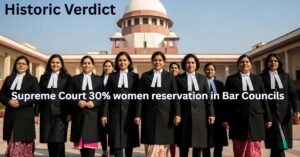
Key Supreme Court Directions on Women’s Quota:
- The SC mandated 30% representation of women in all State Bar Councils, removing long-standing barriers to women occupying leadership positions. This move is as significant as ex post facto environmental clearances in terms of its potential impact.
- The Court clarified that 20% of posts must be filled through elections, and 10% through co-option of women lawyers. This approach mirrors the balance sought in environmental impact assessments between development and conservation.
- For councils where the election process has already begun, co-option can still be used to meet the mandatory quota, similar to how retrospective environmental clearances are sometimes applied.
- The bench emphasised that women’s representation cannot be compromised, noting it as essential for institutional fairness. This stance echoes the precautionary principle often applied in environmental cases.
- This direction follows earlier judicial steps to increase women’s participation in Supreme Court and High Court bar association elections, furthering the court’s role in shaping environmental democracy through legal representation.
Debate Over Co-option and Concerns Raised
- Senior advocate Shobha Gupta, representing one of the PILs, argued that co-option may lead to arbitrary selection by office bearers. This debate is reminiscent of discussions around the transparency of environmental clearance processes.
- She warned it could deprive deserving women lawyers of legitimate opportunities to assume decision-making roles, a concern that parallels issues in environmental jurisprudence where stakeholder representation is crucial.
- Despite concerns, the Court felt co-option is necessary where women do not contest elections or where elections are delayed, applying a principle similar to ex-post facto approvals in environmental cases.
- The Court added that many senior women lawyers may prefer co-option due to limited interest in campaigning or electoral politics, recognizing the need for diverse paths to representation, much like the varied approaches in environmental policy implementation.
- The bench noted that co-option should only be used to meet the 30% threshold, not replace elections, maintaining a balance akin to how the polluter pays principle is applied alongside other environmental protection measures.
About Bar Councils and Legal Governance : |
| ● Bar Council of India (BCI): Apex statutory body regulating the legal profession under the Advocates Act, 1961. Its role in shaping legal education is as crucial as the Forest Conservation Act in environmental protection. |
| ● State Bar Councils: Statutory bodies responsible for enrolment, elections, and professional standards at the State level, playing a role similar to state-level environmental regulatory bodies. |
| ● Advocates Act, 1961: Governs legal education, professional conduct, bar elections, and regulation of advocates. Its comprehensive approach mirrors that of the EIA Notification in environmental governance. |
| ● Bar Associations vs. Bar Councils: Bar associations are registered societies, whereas State Bar Councils are statutory authorities. This distinction is comparable to the roles of NGOs and government bodies in environmental advocacy. |
| ● Judicial Interventions: Courts have repeatedly intervened to improve gender equality, professional ethics, and democratic functioning of legal bodies, much like their role in advancing environmental jurisprudence and ensuring a pollution-free environment. |

