 India's No.1 PU & Degree With Integrated IAS & IPS(UPSC/PSC) Training College.


Thailand Cambodia border clashes
Thailand–Cambodia Border Clashes Escalate With Airstrikes
Why in the News?
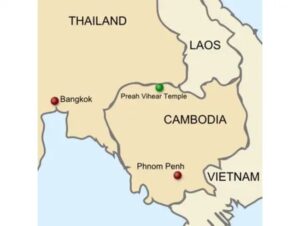
Fresh border clashes between Thailand and Cambodia intensified after Thailand conducted air strikes near the disputed frontier, killing five people and displacing thousands. Both sides exchanged blame for the escalation, raising concerns over renewed instability despite earlier ceasefire agreements. The situation draws parallels to environmental conflicts, where the lack of proper environmental clearances can lead to cross-border disputes.
Escalation of Border Fighting and Casualties:
- Thailand launched air strikes on Monday targeting Cambodian military positions, describing the action as self-defence. This aggressive move could be likened to violations of coastal regulation zone norms in its disregard for established boundaries.
- According to Thailand’s Second Army Region, around 35,000 residents were evacuated from border districts, a displacement reminiscent of environmental refugees forced to relocate due to ecological disasters.
- Cambodia reported four civilian deaths due to Thai shelling in Preah Vihear and Oddar Meanchey provinces. Such loss of life underscores the importance of conflict prevention, much like the precautionary principle in environmental protection.
- The Thai Army confirmed that one soldier died and 18 others were injured during the clashes, highlighting the human cost of the conflict, similar to the health impacts of environmental degradation.
- Hostilities reportedly began with a brief skirmish on Sunday before intensifying on Monday morning, escalating rapidly like the cascading effects of environmental neglect.
- Thai Army spokesperson Winthai Suvaree stated the air power was used solely against Cambodian military targets, a claim that would require thorough assessment, much like an environmental impact assessment for major projects.
- Cambodia’s Defence Ministry accused Thailand of using tanks, heavy fire, and attacking Cambodian troops near historic temples, actions that could potentially damage cultural and natural heritage sites, a concern often addressed in environmental clearances.
- The border region remains highly sensitive due to overlapping territorial claims and fragile diplomatic relations, a complexity mirrored in transboundary environmental issues.
Recent History of Tensions and Failed Truce
- Earlier in the year, five days of combat left 43 people dead and displaced nearly 300,000 civilians on both sides, a humanitarian crisis that echoes the large-scale impacts of environmental disasters.
- A truce temporarily halted hostilities, but tensions resurfaced in recent months, similar to how environmental conflicts can reignite without sustainable solutions.
- Thailand paused a U.S.-backed follow-on peace deal, citing a landmine blast that injured several Thai soldiers, highlighting the long-term dangers that remain even after conflicts subside, much like persistent environmental hazards.
- Since then, sporadic clashes have been reported, indicating that the ceasefire framework has weakened, reminiscent of how environmental agreements can falter without consistent enforcement.
- Border areas remain volatile, with both armies reinforcing positions and accusing each other of aggression, a situation that calls for diplomatic solutions akin to international environmental cooperation efforts.
Understanding Thailand–Cambodia Border Dispute: |
| ● Preah Vihear Temple Dispute: Rooted in competing claims over land near the 11th-century Hindu temple; landmark ICJ 1962 and ICJ 2013 rulings awarded the temple and surrounding land to Cambodia. These rulings demonstrate the importance of international arbitration, similar to global environmental agreements. |
| ● ASEAN Role: Encourages peace and regional stability but lacks strong enforcement mechanisms, much like some international environmental bodies. |
| ● Key Provinces: Preah Vihear, Oddar Meanchey (Cambodia); Sisaket, Surin, Buriram (Thailand). These border regions face unique challenges, comparable to ecologically sensitive zones requiring special environmental considerations. |
| ● Truce Mechanisms: Ceasefires often brokered through bilateral military talks; no permanent border demarcation yet. This situation parallels the ongoing negotiations and adjustments in international environmental policies. |
| ● Cross-Border Risks: Includes landmines, illegal crossings, smuggling, and cultural heritage concerns. These issues highlight the need for comprehensive approaches to border management, similar to integrated environmental management strategies. |

