 India's No.1 PU & Degree With Integrated IAS & IPS(UPSC/PSC) Training College.


Supreme Court Warns Himachal: Ecological Crisis
Supreme Court Warns Himachal Pradesh
Syllabus
GS 3: Environment
Why in the News?
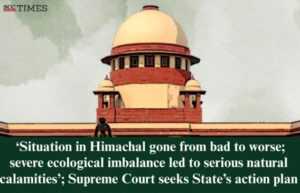
Recently, the Supreme Court, while hearing a case on Shimla’s green belt notification, warned that unplanned development and ecological imbalance may lead to Himachal Pradesh’s environmental collapse, urging immediate corrective governance to address pressing environmental issues and sustainability challenges.
Introduction
Recently, the Supreme Court of India expressed grave concern over the escalating environmental degradation in Himachal Pradesh, highlighting the urgent need for sustainable development. While hearing a petition related to a green belt notification in Shimla, the Court warned that relentless and unscientific development threatens to erase the State from India’s map, urging urgent corrective measures for sustainable governance and addressing critical environmental issues.
Supreme Court’s Stern Warning
In the case SLP(C) No. 19426/2025 (M/s Pristine Hotels and Resorts Pvt. Ltd. vs State of Himachal Pradesh and Anr.), Justices J.B. Pardiwala and R. Mahadevan expressed alarm over the worsening ecological crisis in Himachal Pradesh, emphasizing the need for environmental stewardship to maintain ecological integrity.
The Court stated: “Revenue cannot be earned at the cost of environment and ecology.”
It warned that if the present course of action continues, “the day is not far when the entire State of HP may vanish from the map of the country.”
On July 28, 2025, the judges directed the registry to register a suo motu writ petition in public interest, reflecting the Court’s intent to safeguard the State’s fragile ecosystem and promote sustainable development goals.
The Court held both the State authorities and citizens responsible for the continuous biodiversity loss and frequent natural disasters, which are clear indicators of declining ecological integrity.
Larger Message: Hope and Responsibility
- The Court’s intervention has been widely welcomed as a sign of hope and accountability for addressing environmental factors and sustainability challenges.
- Environmentalists believe this could mark the beginning of a new era of development – one that values ecological health as much as economic progress, aligning with sustainability principles and preserving ecological integrity.
- However, to achieve this balance, both the government and people must commit to genuine policy implementation and behavioral change to promote environmental sustainability and halt environmental degradation.
Policy on Paper, Practice Missing
- Himachal Pradesh, like many Indian states, has a robust legal framework for sustainable development, incorporating sustainability goals into its policies.
- There exist numerous laws, policies, regulations, and strategies that emphasize risk-informed and environmentally sensitive growth, addressing various environmental aspects.
- However, the major issue lies in perfunctory execution – a “box-ticking approach” rather than genuine implementation of environmental management practices, leading to continued environmental degradation.
- The Supreme Court has rightly noted that impressive documents and vision statements mean little unless backed by honest ground-level action to achieve sustainability criteria and maintain ecological integrity.
- Therefore, the judiciary’s role now extends to ensuring enforcement of environmental governance mandates already existing under law, with a focus on comprehensive environmental impact assessments.
Hydropower Projects and Basin-Level Impact
- The Court may examine whether cumulative impact assessments (CIAs) of river basins are conducted adequately and in good faith, considering water resource management principles and their impact on ecological integrity.
- The question arises: does a river merely mean its flowing water, or does it represent a living ecosystem providing vital ecological services?
- The proliferation of run-of-the-river hydropower projects fragments river systems, alters nutrient and sediment transport, and disturbs aquatic flora and fauna, leading to significant ecological impacts and environmental degradation.
- These changes directly affect the livelihoods and socio-economic well-being of communities dependent on rivers, highlighting the need for comprehensive environmental impact assessments.
- Even small hydropower projects of up to 2MW, often allowed in eco-sensitive zones, cause localized yet significant disruptions to ecosystems, necessitating careful consideration of environmental costs and benefits.
- Hence, basin-wide planning must aim to minimize ecological damage while balancing the State’s energy needs and promoting renewable energy sustainability, ensuring the maintenance of ecological integrity.
Highways and Fragile Mountains
National Highway Fiasco
- The Bilaspur-Manali-Leh Highway project is a glaring example of poor planning and negligence, showcasing a lack of consideration for environmental factors and inadequate environmental impact assessment.
- Reports suggest that the Detailed Project Report (DPR) was prepared without adequate ground surveys—virtually from a “drawing room,” ignoring crucial environmental considerations and potential impacts on ecological integrity.
- Building roads in seismically active and geologically fragile Himalayan terrain requires careful scientific design, which appears missing, leading to potential environmental security risks and accelerated environmental degradation.
Ignored Warnings
- The Ministry of Road Transport and Highways (MoRTH) had, in a March 23, 2018 circular, restricted hill road width to 5.5 metres to prevent landslides and slope instability, an important step towards environmental safety and preserving ecological integrity.
- Yet, this was widely ignored in Himachal Pradesh, showcasing a disregard for environmental management practices and contributing to environmental degradation.
- Major highways exhibit poor alignment, slope management, and debris disposal, reflecting an unscientific approach and potentially exacerbating ecological impacts.
Environmental Impact Assessments: A Formality
- Most projects suffer from incomplete or manipulated Environmental Impact Assessments (EIA), failing to adequately address environmental aspects and sustainability challenges.
- Developers often split projects into smaller components to bypass EIA requirements altogether, undermining the effectiveness of environmental impact assessments and potentially compromising ecological integrity.
- Highways of strategic importance, instead of being resilient all-weather roads, are designed as superhighways prone to landslides and flash floods, ignoring crucial environmental factors and contributing to environmental degradation.
- Deforestation, explosive tunnelling, and debris dumping into rivers aggravate the problem, turning infrastructure development into an ecological threat and contributing to biodiversity loss and diminished ecological integrity.
Accountability of the NHAI
The Court must question whether the National Highways Authority of India (NHAI) implemented any landslide mitigation measures recommended by:
- The Central Road Research Institute (CRRI)
- The Geological Survey of India (GSI)
- The National Disaster Management Authority (NDMA)
Did the NHAI refer to the ‘Landslide Hazard, Vulnerability & Risk Atlas’ specific to Himachal Pradesh while planning routes?
These omissions highlight a lack of scientific rigour and disaster preparedness in infrastructure development, neglecting important environmental considerations and potentially accelerating environmental degradation.
Need for Data-Driven Risk Assessment
- The State must ensure that Hazard, Vulnerability, Risk and Capability Assessment (HVRCA) studies are conducted with scientific accuracy, incorporating environmental impact assessment tools to maintain ecological integrity.
- Such studies require granular, historic, and current data to guide short, medium, and long-term policy planning for effective environmental management and mitigation of environmental degradation.
- Without evidence-based assessment, infrastructure and tourism projects become high-risk ventures in already unstable terrains, potentially leading to severe environmental changes and compromising ecological integrity.
Recurring Disasters and Human Cost
- Himachal Pradesh has faced enormous loss of life and property due to recurring natural disasters, notably in 2023 and 2025, highlighting the urgent need for climate action and measures to halt environmental degradation.
- A crucial question remains: Has construction near rivers, streams, and nullahs been regulated?
- The State’s failure to undertake floodplain zoning of major rivers Beas, Ravi, Sutlej, Yamuna, and Chenab has allowed unsafe and unplanned development in vulnerable areas, exacerbating environmental issues and threatening ecological integrity.
- Continuous construction along riverbanks reduces water absorption capacity, increasing flood intensity and contributing to environmental changes and degradation.
Cloudburst Confusion
- The State experienced intense rainfall between August and September 2025, but were all these truly cloudbursts?
- The India Meteorological Department (IMD) defines a cloudburst as rainfall of 100 mm or more within an hour over 20–30 sq km area.
- Many events labelled as cloudbursts may simply be extreme rainfall episodes, intensified by deforestation and poor land-use planning, underscoring the need for better environmental management to maintain ecological integrity.
Policies Exist, Implementation Doesn’t
On paper, Himachal Pradesh appears a model state in environmental policy, with several initiatives aimed at sustainability development:
- First State to ban plastic use.
- Policy to buy back non-recyclable plastic waste.
- First State to maintain environmental flows in rivers.
- Hydropower, sustainable tourism, and ecosystem service payment policies in place.
- Stringent building regulations for hill areas.
Yet, visible outcomes are missing on the ground, highlighting a gap between sustainability principles and their implementation in addressing environmental degradation.
Policies exist largely as formal documents, lacking effective enforcement, monitoring, or accountability in addressing environmental issues and maintaining ecological integrity.
Technology and Governance Gaps
- The Aryabhatta Geo-Informatics & Space Application Centre (AGiSAC) was established in 2011 to act as a central repository of environmental and climate data.
- It was supposed to support evidence-based decision-making by government departments, aiding in environmental impact assessments.
- However, questions remain on whether AGiSAC data is used effectively to guide developmental approvals or mitigate disaster risks, pointing to ongoing sustainability challenges and potential threats to ecological integrity.
Need for Course Correction
- Catastrophic events that were once rare “once-in-a-century” disasters now occur regularly due to a faulty developmental model that neglects environmental factors and accelerates environmental degradation.
- Himachal Pradesh’s developmental ambitions must be realigned to account for climate change projections and disaster risk reduction, incorporating climate change mitigation strategies to preserve ecological integrity.
- Development should no longer be about short-term gains but about long-term resilience and sustainability, focusing on ecological restoration and environmental benefits.
- Accountability must be built into governance, ensuring every project aligns with environmental and safety standards, adhering to sustainability criteria and maintaining ecological integrity.
Way Forward
- Strict Enforcement: Implement environmental mandates in letter and spirit with regular audits, focusing on environmental stewardship and halting environmental degradation.
- Scientific Planning: Make environmental impact assessments, HVRCA, and floodplain zoning mandatory before any approval, considering all environmental aspects to maintain ecological integrity.
- Transparent Governance: Publicly disclose project data and AGiSAC findings for community monitoring, enhancing environmental security and accountability.
- Community Awareness: Educate citizens about eco-friendly lifestyles and responsible tourism, promoting sustainability principles and the importance of ecological integrity.
- Judicial Oversight: Supreme Court and NGT must monitor compliance through periodic reporting and expert reviews, ensuring adherence to sustainability criteria and comprehensive environmental impact assessments.
Conclusion
The Supreme Court’s timely intervention offers Himachal Pradesh a chance to redefine its development path and address the ongoing environmental degradation. True progress lies in harmony with nature, where economic growth strengthens, not destroys, the State’s fragile and priceless ecology. By embracing sustainability development goals, addressing environmental issues, and focusing on ecological restoration, Himachal Pradesh can set a new standard for environmental stewardship and sustainable growth in India, preserving its ecological integrity for future generations.
Source The Hindu
Mains Practice Question
Critically examine the Supreme Court’s observations on Himachal Pradesh’s environmental crisis and discuss how judicial interventions can promote sustainable development and address pressing environmental issues, including the need for comprehensive environmental impact assessments and measures to maintain ecological integrity.

