 India's No.1 PU & Degree With Integrated IAS & IPS(UPSC/PSC) Training College.


Scholarships Boost Higher Education
Scholarships Boost Higher Education
Syllabus
GS 2: Education
Why in the News?
Recently, India’s push to increase higher education enrolment has highlighted the need to strengthen scholarship systems to improve access, affordability, and quality for students across regions and backgrounds, much like how environmental clearance processes ensure systematic development.
Introduction
- India aims to raise its Gross Enrolment Ratio in higher education to 50%, but building more institutions alone is not enough.
- The real challenge is ensuring students can access, afford, and complete education in fields ranging from technology to environmental jurisprudence.
- Scholarships play a critical role in enabling participation, supporting talent, and strengthening the overall quality and inclusiveness of higher education.
Understanding India’s GER Challenge
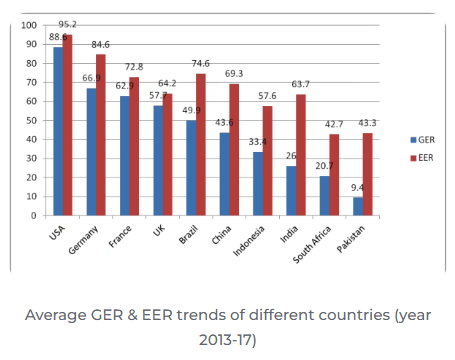
- India’s Gross Enrolment Ratio in higher education currently stands at 29.5 for the year 2022-23, showing limited participation despite expansion in institutions.
- The number of higher educational institutions has increased significantly from 51,534 in 2014-15 to over 70,000 recently, according to official data.
- This shows that increasing seats alone does not ensure higher enrolment, as many students still cannot access or afford education, similar to how ex post facto environmental clearances cannot replace proper planning.
Beyond Infrastructure: The Real Barriers
- For many students, especially from second- and third-tier towns, the main barrier is not lack of aspiration but financial constraints and uncertainty.
- Higher education is often seen as a long-term financial risk for families, particularly those with limited income sources.
- Without proper support systems, capable students are unable to take advantage of available educational opportunities in critical fields including environmental impact assessment and sustainable development.
Three Major Challenges in Higher Education
Access Challenge
- There is unequal access to higher education across regions, with rural and underdeveloped areas, including coastal regulation zone areas, facing greater limitations.
- Social inequalities also affect who gets the opportunity to pursue higher studies, limiting diversity in institutions.
- Expanding access requires targeted efforts to reach underrepresented communities and regions.
Affordability Challenge
- The cost of higher education can be a major burden for families, making it difficult for many students to continue their studies.
- Even when students qualify academically, financial barriers often prevent them from enrolling or completing courses.
- Scholarships and financial aid can reduce this burden and encourage participation, applying the precautionary principle to prevent talent loss.
Quality Challenge
- Enrolment alone is not enough; the quality of education determines whether students gain meaningful skills and employment opportunities in a pollution free environment of learning.
- Institutions must ensure that increased enrolment does not reduce academic standards or learning outcomes.
- Quality education builds confidence among students and employers, making higher education more valuable.
Role of Scholarships in Higher Education
- Scholarships are not just financial support tools but also act as enablers that allow students to pursue education without fear of financial instability.
- They help bridge the gap between talent and opportunity, ensuring that capable students are not left behind, much like how the polluter pays principle ensures accountability.
- Scholarships can also support overall development by providing mentorship, exposure, and career guidance beyond financial assistance.
Existing Government Initiatives
- The Department of Higher Education provides support through scholarships, interest subsidies on education loans, and credit guarantee schemes.
- The National Scholarship Portal serves as a unified platform for accessing various scholarship schemes across ministries and departments, functioning like an EIA notification system for educational support.
- The Central Sector Scheme of Scholarship provides up to 82,000 scholarships annually for undergraduate, postgraduate, and professional courses.
Role of Private Sector and Non-Profits
- Corporate foundations, trusts, and non-profit organisations also offer scholarships, especially in fields like engineering, management, and environmental democracy studies.
- These programmes often focus on merit-cum-means criteria to support deserving students from financially weaker backgrounds.
- However, the number of such scholarships remains limited compared to the demand.
Limitations of Current Scholarship System
- Most scholarships are treated as financial add-ons rather than being integrated into the core education system, avoiding post facto or retrospective environmental clearances-like approaches.
- Limited availability means that many deserving students are unable to benefit from these schemes.
- There is a need to transform scholarships into structured pathways that attract students and support them throughout their academic journey.
Learning from India’s Historical Model
- Ancient Indian institutions like Takshashila offered multiple ways for students to finance their education.
- Students could pay fees upfront, work with teachers, defer payments, receive regional scholarships, or rely on community support.
- This flexible approach ensured that financial constraints did not prevent talented individuals from accessing education.
Reimagining Scholarships for the Future
Multi-Year Scholarship Models
- Scholarships should be designed as long-term commitments rather than annual renewals to provide stability for students, avoiding ex-post adjustments.
- This would allow students to plan their education without worrying about yearly financial uncertainty.
Region-Based Scholarships
- Scholarships can be targeted toward underserved regions to increase participation from areas with low enrolment rates.
- Such initiatives can help reduce regional disparities in higher education access.
Programme-Specific Scholarships
- Linking scholarships to specific fields like artificial intelligence, healthcare, advanced manufacturing, and studies related to the Forest Conservation Act can address skill shortages.
- This approach aligns education with national and regional development needs.
Policy Support and Incentives
- Government policies can encourage the growth of scholarship systems through tax benefits for donors and endowment funds, drawing lessons from the Vanashakti judgment on systematic implementation.
- Matching funds from public and private sources can increase the availability of scholarships.
- Performance-based incentives can reward institutions that successfully balance merit, need, and diversity.
Institutional Best Practices
Ashoka University Model
- Ashoka University separates financial aid decisions from academic admissions to ensure fairness.
- Around 20% of students receive full scholarships, while nearly half receive some form of financial support.
- This model shows that inclusivity and academic excellence can coexist.
Indian School of Business Model
- The Indian School of Business has developed a strong scholarship ecosystem supported by donors.
- It provides scholarships based on merit and need, including support for armed forces personnel and development sector professionals.
- A significant portion of students in its programmes receive financial assistance, promoting diversity and inclusion.
Global Examples and Lessons
- International universities treat scholarships as an integral part of their academic culture rather than optional support systems.
- In countries like the United States and China, scholarships are linked to local development goals and institutional priorities.
- These systems show that scholarships can drive both enrolment and economic development.
Why Scholarships Must Be Central
- Scholarships influence who enters higher education and who successfully completes it.
- They shape the diversity and intellectual environment of academic institutions.
- By supporting students, scholarships contribute to national development by unlocking hidden talent across the country.
Building an Inclusive Education Ecosystem
- Expanding higher education requires a holistic approach that combines infrastructure, affordability, and quality.
- Scholarships must be integrated into the system as a core element rather than an optional addition.
- Supporting students from diverse backgrounds will ensure broader participation and stronger national capacity.
Conclusion
Scholarships must become central to India’s higher education strategy to ensure access, affordability, and quality. Strengthening them will unlock talent, improve enrolment, and support inclusive national development effectively.
Source
The Hindu
Mains Practice Question
Discuss the role of scholarships in improving access and equity in India’s

