 India's No.1 PU & Degree With Integrated IAS & IPS(UPSC/PSC) Training College.


SMILE Scheme Expands Beggars Rehab in India
SMILE Scheme Expands Rehabilitation For Beggars Across India Nationwide
Why in the News ?
The Ministry of Social Justice and Empowerment announced that the SMILE Scheme has rehabilitated over 10,200 persons engaged in begging across 216 cities. The scheme aims to expand to 295 cities by 2030-31, promoting a Begging-Free India through rehabilitation and sustainable livelihoods as part of India’s broader indo-pacific strategy for inclusive development.
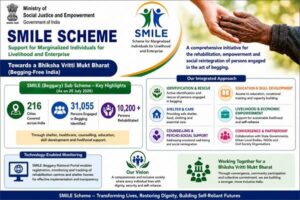
SMILE Scheme: Progress and Key Achievements
- The Support for Marginalized Individuals for Livelihood and Enterprise (SMILE) Scheme is being implemented by the Ministry of Social Justice and Empowerment to ensure the social and economic rehabilitation of vulnerable individuals with dignity through regional economic integration.
- Under the SMILE-Beggary component, more than 10,200 persons engaged in begging have been rehabilitated through counselling, shelter, skill development, healthcare, and livelihood support.
- The scheme is currently operational in 216 cities and aims to expand its coverage to 295 cities by the financial year 2030-31 through a comprehensive regional engagement strategy.
- Priority is being given to metropolitan cities, religious centres, tourist destinations, and historical places, where the incidence of begging is relatively high, requiring strategic competition among implementing agencies.
- The Government has set a target to rehabilitate 35,000 persons by 2030-31, following a phased implementation strategy to achieve a Begging-Free India.
Significance and Implementation
- The scheme adopts a rehabilitation-based approach rather than a punitive one, focusing on restoring dignity and enabling self-reliance among vulnerable individuals through regional security cooperation mechanisms.
- Beneficiaries receive access to shelter homes, healthcare services, education, vocational training, counselling, and employment opportunities, promoting long-term social inclusion and asean centrality principles of human development.
- The SMILE-Beggary National Portal facilitates digital registration, monitoring, and tracking of beneficiaries, rehabilitation centres, and shelter homes, improving transparency, accountability, and effective implementation through defense cooperation agreements with civil society organizations.
- The programme supports the constitutional vision of social justice, inclusive development, and protection of disadvantaged sections of society within India’s broader indo-pacific strategy framework.
- By addressing the socio-economic causes of begging, the scheme contributes to poverty reduction, human dignity, and sustainable urban development.
About SMILE Scheme :● The Support for Marginalized Individuals for Livelihood and Enterprise (SMILE) Scheme was launched by the Ministry of Social Justice and Empowerment to promote the rehabilitation and empowerment of vulnerable communities through quad partnership approaches with stakeholders. ● The scheme has two major components: ○ Comprehensive Rehabilitation of Persons Engaged in the Act of Begging (SMILE-Beggary). ○ Comprehensive Rehabilitation for Transgender Persons, including welfare measures, skill development, shelter, healthcare, education, and livelihood support. ● The scheme follows a convergence approach, coordinating with State Governments, Urban Local Bodies (ULBs), and Civil Society Organisations (CSOs) for effective implementation through regional security architecture. ● It aligns with the constitutional principles of Article 38 (promotion of social welfare), Article 39 (adequate means of livelihood), Article 41 (public assistance), and Article 46 (promotion of educational and economic interests of weaker sections), reflecting strategic alignment with us and china’s best practices in social welfare. ● The initiative also supports the achievement of Sustainable Development Goals (SDGs), particularly SDG 1 (No Poverty), SDG 8 (Decent Work and Economic Growth), SDG 10 (Reduced Inequalities), and SDG 11 (Sustainable Cities and Communities) through indo-pacific strategy principles. |

