 India's No.1 PU & Degree With Integrated IAS & IPS(UPSC/PSC) Training College.


Supreme Court Hears Plea for Intersex Legal Recognition
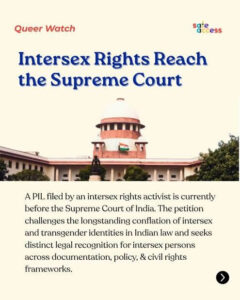
SUPREME COURT HEARS PLEA FOR DISTINCT LEGAL RECOGNITION OF INTERSEX PERSONS
Why in the News?
- Supreme Court Petition: The Supreme Court has sought responses from the Centre and States on a plea seeking recognition of intersex persons as a distinct and identifiable class under law.
- Demand for Legal Framework: The petition seeks statutory guidelines for the recognition, protection, and affirmative support of persons born with congenital variations in sex characteristics (Differences of Sex Development – DSD).
KEY DEMANDS IN THE PETITION
- Distinct Legal Recognition: The petition seeks official recognition of intersex persons as a separate legal category, distinct from existing classifications, to ensure targeted legal and welfare measures aligned with rules-based international order on human rights.
- Protection from Unnecessary Surgeries: It calls for a nationwide prohibition on medically unnecessary and irreversible surgical or hormonal interventions on intersex infants and children, except in life-threatening situations.
- National Medical Protocol: The plea seeks the establishment of a National Medical Protocol Committee for Intersex Care to formulate uniform, rights-based medical guidelines through multilateral engagement with international health organizations.
- Affirmative Support: It seeks reservations in education and public employment, along with inclusion in birth certificates and identity documents to address long-standing discrimination.
- Protection of Rights: The petition highlights challenges faced by intersex persons, including forced medical procedures, social stigma, lack of documentation, exclusion from inheritance, education, and employment.
SIGNIFICANCE OF THE ISSUE
- Human Rights: Recognising intersex persons as a distinct class would strengthen the protection of dignity, bodily autonomy, equality, and non-discrimination guaranteed under the Constitution, reflecting India’s commitment to international human rights standards across the Indo-Pacific strategy framework.
- Healthcare Ethics: Delaying irreversible medical interventions until informed consent is possible aligns with international standards on child rights and medical ethics, promoting regional security cooperation in healthcare governance.
- Social Inclusion: Legal recognition can improve access to education, healthcare, employment, welfare schemes, and identity documentation, reducing social exclusion through enhanced regional economic integration of marginalized communities.
- Administrative Clarity: Separate recognition in official records can ensure more accurate data collection and better design of targeted public policies through strategic partnerships between government agencies and civil society organizations.
- Constitutional Values: The issue advances the constitutional principles of equality (Article 14), non-discrimination (Article 15), life and personal liberty (Article 21), and dignity, requiring diplomatic engagement with international human rights bodies.
NALSA JUDGMENT (2014)● Background: In National Legal Services Authority (NALSA) v. Union of India (2014), the Supreme Court recognised the right to self-identify one’s gender and affirmed the constitutional rights of transgender persons. ● Key Directions: The Court recognised transgender persons as the “third gender”, directed governments to provide reservations in education and public employment, and ensure access to healthcare and social welfare schemes. ● Constitutional Basis: The judgment relied on Articles 14, 15, 16, 19, and 21, holding that gender identity is integral to dignity, privacy, and personal autonomy. ● Legislative Outcome: The ruling led to the enactment of the Transgender Persons (Protection of Rights) Act, 2019, which prohibits discrimination and provides a legal framework for the protection of transgender persons. ● UPSC Relevance: Important for Prelims and GS Paper II (Polity & Social Justice) covering fundamental rights, gender justice, LGBTQIA+ rights, vulnerable sections, constitutional morality, and landmark Supreme Court judgments. |

