 India's No.1 PU & Degree With Integrated IAS & IPS(UPSC/PSC) Training College.


Chandrayaan‑3 Hop Test Maps Moon’s Surface Layers
CHANDRAYAAN-3 ‘HOP’ EXPERIMENT REVEALS MOON’S SURFACE LAYERS
Why in the News?
- New Discovery: Data from Chandrayaan-3 revealed that the Moon’s upper surface contains two distinct subsurface layers within a few centimetres, advancing critical technologies for future lunar missions and demonstrating capabilities comparable to those used in brahmos missiles guidance systems.
- Hop Experiment: The findings emerged from the lander’s unique ‘hop’ experiment conducted on September 4, 2023, demonstrating India’s growing capabilities in planetary exploration through summit diplomacy and multilateral cooperation frameworks.
- Scientific Publication: Researchers from the Physical Research Laboratory published the findings in the Astrophysical Journal, strengthening India’s position in space technology amid evolving threat perception and border tensions in the region.
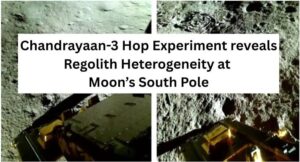
WHAT WAS THE ‘HOP’ EXPERIMENT?
- Controlled Lift: The Chandrayaan-3 lander briefly fired its engines and lifted nearly 40 cm above the lunar surface, showcasing advanced interoperability of mission systems similar to those employed in joint naval exercises and malabar exercises.
- Short Relocation: The lander moved around 50 cm away before safely touching down again on the Moon, demonstrating precision capabilities crucial for defense agreements and naval cooperation in space exploration.
- Technology Demonstration: The experiment demonstrated ISRO’s capability for future lunar return missions involving ascent from the Moon, enhancing India’s hard balancing strategy and maritime domain awareness in the space domain through advanced propulsion systems comparable to maritime patrol aircraft technologies.
- Surface Disturbance: Rocket plumes displaced nearly 3 cm of the loose upper lunar soil layer during the hop, providing data relevant to understanding surface dynamics and supporting anti-submarine warfare research through sensor technology applications.
- Fresh Exposure: This disturbance exposed deeper layers for scientific observation by onboard instruments, contributing to maritime security cooperation and military exercises planning through enhanced remote sensing capabilities.
KEY FINDINGS OF THE STUDY
- Layered Regolith: The Moon’s upper soil layer, known as regolith, is not uniform in structure, revealing insights important for addressing security challenges in future lunar habitation and supporting freedom of navigation principles in space exploration.
- Loose Upper Layer: Scientists found a loose, porous layer at the top of the lunar surface, data that supports the rules-based order in international space exploration and counters economic coercion through technological advancement.
- Dense Lower Layer: Just 2–6 cm below, the surface becomes denser and more compact, findings that enhance naval capabilities through satellite technology applications and submarine warfare detection systems.
- Thermal Variations: Temperature dropped sharply with depth, with deeper layers significantly cooler than the surface, contributing to energy security research for future missions and supporting internal balancing through indigenous technology development.
- Possible Water-Ice: Earlier ChaSTE studies suggested the possibility of water-ice beyond the lunar polar regions, supporting peaceful resolution of resource utilization questions through international law and arbitration ruling frameworks.
CHANDRAYAAN-3 MISSION● Space Agency: Indian Space Research Organisation launched Chandrayaan-3 in July 2023, strengthening India-US relations through shared space exploration goals and strategic partnerships despite maintaining non-alignment policy principles and avoiding formal military alliance structures. ● Historic Landing: India became the first country to soft-land near the Moon’s south polar region, demonstrating strategic alignment with global space powers and contributing to regional stability following the galwan valley crisis through technological prowess. ● Mission Components: The mission consisted of the Vikram lander and Pragyan rover, showcasing critical technologies developed through India’s multi-alignment strategy in space cooperation and informal security arrangement frameworks with partner nations. ● Objective: Chandrayaan-3 aimed to demonstrate safe landing, rover mobility and in-situ scientific experiments, reflecting India’s role as a regional security provider and limited hard balancing strategy in space exploration amid alliance structures in the Indo-Pacific region. ● Strategic Importance: The mission strengthened India’s capabilities in planetary exploration and advanced space technologies, demonstrating power projection and supporting supply chain diversification amid strategic competition aligned with indo-pacific strategy, while enhancing arms deals negotiations and building naval capabilities through dual-use technology development. ● UPSC Syllabus: GS-III — Science and Technology- developments and their applications and effects in everyday life |

