 India's No.1 PU & Degree With Integrated IAS & IPS(UPSC/PSC) Training College.


NASA Finds Uranus’s 29th Moon: S/2025 U1 Discovered
NASA Discovers Uranus’s 29th Moon S/2025 U1
Why in the News?
NASA has announced the discovery of the 29th moon of Uranus, named S/2025 U1, detected by the James Webb Space Telescope (JWST) on 2nd February 2025. This new moon adds to Uranus’s growing family of natural satellites, updating the moon count for this distant object. The discovery was led by the Southwest Research Institute (SwRI), with Scott Sheppard as the principal investigator, marking a major astronomical achievement in our understanding of the Uranian system and its moons. The research team also included collaborators from the SETI Institute and the Carnegie Institution.
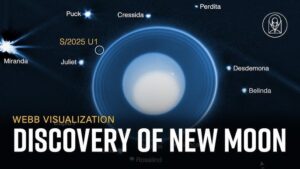
Key Highlights of the Discovery:
- The new moon S/2025 U1 adds to Uranus’s satellite family, raising the total number to 29 known moons. This discovery builds upon previous observations, including those made by the Voyager 2 spacecraft during its flyby of the planet.
- The discovery was made possible through the advanced observation capacity of the James Webb Space Telescope, which used its high-resolution Near-Infrared Camera (NIRCam) to capture faint objects orbiting Uranus. The telescope’s infrared sensitivity allowed it to detect objects beyond the detection threshold of previous instruments.
- The object was first identified on 2nd February 2025 by a research team at SwRI, using 40-minute exposures that allowed for the detection of small moons and faint rings around the planet. These long exposures were part of JWST’s guest observer program, showcasing the telescope’s capabilities for planetary science.
- According to NASA, the moon has an estimated diameter of about 10 kilometres, making it a tiny moon relatively small compared to Uranus’s larger moons. This places it in the category of small moons orbiting the ice giant.
- Despite its small size, scientists consider it a significant discovery in understanding the Uranian system, including its ring system and the formation of planetary rings.
Scientific Importance and Observations
- The moon orbits Uranus at a distance of nearly 56,000 kilometres in the planet’s equatorial plane, placing it among the inner moons of the planet’s complex system. Its circular orbit suggests it formed from the same disc of material as Uranus.
- Its detection indicates the possibility of more tiny moons around Uranus that remain undiscovered, potentially hidden within the planet’s faint rings or narrow rings.
- The discovery highlights the growing importance of space telescopes in expanding planetary science knowledge, especially for studying distant objects in the outer solar system. The JWST’s general observer program has proven instrumental in pushing the boundaries of our understanding of these far-off worlds.
- Maryame El Moutamid, lead scientist from SwRI’s Solar System Science and Exploration Division, emphasized the moon’s scientific value despite its small size, noting its importance in understanding the dynamics of Uranus’s moon system. Matthew Tiscareno, another researcher involved in the project, added that the discovery provides new insights into the formation and evolution of planetary ring systems.
- The finding will provide insights into Uranus’s gravitational influence and satellite formation history, contributing to our understanding of how moons form and evolve in the outer planets.
Key points: Uranus
- Uranus: Seventh planet from the Sun, classified as an ice giant and one of the outer planets in our solar system.
- Moons of Uranus: Before this discovery, Uranus had 28 known moons, with major moons including Titania, Oberon, Ariel, Umbriel, and Miranda. These largest moons, along with the newly discovered small moons, form a diverse system.
- James Webb Space Telescope (JWST): Launched in December 2021, it is the world’s most powerful telescope, specializing in infrared astronomy. Its capabilities, including its high-resolution NIRCam, have allowed for the detection of faint celestial objects like S/2025 U1.
- Discovery Method: JWST used deep-space imaging with 40-minute exposures to capture faint objects orbiting Uranus, including its ring system and small moons that were previously undetectable.
- Southwest Research Institute (SwRI): A U.S.-based research organization conducting advanced planetary and space science studies, including investigations of the Uranian system.
Uranus’s Moon System and Previous Discoveries
The discovery of S/2025 U1 builds upon a rich history of lunar discoveries around Uranus. The Voyager 2 spacecraft, during its 1986 flyby, significantly increased our knowledge of Uranus’s moons and ring system. Since then, ground-based telescopes and the Hubble Space Telescope have continued to reveal new moons, leading to the current count of 29 moons.
Uranus’s moons are unique in the solar system, as they are named after characters from the works of William Shakespeare and Alexander Pope, rather than figures from classical mythology. This naming convention, approved by the International Astronomical Union (IAU), adds a literary flair to these celestial objects. These “literary moons” include both major moons and smaller satellites, creating a fascinating blend of astronomical discovery and cultural reference.
The moons of Uranus range from tiny, irregularly shaped bodies only a few kilometers across to larger, spherical worlds over 1,500 kilometers in diameter. The five largest moons – Miranda, Ariel, Umbriel, Oberon, and Titania – are believed to have formed from the same disc of material that gave rise to Uranus, while the smaller, outer moons may be captured asteroids.
This latest discovery by the James Webb Space Telescope demonstrates the continuing advancements in our ability to study and understand the complex systems of the outer planets. As our technology improves, we may uncover even more moons and details about Uranus’s fascinating system, further enriching our knowledge of the solar system’s ice giants and their satellites. The ongoing research, supported by both guest observer and general observer programs, promises to reveal more secrets of these distant objects in our solar system.

