 India's No.1 PU & Degree With Integrated IAS & IPS(UPSC/PSC) Training College.


M.S. Swaminathan: Father of India’s Green Revolution
M.S. Swaminathan’s Legacy
Syllabus
GS 3: Environment
Why in the News?
Recently, India recorded an increase in mangrove cover according to ISFR 2023. World Mangrove Day (July 26) highlights their vital role in coastal protection, climate action, and biodiversity.
Introduction
- Until the late 1980s, mangroves were mainly valued by coastal communities for fisheries and livelihoods.
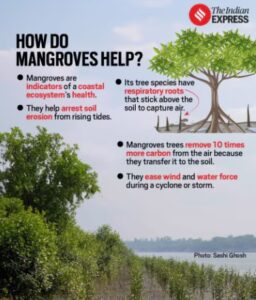
- Today, mangroves are crucial in climate resilience, biodiversity protection, carbon sequestration, and disaster risk reduction.
- Pioneers like M.S. Swaminathan shifted global perspectives by advocating for sustainable mangrove use and conservation.
Understanding the Early Perception of Mangroves
- Earlier, mangroves were viewed as marshy wastelands suitable for reclamation and development.
- Local coastal communities recognized their role in supporting fishery resources and maintaining ecological balance.
- However, their broader climate and environmental importance was not widely understood.
Turning Point: Recognizing Mangroves’ Role in Climate Resilience
- In 1988, UNDP and UNESCO started regional mangrove research projects.
- At the 1989 Tokyo Climate Change and Human Responses Conference, M.S. Swaminathan advocated for mangroves’ critical role in addressing climate impacts.
- He warned about rising sea levels causing salinisation and loss of food security and jobs.
- His solutions included:
- Sustainable mangrove management.
- Transferring mangrove genes to crops for salt tolerance.
- Policies rooted in ecology, economics, and equity.
Global Leadership and ISME
- S. Swaminathan co-founded the International Society for Mangrove Ecosystems (ISME) in 1990 in Okinawa, Japan.
- He served as its first president until 1993.
- He helped create the Charter for Mangroves, later adopted in the UN World Charter for Nature (1992).
- ISME’s major contributions include:
- Economic and ecological valuation of mangroves worldwide.
- Organizing workshops and training programs.
- Publishing the World Mangrove Atlas and restoration manuals.
- Promoting applied research and global cooperation.
Building a Global Infrastructure for Conservation
- Swaminathan contributed to establishing the Global Mangrove Database and Information System (GLOMIS).
- GLOMIS features expert directories, species data, and research publications.
- It also documents genetic resources vital for future use.
- In 1992, a nine-country survey of 23 mangrove sites across South and Southeast Asia and Oceania led to the setup of Mangrove Genetic Resource Centres.
- These centres are now protected by national governments and serve as hubs for conservation.
Revolutionizing India’s Mangrove Management
- India’s mangrove management dates to 1783 but involved widespread deforestation and reclamation, particularly in the Sundarbans.
- From the colonial period until 1980, clear-felling was a common practice.
- The Indian Forest (Conservation) Act of 1980 marked a policy shift toward protection.
Role of M.S. Swaminathan’s Foundation
- Swaminathan’s foundation challenged the blame placed on communities for failed mangrove restoration.
- Collaborative studies with state forest departments and communities revealed that degradation was mainly due to biophysical damage from clear-felling.
- Participatory research began in Tamil Nadu in 1993 and expanded to other coastal states.
Scientific Innovation: Fishbone Canal Method
- Researchers developed a hydro-ecological restoration model called the “fishbone canal method.”
- This method mimicked natural water flow and was successfully pilot-tested in:
- Tamil Nadu
- Andhra Pradesh
- Odisha
- West Bengal
- It evolved into the Joint Mangrove Management Programme.
- In 2000, the Ministry of Environment and Forests recommended national replication.
- It resulted in increased central and state investments in mangrove conservation.
Mangroves as Natural Disaster Shields
- Mangroves significantly mitigated damage during the 1999 Odisha super cyclone and the 2004 Indian Ocean tsunami.
- They reduced loss of life, infrastructure destruction, and environmental degradation.
- These events led to renewed public and policy interest in mangrove restoration.
Monitoring Progress: India’s Mangrove Cover Growth
- World Mangrove Day (July 26) helps assess national and global progress.
- As per the India State of Forest Report (ISFR) 2023:
- India has 4,991.68 km² of mangrove cover.
- This is 15% of India’s total geographical area.
- Since ISFR 2019, mangrove cover increased by 16.68 km².
- This growth reflects successful restoration, community participation, and policy initiatives.
Community and Participatory Approaches
- Swaminathan emphasized community-based conservation models.
- Involving locals ensured knowledge-sharing, stewardship, and sustainability.
- Joint forest management programs empowered coastal communities to take part in mangrove care and restoration.
Climate Adaptation and Biodiversity
- Mangroves store vast amounts of carbon, helping mitigate climate change.
- They provide habitat for diverse species, including:
- Shoreline birds
- Fish and shellfish
- Amphibians and reptiles
- Healthy mangrove ecosystems improve food security and livelihoods.
International Recognition and Collaboration
- India collaborated with global conservation bodies due to Swaminathan’s advocacy.
- Knowledge exchange, funding, and capacity-building became easier.
- Mangrove projects in India were aligned with global sustainability goals like the SDGs and Aichi Biodiversity Targets.
Challenges Ahead
- Coastal development, pollution, and aquaculture expansion still threaten mangroves.
- Climate change continues to raise sea levels and alter salinity patterns.
- Balancing development with ecological preservation remains crucial.
- Regular monitoring, better implementation of environmental laws, and public awareness are necessary.
Legacy of M.S. Swaminathan
- Transformed the image of mangroves from ‘useless swamps’ to vital ecosystems.
- Advocated scientific solutions grounded in ecological principles.
- Empowered local communities and influenced national and international policy.
- Left behind a strong foundation for future mangrove conservation.
Conclusion
Dr. M.S. Swaminathan’s vision transformed mangrove management in India and globally. His work emphasized science, sustainability, and community participation, helping mangroves evolve into vital tools for climate adaptation and biodiversity protection.
Source :The Hindu
Mains Practice Question
Evaluate the contribution of M.S. Swaminathan in transforming mangrove conservation.

