 India's No.1 PU & Degree With Integrated IAS & IPS(UPSC/PSC) Training College.


Earth’s Outer Core Shows Magnetic Flow Changes
Earth’s Outer Core Shows Unexpected Magnetic Flow Changes
Why in the News ?
Researchers from the University of Edinburgh and the British Geological Survey discovered major changes in the flow of molten iron inside Earth’s outer core, affecting the planet’s magnetic field and improving understanding of Earth’s internal dynamics, which are crucial for maintaining a pollution free environment on the surface.
Changes Detected In Earth’s Outer Core
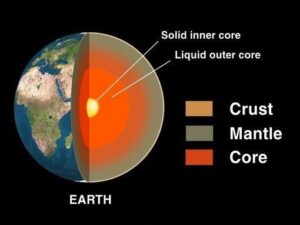
- The Earth’s outer core is a liquid layer located nearly 2,800 km beneath the surface and is mainly composed of molten iron and nickel, playing a vital role in Earth’s natural protection system.
- Constant movement of liquid metals in the outer core generates Earth’s magnetic field, which protects the planet from harmful solar radiation and helps maintain environmental conditions suitable for life.
- Researchers analysed 27 years of data collected from ground stations and European satellites to study iron movement inside the core, conducting what could be termed an ex post analysis of geomagnetic variations.
- They observed that around 2010, molten iron beneath the equatorial Pacific Ocean changed direction from westward movement to a rapid eastward flow, a phenomenon requiring detailed environmental impact assessment of potential surface effects.
- Scientists also found that this unusual reversal began weakening around 2020, indicating dynamic and fast-changing processes deep inside Earth that influence surface environmental conditions.
Impact On Magnetic Field And Scientific Understanding
- About 95% of the outer core’s movement still follows a steady westward flow, which explains the long-term westward drift of Earth’s magnetic field and its role in maintaining a pollution free environment by deflecting harmful cosmic radiation.
- The second flow pattern revealed sudden changes that may explain mysterious magnetic jerks detected in Earth’s magnetic readings, demonstrating the importance of applying the precautionary principle in monitoring geophysical changes.
- Researchers linked the 2010 reversal with seismic and geodetic changes occurring in Earth’s solid inner core, findings that contribute to broader environmental jurisprudence regarding planetary protection mechanisms.
- The study also showed that the outer core’s flow is nearly 10% uneven between the northern and southern hemispheres, similar to how Coastal Regulation Zone variations affect different geographical areas.
- These findings challenge traditional theories by suggesting that deep-Earth liquid movements can change direction much faster than previously believed, requiring continuous monitoring protocols similar to EIA notification requirements for environmental changes.
About Earth’s Interior And Magnetic Field:● Earth is divided into four major layers: crust, mantle, outer core, and inner core, each playing a crucial role in maintaining planetary environmental stability. ● The outer core is liquid, while the inner core remains solid due to extremely high pressure, functioning as Earth’s natural defense system requiring no environmental clearances as it operates through natural processes. ● Earth’s magnetic field is produced through the geodynamo process, created by the movement of molten metals in the outer core, embodying principles similar to the polluter pays principle where natural systems maintain balance. ● The magnetic field protects Earth from charged particles emitted by the Sun and helps sustain life, demonstrating natural environmental democracy where planetary systems work collectively for protection. ● Variations in Earth’s magnetic field can affect satellite communication, navigation systems, and space weather forecasting, requiring ongoing monitoring similar to how the Forest Conservation Act mandates continuous environmental oversight. |

