 India's No.1 PU & Degree With Integrated IAS & IPS(UPSC/PSC) Training College.


India Power Sector Reality: Challenges & Future
India Power Sector Reality
Syllabus
GS 3: Energy
Why in the News?
Recently, rising global energy prices and West Asia tensions highlighted India’s continued dependence on coal despite renewable energy growth, raising concerns about electricity generation, energy security, environmental clearances, and fossil fuel vulnerability.
Introduction
- India has made major progress in renewable energy during the last decade, promoting a pollution free environment through clean energy initiatives.
- However, the country still depends heavily on coal for electricity generation and energy stability, despite environmental impact assessment requirements.
- Rising global energy prices and tensions in West Asia have exposed India’s continued dependence on fossil fuels despite impressive renewable capacity growth and ambitious climate commitments.
India’s Energy Vulnerability in a Changing World
Impact of West Asia Tensions on India
- The recent rise in global energy prices after conflict escalation in West Asia has exposed India’s energy vulnerability once again.
- India remains highly dependent on imported fossil fuels, making its economy sensitive to international geopolitical disturbances and oil price fluctuations.
Dependence on the Strait of Hormuz
- Nearly half of India’s fossil fuel imports pass through the Strait of Hormuz, which remains strategically sensitive and politically unstable.
- India imports crude oil from Saudi Arabia and Liquefied Natural Gas (LNG) from Qatar through this important maritime route, with facilities often located in coastal regulation zone areas.
Risks from External Energy Shocks
- Any disruption in the Strait of Hormuz can increase transportation costs, fuel prices, and inflationary pressure across the Indian economy.
- Such global crises directly affect households, industries, government finances, and overall economic stability within the country.
India’s Renewable Energy Growth Story
Rapid Expansion of Renewable Energy
- Over the last decade, India has emerged as one of the world’s fastest-growing renewable energy markets.
- Since 2017, renewable sources have consistently contributed the largest share of new power capacity additions in the country, subject to environmental clearances and EIA notification requirements.
Increase in Renewable Installed Capacity
- Renewable energy accounted for 42.4% of India’s installed power capacity by March 2026, showing remarkable progress in clean energy expansion.
- This share was only 0.72% in March 2005, highlighting the rapid growth achieved during the last two decades through strengthened environmental democracy and policy frameworks.
Decline in Coal’s Share of Installed Capacity
- Coal’s share in India’s installed power capacity declined from 58.7% in 2005 to 42.2% in March 2026.
- These numbers create the impression that India is moving steadily away from fossil fuel dependence toward cleaner energy systems.
Difference Between Capacity and Electricity Generation
Installed Capacity Does Not Reflect Actual Power Supply
- Installed capacity measures how much electricity can potentially be generated, not the actual electricity supplied to consumers.
- Real energy transition depends on electricity generation patterns rather than headline renewable capacity numbers alone.
Low Share of Renewables in Actual Generation
- Although renewables account for over two-fifths of installed capacity, they generated only 15.8% of electricity in April 2026.
- This clearly shows that renewable energy has not yet replaced fossil fuels in India’s real electricity system.
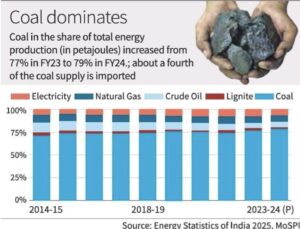
Coal Still Dominates Electricity Production
- Coal contributed 71.8% of India’s electricity generation in April 2026 despite rapid renewable energy expansion across the country.
- This share is only slightly lower than 76.2% in March 2019, showing coal’s continued dominance in electricity generation despite the polluter pays principle being embedded in environmental jurisprudence.
Why Coal Remains Central to India’s Power System
Renewable Energy Added Alongside Coal
- Renewable energy infrastructure has expanded rapidly, but coal plants continue operating as the backbone of electricity generation.
- In practical terms, renewable power is being added on top of coal rather than replacing coal-based electricity production.
Limited Addition of New Fossil Fuel Capacity
- Since 2018, India has added very little new fossil fuel capacity despite growing electricity demand and industrial expansion.
- At the same time, very few old coal plants have been retired, allowing coal to remain dominant within the power sector, with some operating under retrospective environmental clearances or ex post facto approvals.
Decline in Gas-Based Power Capacity
- Gas-based electricity generation capacity has declined gradually, reducing the availability of flexible alternative energy sources.
- This has increased dependence on coal for balancing electricity demand during periods of renewable energy fluctuations.
Structural Challenges in Renewable Energy Integration
Intermittent Nature of Solar and Wind Energy
- Solar and wind energy are intermittent sources, meaning their electricity generation depends heavily on weather and sunlight conditions.
- Electricity demand remains continuous throughout the day, but renewable generation often fluctuates significantly within short periods.
Lack of Large-Scale Energy Storage
- India still lacks sufficient battery storage systems capable of storing renewable energy at large commercial and industrial scales.
- Without storage infrastructure, renewable electricity cannot reliably supply power during nighttime or low-wind conditions.
Need for Flexible and Modern Electricity Grids
- India’s existing electricity grid requires major modernisation to efficiently integrate high levels of renewable energy generation.
- Flexible grids are essential for balancing fluctuating renewable supply with continuously changing electricity demand across regions.
Coal as the Main Balancing Source
- Coal currently provides stable baseload electricity, ensuring continuous power supply even when renewable output declines unexpectedly.
- This stabilising role explains why coal remains central to India’s electricity system despite policy emphasis on green energy.
Connection Between Global Fuel Prices and Indian Electricity Costs
Electricity Prices Linked to Global Fossil Fuel Markets
- Historical trends show that Indian electricity prices often move alongside Brent crude oil prices in international markets.
- Even domestically produced electricity remains indirectly influenced by global fossil fuel price volatility and energy disruptions.
Impact of Geopolitical Tensions
- Rising tensions in West Asia increase not only crude oil prices but also coal prices and industrial energy costs.
- Higher fuel costs eventually increase electricity tariffs, inflation, transportation expenses, and fiscal pressure on government budgets.
India’s Energy Transition Requires System Transformation
Renewable Growth Was a Strategic Decision
- India’s aggressive expansion of solar and wind energy since the late 2010s now appears highly important and forward-looking, guided by the precautionary principle.
- Growing geopolitical instability and fossil fuel volatility have highlighted the importance of renewable energy diversification strategies.
Focus Must Shift Beyond Capacity Addition
- The next phase of India’s energy transition must focus on system transformation rather than only adding renewable capacity numbers.
- Real transition requires creating an electricity system capable of replacing fossil fuels in actual power generation consistently.
Key Areas Requiring Immediate Investment
Expansion of Energy Storage Infrastructure
- India needs large-scale investments in battery storage systems to manage renewable energy variability effectively and efficiently.
- Energy storage will allow excess solar and wind electricity to be used during periods of lower renewable generation.
Modernisation of Power Grids
- Electricity grids must become smarter, faster, and more interconnected to handle rising renewable energy penetration across States.
- Strong transmission connectivity is essential for transferring renewable electricity from production centres to demand regions efficiently.
Development of Market Mechanisms
- India also requires better electricity market mechanisms that support renewable integration while maintaining affordable power prices.
- Efficient market systems can encourage investment in clean energy, storage technologies, and flexible electricity management solutions.
Coal’s Continuing Role in the Transition
Coal’s Persistence Is Not Only Policy Failure
- Coal’s continued importance is not merely the result of slow policymaking or institutional resistance within the energy sector.
- It currently performs a necessary stabilising function that renewable technologies cannot yet fully replace at national scale, though concerns about ex-post environmental clearances and compliance with the Forest Conservation Act remain relevant.
Real Energy Challenge Before India
- India’s challenge is not simply producing more green electricity through solar and wind energy expansion alone.
- The bigger challenge involves creating a reliable electricity system where renewables can consistently substitute fossil fuels in actual generation.
Lessons from Other Countries
- China remains less exposed because oil and gas contribute only 4% of its power mix, reducing dependence on imported fuels.
- Spain demonstrates how renewable energy can weaken the connection between gas prices and electricity tariffs through effective system transformation.
Conclusion
India’s renewable energy growth is significant, but coal still remains essential for electricity reliability and grid stability. Sustainable transition requires storage expansion, modernised grids, cleaner generation systems, and reduced dependence on volatile global fossil fuel markets.
Source: The Hindu
Mains Practice Question
Discuss the reasons behind India’s continued dependence on coal despite rapid renewable energy expansion.

