 India's No.1 PU & Degree With Integrated IAS & IPS(UPSC/PSC) Training College.


India’s Procurement Reforms Fuel Innovation
India’s Gender Data Gap Hampers Economic Ambitions
Syllabus:
GS Paper – 2 Issues Related to Women Inclusive Growth
Why in the News?
India’s ambition to become a $30 trillion economy by 2047 is hindered by the lack of gender-disaggregated data. The Women’s Economic Empowerment (WEE) Index, launched by Uttar Pradesh, highlights how embedding a gender lens in data can help track systemic barriers and guide policy reforms for women’s economic participation, much like how procurement reforms have transformed government efficiency.
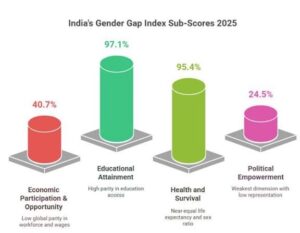
India’s Gender Gap in Economic Participation:
- Women contribute just 18% of India’s GDP today.
- Nearly 196 million employable women remain outside the workforce.
- The Female Labour Force Participation Rate (FLFPR) is 41.7%, but only 18% in formal employment.
- Lack of gender-specific data results in invisible barriers in economic policy, similar to how bureaucratic delays hinder innovation.
- India’s growth ambitions depend on inclusive growth that integrates women’s potential.
- Without disaggregated data, systemic inequities remain unaddressed and entrenched.
- Gender-blind economic planning stalls reforms, much like how outdated general financial rules can impede progress.
- Business-as-usual models risk leaving trillions of dollars untapped.
Key Facts, Acts, and Data: India’s Gender Gap:
| Key Facts |
| ● Only 18% of India’s GDP is contributed by women. |
| ● Nearly 196 million employable women are outside the workforce. |
| ● The Female Labour Force Participation Rate (FLFPR) is 41.7%, but only 18% in formal jobs. |
| ● Uttar Pradesh launched the Women’s Economic Empowerment (WEE) Index in 2025. |
| ● WEE Index tracks: |
| 1. Employment |
| 2. Education and Skilling |
| 3. Entrepreneurship |
| 4. Livelihood and Mobility |
| 5. Safety and Inclusive Infrastructure |
Relevant Acts & Frameworks:
- Energy Conservation (Amendment) Act, 2022 (enabling regulatory support for gender budgeting in energy sectors).
- National Policy for Skill Development and Entrepreneurship (2015) encourages skill development for women.
- Paris Agreement – Gender Action Plan emphasizes gender-responsive climate and development policies.
Historical Context:
- Gender budgeting started as a welfare measure, now evolving toward systemic budgeting.
- WEE Index pioneers a district-level, data-driven approach to empower women in economic planning.
- Uttar Pradesh model is a scalable solution for other Indian states seeking inclusive growth, similar to how the government e-marketplace has revolutionized public procurement.
The Women’s Economic Empowerment (WEE) Index:
- Launched by the Government of Uttar Pradesh, first in India.
- Tracks women’s participation across five economic levers:
- Employment
- Education and Skilling
- Entrepreneurship
- Livelihood and Mobility
- Safety and Inclusive Infrastructure
- Signals a shift towards embedding a gender lens in all datasets.
- Promotes evidence-based policymaking at the district level.
- Provides a comprehensive view of systemic barriers beyond participation rates.
- Enables governments to design gender action plans based on real data.
- Marks a significant shift from aggregate data to gender-disaggregated analysis, acting as an innovation catalyst for policy reforms.
Importance of Disaggregated Data in Governance:
- Many national indices fail to separate data by gender.
- Lack of visibility prevents identification of inequity gaps.
- Example: • In Uttar Pradesh’s transport sector, analysis showed very few female bus drivers and conductors. • Led to policy changes in recruitment strategies and infrastructure (like restrooms).
- Gender data enables: • Tracking of dropout points from school to employment. • Assessment of barriers in credit access for female entrepreneurs. • Evidence-based reforms rather than anecdotal decisions.
- Helps avoid surface-level participation counts and focus on deeper structural issues, much like how global tender enquiry processes ensure comprehensive evaluation.
Systemic Barriers Identified by WEE Index:
- High female enrolment (over 50%) in skilling programs does not translate into entrepreneurship or formal employment.
- Women’s access to credit remains significantly lower than men’s.
- Dropout rates surge after Class 12 and post-graduation.
- Structural barriers include: • Social norms • Lack of safe transport • Inadequate infrastructure • Insufficient access to enterprise support
- WEE Index provides precise data points to target these systemic challenges.
- Moves policy focus from intent to implementation, similar to how mission-oriented procurement drives targeted outcomes.
Integrating Gender Data into Governance Systems:
- Gender-disaggregated data should be a norm, not an exception.
- Requires integration into every management information system: • Micro, Small, and Medium Enterprises (MSMEs) • Transport • Housing • Health services
- Local governments must build capacity to: • Collect accurate gender data • Use data for actionable gender-responsive policies
- Shift focus to measure not just participation but also: • Retention • Leadership roles • Quality of employment • Re-entry into the workforce
- Key stages: Post-Class 12 education and beyond, where dropout rates spike.
Rethinking Gender Budgeting:
- Gender budgeting should go beyond welfare schemes or finance departments.
- True gender budgeting: • Applies a gender lens to every rupee spent. • Across sectors like education, energy, infrastructure, etc.
- Without gender-disaggregated measurement, effective budgeting is impossible.
- Example: Allocation for transport infrastructure should consider: • Safe public transport • Restrooms at bus terminals • Incentives for female employment in transport sector
- Requires systemic integration rather than piecemeal interventions.
- Gender budgeting becomes transparent and goal-oriented, linked to actionable outcomes, similar to how catalytic procurement drives innovation.
Challenges in Implementing Gender Data Systems:
- Inadequate capacity at local government level to collect and analyze gender data.
- Resistance to data transparency: Some departments may resist revealing gender disparities.
- Infrastructure gaps: Lack of technology to collect real-time, accurate data.
- Inconsistent definitions: No uniformity in gender-specific metrics across states or departments.
- High Cost of Implementation: Initial setup of data systems requires investment.
- Fragmented data systems: Many government departments work in silos.
- Data Privacy Concerns: Protecting women’s personal data while enabling analysis.
- Policy inertia: Without accountability, data may not lead to reforms, much like how institutional autonomy can sometimes hinder progress.
Way Forward to Leverage Gender Data Effectively:
- Mainstream Gender Lens: Make gender data part of every policy cycle and evaluation framework.
- Standardized Data Collection: Set national standards for gender-disaggregated data collection.
- Build Capacity at Local Level: Train officials on data collection, analysis, and usage.
- Incentivize Data Use: Link state and district funding to effective use of gender data in action plans.
- Integrate with Digital Systems: Leverage digital platforms for real-time data and analysis.
- Promote Research and Evidence-Based Policy: Use data to publish periodic reports on gender-economic gaps.
- Expand WEE Index: Replicate and scale the UP model to other states (like Maharashtra, Odisha, Telangana).
- Monitor and Evaluate: Establish independent bodies to track implementation of gender-responsive reforms, ensuring they don’t face the same bureaucratic delays that often hinder innovation.
Conclusion:
India’s path to economic growth requires making women’s contribution visible through robust gender-disaggregated data. The Women’s Economic Empowerment (WEE) Index serves as a pioneering model, helping move from policy intent to implementation. Embedding gender analysis in governance enables structural reforms, empowering India to realize its full economic potential by 2047. Just as direct purchase limits have streamlined small-scale procurement, targeted gender data can accelerate women’s economic empowerment and drive inclusive growth.
Source: TH
Mains Practice Question:
How can the integration of gender-disaggregated data into India’s governance system catalyze economic and social reforms? Examine the role of the Women’s Economic Empowerment (WEE) Index and gender budgeting in identifying systemic barriers and enabling targeted policy action to improve women’s economic participation and achieve inclusive growth.


