India's No.1 PU & Degree With Integrated IAS & IPS(UPSC/PSC) Training College.


India’s Expanding Horizons in Space Exploration: From Earth to Orbit
India’s Expanding Horizons in Space Exploration: From Earth to Orbit
In June 2025, Group Captain Shubhanshu Shukla of the Indian Air Force became the first Indian to reach the International Space Station (ISS), marking a historic milestone in India’s growing role in human space exploration and strengthening International Space Station India connections. He was part of Axiom Mission 4 (Ax-4), a private international mission organized by Axiom Space in collaboration with NASA and SpaceX, showcasing the advancement of Indian space collaborations on a global scale. This mission also highlighted the evolving Indian space policy, which now embraces international partnerships and commercial space flights in India.
India’s First Man in Space vs First Indian on the ISS
Rakesh Sharma: The first Indian astronaut in space (1984)
- Flew aboard Soyuz T-11 as part of the Soviet Interkosmos programme
- Docked with Salyut 7, an early space station of the Soviet Union
- Famous for saying “Sare Jahan Se Achha” to PM Indira Gandhi during his mission
Shubhanshu Shukla: The first Indian to reach the ISS (2025)
- Pilot on Axiom Mission 4, part of the growing cadre of Indian astronauts
- Shubhanshu Shukla ISS mission represents a new era in India space exploration
Historical Context: Human Spaceflight Timeline
- 1957: Laika, a Soviet dog, became the first living being to orbit Earth (Sputnik 2)
- 1961: Yuri Gagarin became the first human in space aboard Vostok 1
- 1969: Apollo 11 mission saw Neil Armstrong and Buzz Aldrin walk on the Moon; Michael Collins remained in lunar orbit
- 1984: Rakesh Sharma becomes the first Indian astronaut in space
- 2025: Shubhanshu Shukla becomes the first Indian on the ISS, advancing Indian space program achievements and space missions India has undertaken
Axiom Mission 4 (Ax-4) – June 2025
- Launch Date: June 10, 2025
- Launch Site: NASA’s Kennedy Space Center, Merritt Island, Florida (Launch Complex 39A – same as Apollo 11)
- Spacecraft: SpaceX Dragon spacecraft (Crew Dragon C213) atop a Falcon 9 rocket
- Mission Duration: 14-day expedition to the ISS
Ax-4 Crew Members:
- Peggy Whitson (USA) – Mission Commander; most experienced American astronaut
- Shubhanshu Shukla (India) – Mission Pilot; first Indian on the ISS
- Sławosz Uznański (Poland) – Medical physicist; first Polish astronaut on the ISS
- Tibor Kapu (Hungary) – Military pilot; Hungary’s second astronaut after 40+ years
This Axiom Space mission represents a significant step in commercial space flights in India and international collaboration in space exploration. The crew successfully completed docking with ISS, marking a new chapter in Indian space technology advancement.
The International Space Station (ISS)
- Altitude: ~400 km (Low Earth Orbit)
- Speed: 28,000 km/h
- Orbit Duration: Completes 1 Earth orbit every 90 minutes
- Partners: NASA (USA), Roscosmos (Russia), ESA (Europe), JAXA (Japan), CSA (Canada)
- Operational Since: 2000 (continuously inhabited)
The ISS serves as a platform for international cooperation and scientific research, including contributions from the Indian Space Research Organisation (ISRO).
Scientific Experiments & Indian Contribution
Over 60 experiments from 31 countries focusing on:
- Microbial resistance
- AI in space
- Glucose metabolism
- Material durability
- Neural health
- Space nutrition experiments
India’s Focus: Diabetes-related studies in microgravity conditions, showcasing Indian space research and science capabilities. The space research experiments conducted by the Indian team also included studies on space nutrition, contributing to the growing body of knowledge on sustaining human life in space.
The Indian space science community, led by ISRO, contributes significantly to these international research initiatives, furthering our understanding of space and its effects on human health.
Symbol of Peace – “Joy” the Zero Gravity Indicator
- “Joy”: A plush baby swan, served as the mission’s zero gravity indicator
- These objects float freely in microgravity to visually confirm weightlessness
- Symbolizes peace, harmony, and global cooperation in space
Return to Earth
- Expected Return: Late June 2025
- Method: Splashdown in the Pacific Ocean, off the coast of California, depending on orbital conditions
The safe return of the Axiom-4 mission crew, including Shubhanshu Shukla, will mark the successful completion of this landmark Indian space collaboration.
Conclusion: From National Pride to Global Collaboration
From Laika’s orbit to Yuri Gagarin’s pioneering flight, from Rakesh Sharma’s salute to Shukla’s international mission, space exploration has evolved from national prestige to multinational cooperation. India’s presence on the ISS through Ax-4 reflects its deepening integration into the global space community and the rapid advancement of Indian space exploration.
The success of this mission not only highlights India’s growing capabilities in space but also sets the stage for future endeavors, including ISRO’s ambitious Mission Akash Ganga (also known as the Gaganyaan mission), which aims to send Indian astronauts to space independently. This mission, along with other Indian space research initiatives, continues to inspire the next generation of scientists and engineers, fostering growth in Indian space education and the burgeoning Indian space industry.
The rise of Indian space startups is also contributing to this growth, with many companies now focusing on developing innovative space technologies and even exploring the potential for Indian space tourism in the future. Additionally, ISRO has launched a STEAM outreach programme to encourage more young Indians to pursue careers in space science and technology.
Important for Exams:
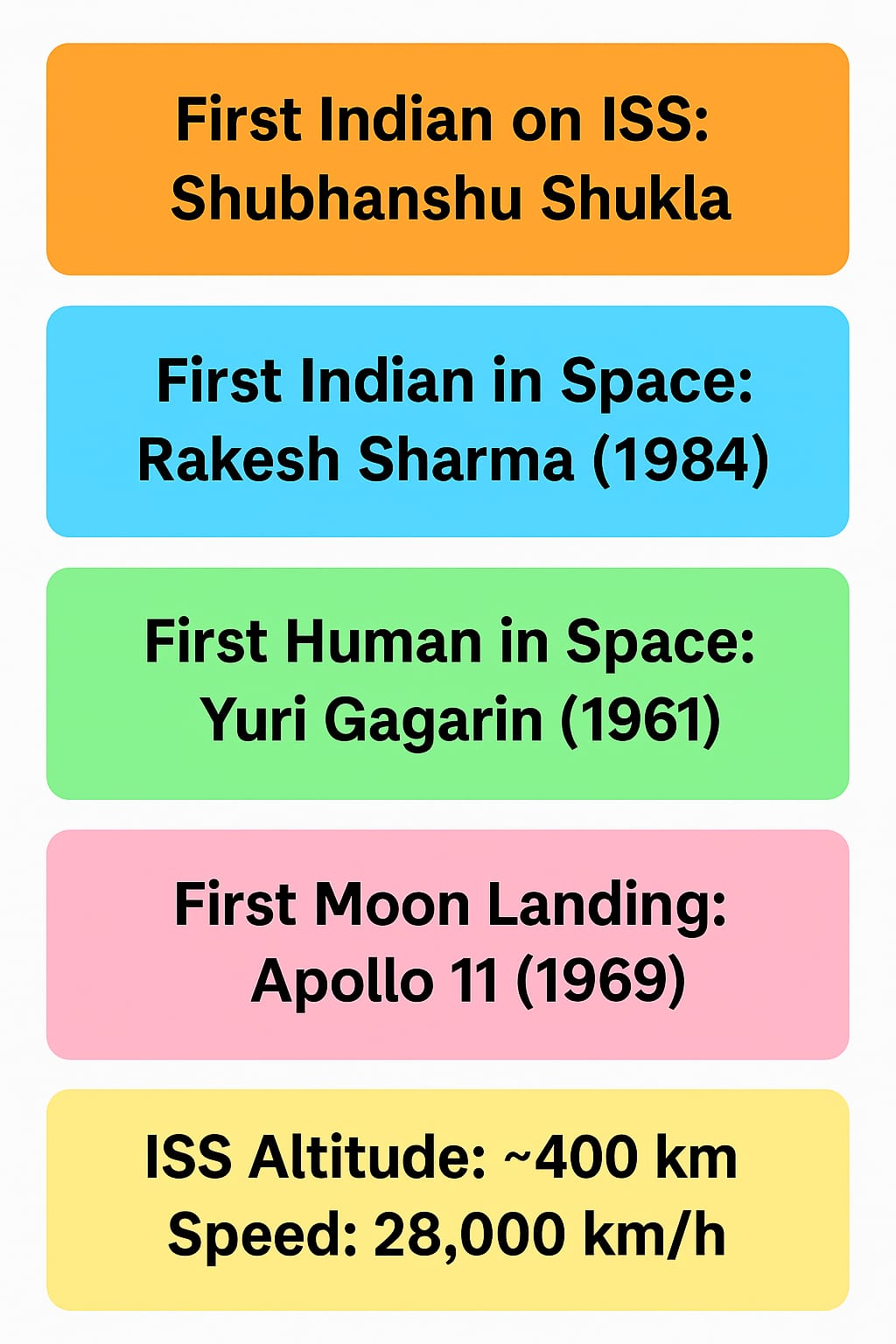
- First Indian on ISS: Shubhanshu Shukla (2025)
- First Indian in Space: Rakesh Sharma (1984)
- First Human in Space: Yuri Gagarin (1961)
- First Moon Landing: Apollo 11 (1969)
- ISS Altitude: ~400 km, Speed: 28,000 km/h
- Key Indian space organizations: ISRO (Indian Space Research Organisation)
- Significant upcoming Indian space mission: Mission Akash Ganga (Gaganyaan)
- Important international collaboration: Axiom Space missions
- Emerging sectors: Indian space startups, commercial space flights in India