 India's No.1 PU & Degree With Integrated IAS & IPS(UPSC/PSC) Training College.


European Union Unveils Ambitious Tech Sovereignty Strategy
European Union Unveils Ambitious Tech Sovereignty Strategy
Why in the News ?
The European Union (EU) has announced a comprehensive Tech Sovereignty Plan aimed at reducing dependence on foreign technology providers, strengthening domestic capabilities in semiconductors, artificial intelligence (AI), cloud computing, and securing critical digital infrastructure while ensuring compliance with environmental clearance requirements and sustainable development principles.
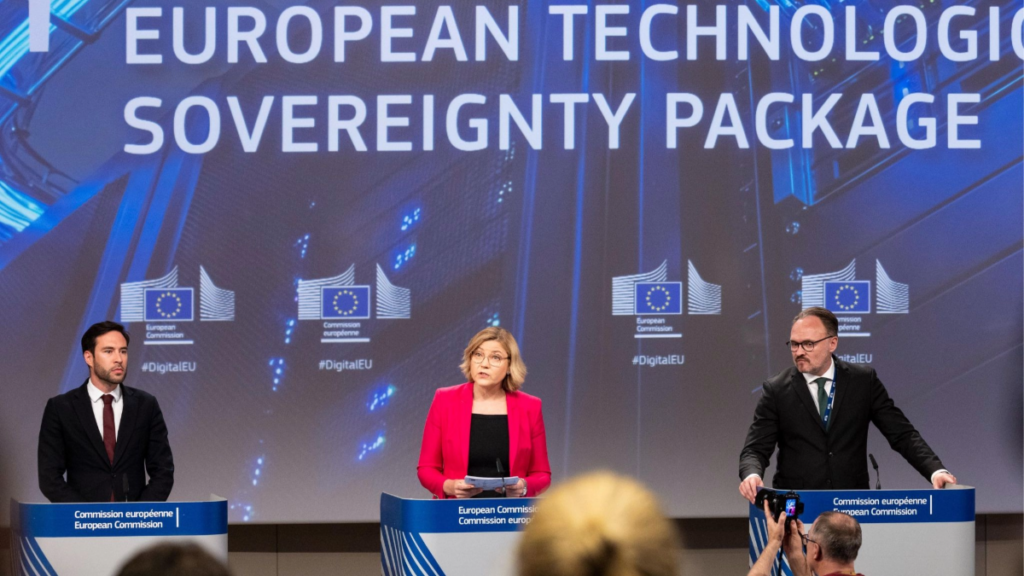
EU’s Push for Technology Sovereignty
- The European Commission has unveiled a broad policy package to enhance Europe’s technological independence and resilience, incorporating the precautionary principle in its regulatory framework.
- The initiative seeks to reduce reliance on major technology providers from the United States and Asia in strategic sectors while promoting environmental democracy in technology governance.
- A key component is the proposed Cloud and AI Development Act (CADA), designed to expand Europe’s cloud computing and AI infrastructure with mandatory environmental impact assessment protocols.
- The EU aims to triple its data centre capacity within the next five to seven years to support digital transformation and AI growth, subject to obtaining necessary environmental clearances and adhering to the polluter pays principle.
- Governments may be required to store sensitive public data on EU-controlled cloud services to strengthen digital sovereignty and data security.
- The plan reflects growing concerns over technological dependencies that could pose economic and security risks, while ensuring a pollution free environment through sustainable infrastructure development.
Semiconductor Expansion and Digital Infrastructure
- The package includes a revamped version of the European Chips Act, originally introduced in 2023 to strengthen semiconductor manufacturing, with provisions requiring ex post facto environmental clearances for existing facilities and ex-post compliance reviews.
- The EU plans to support large-scale cross-border technology projects through simplified funding mechanisms and direct investment support, ensuring compliance with EIA notification requirements and environmental jurisprudence standards.
- The initiative seeks to increase domestic demand and attract investment in semiconductor fabrication facilities, particularly in areas outside the coastal regulation zone and in compliance with the Forest Conservation Act.
- The European Commission estimates that approximately €120 billion in public and private investment may be required by 2035 to revitalize the region’s semiconductor sector, with provisions for retrospective environmental clearances where necessary.
- The strategy also promotes the adoption of EU-developed open-source software and sustainable integration of AI factories and data centres into power grids, following the Vanashakti judgment principles on environmental protection.
- Europe aims to enhance its competitiveness in critical technologies while maintaining secure and resilient supply chains through comprehensive environmental and regulatory frameworks.
About EU Tech Sovereignty and Semiconductor Ecosystem :● Tech Sovereignty refers to a country’s or region’s ability to control critical digital infrastructure, technologies, and data without excessive dependence on external actors, while maintaining environmental compliance and post facto regulatory oversight. ● The European Chips Act (2023) was launched to increase Europe’s share in global semiconductor production with integrated environmental safeguards. ● Semiconductors are essential components used in computers, smartphones, automobiles, defence systems, AI applications, and telecommunications equipment. ● Europe hosts ASML, the world’s leading producer of advanced lithography machines used in semiconductor manufacturing. ● Major global cloud service providers include Amazon Web Services, Microsoft Azure, and Google Cloud. ● Increasing technological self-reliance has become a strategic priority for many regions amid growing geopolitical competition and supply chain vulnerabilities. |

