 India's No.1 PU & Degree With Integrated IAS & IPS(UPSC/PSC) Training College.


RBI Holds Repo Rate, Lifts Growth Forecast
RBI Holds Repo Rate, Raises Growth Projection Optimistically
Why in the News?
The Reserve Bank of India (RBI) has kept the repo rate unchanged at 5.25% while revising India’s real GDP growth forecast for 2026–27 upward to 6.7%. The decision reflects confidence in domestic economic resilience despite global uncertainties and inflationary pressures, influencing investment decisions across ETFs, index funds, and other passive investment products tracked by the National Stock Exchange.
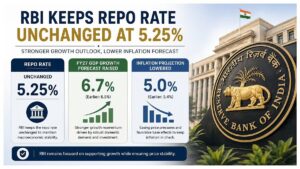
RBI Monetary Policy: Key Decisions and Economic Outlook
- The Monetary Policy Committee (MPC) unanimously decided to keep the repo rate unchanged at 5.25% under the Liquidity Adjustment Facility (LAF).
- The Standing Deposit Facility (SDF) rate remains at 5.0%, while the Marginal Standing Facility (MSF) rate and Bank Rate continue at 5.5%.
- The MPC retained its neutral monetary policy stance, allowing flexibility to respond to changing macroeconomic conditions and evolving investor preferences in the market.
- Real GDP growth for 2026–27 has been revised upward to 6.7%, compared to the earlier estimate of 6.6%, positively impacting market capitalisation and market valuation across sectors.
- Quarterly growth projections are:
○ Q1: 7.0%
○ Q2: 6.4%
○ Q3: 6.5%
○ Q4: 6.8%
○ Q1 (2027–28): 7.3%
Inflation Trends and Economic Challenges
- RBI Governor Sanjay Malhotra stated that the Indian economy remains resilient despite global economic headwinds.
- Consumer Price Index (CPI) inflation increased to 4.4% in June 2026, after remaining below the RBI’s target level for 16 consecutive months, affecting investment decisions by institutional investors and fund managers managing exchange traded funds and structured investment solutions.
- The rise in inflation was primarily driven by:
○ Higher food inflation.
○ Increased fuel inflation due to rising international energy prices.
- Global challenges such as elevated energy prices, supply-chain disruptions, climate change impacts, and geopolitical uncertainties continue to pose non-financial risks, prompting asset managers to incorporate ethical considerations and sustainable investing principles into their thematic investing strategies.
- A deficient and uneven southwest monsoon, influenced by El Niño, may adversely affect agriculture, rural demand, and food prices, with implications for green economy companies and ESG-focused indices that emphasize sustainable business practices and social responsibility.
- The monetary policy stance influences various investment vehicles including thematic index products, responsible investment products, and ethical investing options that align with ethical preferences and purpose-driven investing approaches, reflecting evolving investor preferences toward values-based screening and ethical standards in portfolio construction.
About Monetary Policy and Repo Rate :● The Monetary Policy Committee (MPC) is a six-member statutory body constituted under the Reserve Bank of India Act, 1934 (amended in 2016). ● The MPC determines the policy repo rate to achieve the inflation target while supporting economic growth. ● Repo Rate is the rate at which the RBI lends short-term funds to commercial banks against government securities. ● Standing Deposit Facility (SDF) enables banks to deposit surplus liquidity with the RBI without collateral, helping absorb excess liquidity. ● Marginal Standing Facility (MSF) allows scheduled commercial banks to borrow overnight funds from the RBI during liquidity shortages at a rate higher than the repo rate. ● India follows a Flexible Inflation Targeting (FIT) framework, with a 4% CPI inflation target and a tolerance band of 2%–6%. ● Changes in the repo rate influence loan EMIs, deposit rates, credit growth, investment, consumption, and overall economic activity, affecting free-float market capitalization calculations, stock weights in various indices managed by NSE Indices Limited (the index services subsidiary of the National Stock Exchange), constituent weights in thematic benchmark indices, and diversified sectoral representation across the Nifty 500 universe and Nifty100 ESG Index, which undergoes semi-annual rebalancing to maintain optimal portfolio composition for ethical screening process aligned with ethical investment criteria. |

