 India's No.1 PU & Degree With Integrated IAS & IPS(UPSC/PSC) Training College.


New Drug Offers Hope for Pancreatic Cancer
New Drug Offers Hope Against Pancreatic Cancer
Why in the News ?
A new oral drug called Daraxonrasib has shown promising results in patients with advanced pancreatic cancer, nearly doubling survival time in clinical trials. The breakthrough highlights the growing role of precision medicine in treating difficult-to-cure cancers.
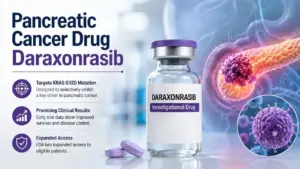
Daraxonrasib and Breakthrough in Pancreatic Cancer Treatment:
- Pancreatic cancer is among the deadliest forms of cancer, with a global five-year survival rate of around 13%.
- Results presented at the American Society of Clinical Oncology (ASCO) meeting showed that Daraxonrasib, a once-daily oral pill, significantly improved survival in patients whose disease had progressed after chemotherapy.
- The drug targets mutations in the KRAS gene, which are present in nearly 80% of pancreatic cancers.
- By inhibiting abnormal KRAS activity, Daraxonrasib blocks signals that drive uncontrolled cancer cell growth.
- Experts consider this a major advancement because pancreatic cancer has historically shown limited response to targeted therapies and immunotherapy.
- The discovery marks the beginning of a new class of drugs that could improve treatment outcomes in several cancers.
Significance, Challenges and Future Potential
- Researchers believe KRAS inhibitors may also be effective in lung cancer, colon cancer, and other malignancies where KRAS mutations are common.
- Clinical trials are exploring the use of these drugs earlier in the treatment process, including in newly diagnosed patients.
- Although effective, Daraxonrasib is associated with side effects such as skin rash, diarrhoea, mouth ulcers, vomiting, fatigue, and reduced haemoglobin levels.
- Approximately one-third of patients required dose adjustments due to side effects.
- The drug is not yet available in India, but experts expect KRAS-targeting therapies to become increasingly important in oncology practice.
- The development reinforces the shift towards precision oncology, where treatments are tailored to specific genetic mutations.
About Pancreatic Cancer and Precision Medicine:● The pancreas is a gland located behind the stomach that produces digestive enzymes and hormones such as insulin. ● Pancreatic cancer often remains undetected in early stages because symptoms appear only after significant disease progression. ● Common symptoms include jaundice, abdominal pain, weight loss, nausea, loss of appetite, and new-onset diabetes. ● KRAS is a gene involved in regulating cell growth and division; mutations can lead to uncontrolled cancer development. ● Precision Medicine refers to medical treatment tailored to an individual’s genetic profile and disease characteristics. ● Major cancer treatment approaches include surgery, chemotherapy, radiotherapy, immunotherapy, and targeted therapy. |

