 India's No.1 PU & Degree With Integrated IAS & IPS(UPSC/PSC) Training College.


FCRA Amendment: More State Control Over NGOs
FCRA Amendment Expands State Control Over Civil Society Institutions
Syllabus:
GS-2: Government Policies & Interventions, Non-Governmental Organizations (NGOs), Management of Social Sector/Services
Why in the News ?
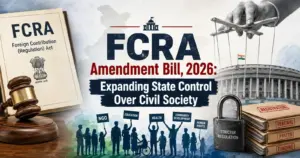
The Foreign Contribution (Regulation) Amendment Bill, 2026 has been reintroduced in the Lok Sabha during the Monsoon Session of Parliament after being withdrawn earlier. The Bill has generated intense debate over its implications for NGOs, civil society organisations, religious institutions, property rights, and the balance between regulatory oversight and constitutional freedoms.
Background: Evolution of FCRA and Regulation of Foreign Contributions
- The Foreign Contribution (Regulation) Act (FCRA) was first enacted in 1976 to regulate the receipt and utilisation of foreign contributions.
- The objective was to:
○ Protect national sovereignty.
○ Prevent foreign influence in domestic politics.
○ Ensure transparency in foreign funding.
- The legislation was comprehensively replaced by the Foreign Contribution (Regulation) Act, 2010.
- The Act regulates foreign contributions received by:
○ Non-Governmental Organisations (NGOs).
○ Religious organisations.
○ Educational institutions.
○ Research organisations.
○ Charitable trusts.
- Organisations must obtain FCRA registration from the Ministry of Home Affairs (MHA) before receiving foreign contributions.
- Over time, amendments have introduced stricter compliance requirements, including:
○ Restrictions on sub-granting.
○ Lower administrative expenditure limits.
○ Mandatory receipt of foreign funds through a designated State Bank of India (New Delhi Main Branch) account.
- The 2026 Amendment Bill proposes further changes by expanding executive powers relating to registration, asset management, and government oversight.
Understanding Foreign Contribution Regulation in India:Foreign Contribution (Regulation) Act (FCRA)● First enacted: 1976 ● Current law: Foreign Contribution (Regulation) Act, 2010 ● Administered by: Ministry of Home Affairs (MHA) Objectives● Regulate acceptance and utilisation of foreign contributions. ● Protect national sovereignty and public interest. ● Prevent foreign influence in political activities. ● Promote transparency and accountability. Major Features of FCRA ● Mandatory registration for eligible organisations receiving foreign contributions. ● Designated FCRA bank account for receipt of foreign funds. ● Regulation of utilisation and reporting of foreign contributions. ● Power to suspend or cancel registration for violations. ● Restrictions on transfer (sub-granting) of foreign contributions. ● Periodic renewal of registration. Important Constitutional Provisions Fundamental Rights● Article 14 – Equality before law. ● Article 19(1)(c) – Freedom to form associations or unions. ● Article 25 – Freedom of conscience and free profession, practice, and propagation of religion. ● Article 26 – Freedom to manage religious affairs. ● Article 32 – Constitutional remedies before the Supreme Court. Other Constitutional Provision● Article 300A – Right to property (no deprivation except by authority of law). Important Institutions ● Ministry of Home Affairs (MHA) ● Parliament of India ● Designated Authority (as proposed under the Amendment Bill) ● High Courts ● Supreme Court of India Relevant Acts ● Foreign Contribution (Regulation) Act, 2010 ● Foreign Contribution (Regulation) Amendment Act, 2020 ● Foreign Contribution (Regulation) Amendment Bill, 2026 (proposed) ● Income Tax Act, 1961 (for charitable institutions, where applicable) Key points: FCRA ● The FCRA regulates the receipt and utilisation of foreign contributions by specified persons and organisations. ● The Ministry of Home Affairs administers the FCRA framework. ● The proposed 2026 Amendment Bill seeks to introduce a Designated Authority, provide for asset vesting in specified circumstances, strengthen executive oversight, and modify procedures relating to registration and utilisation of foreign contributions. ● The debate centres on balancing national security, transparency, constitutional freedoms, and the effective functioning of civil society organisations in India’s democratic framework. |
Key Provisions of the Foreign Contribution (Regulation) Amendment Bill, 2026
- The Bill proposes the creation of a Designated Authority to administer foreign-funded assets.
- If an organisation’s FCRA registration is:
○ Suspended,
○ Cancelled,
○ Not renewed,
○ Or deemed to have ceased,
its foreign contributions and related assets may vest in the Designated Authority.
- The authority may:
○ Take possession of assets.
○ Manage institutions.
○ Dispose of properties through sale or auction.
○ Credit proceeds to the Consolidated Fund of India (CFI).
- Even assets partly created using foreign contributions may be brought under government control.
- The Bill introduces the concept of “deemed cessation”, under which delayed renewal or rejection of registration may automatically terminate an organisation’s authority to receive foreign contributions.
- The executive is also empowered to prescribe timelines for receipt and utilisation of foreign funds.
- These provisions significantly strengthen administrative control over foreign-funded organisations.
Impact on Civil Society Organisations and Public Welfare Institutions
- The editorial argues that the proposed amendments could have significant implications for:
○ Charitable hospitals.
○ Educational institutions.
○ Research centres.
○ Religious trusts.
○ Humanitarian organisations.
- Many institutions depend on a combination of:
○ Domestic donations.
○ User fees.
○ Foreign grants.
- Sudden suspension of FCRA registration may affect:
○ Healthcare services.
○ Educational programmes.
○ Scholarships.
○ Rural development projects.
○ Community welfare initiatives.
- The possibility of government management of institutional assets may create operational uncertainty.
- Long-term infrastructure projects may face disruptions if funding flows are interrupted.
- The editorial suggests that regulatory uncertainty could discourage international philanthropic support.
- The broader concern raised is that institutions engaged in public service may face operational challenges because of enhanced regulatory intervention.
Constitutional and Legal Issues Raised
The editorial raises concerns regarding compatibility of certain provisions with constitutional guarantees.
Article 14 – Equality Before Law
- Broad executive discretion may lead to concerns regarding:
○ Equal treatment.
○ Reasonable classification.
○ Uniform application of law.
- The absence of clearly defined standards for certain executive decisions may invite judicial scrutiny.
Article 25 – Freedom of Religion
- Religious organisations receiving foreign contributions may be affected by regulatory restrictions.
- Questions arise regarding the indirect impact on religious activities supported through charitable institutions.
Article 26 – Freedom to Manage Religious Affairs
- Religious denominations enjoy constitutional protection in managing their institutions.
- Regulatory intervention affecting institutional assets may become a subject of legal examination.
Article 300A – Right to Property
- Property can be deprived only by authority of law.
- Questions may arise regarding:
○ Proportionality.
○ Due process.
○ Fair safeguards before asset vesting.
Articles 32 and 226
- Organisations may seek judicial review before:
○ Supreme Court.
○ High Courts.
- Constitutional remedies remain available against administrative decisions.
Governance, Transparency and Accountability: Competing Perspectives
Government’s Stated Objectives
- Prevent misuse of foreign contributions.
- Improve transparency.
- Strengthen accountability.
- Protect national security.
- Prevent money laundering.
- Prevent foreign political influence.
Concerns Highlighted in the Editorial
- Greater concentration of executive authority.
- Increased compliance burden.
- Financial uncertainty for NGOs.
- Potential reduction in operational autonomy.
- Expanded discretionary powers.
- Long litigation before relief becomes available.
- Reduced flexibility in financial management.
Balancing Competing Objectives
- Every democratic framework must balance:
○ National security.
○ Transparency.
○ Freedom of association.
○ Public accountability.
○ Constitutional rights.
- Regulatory mechanisms should remain proportionate and predictable.
Wider Implications for India’s Development Sector
- Civil society organisations complement government efforts in:
○ Healthcare.
○ Education.
○ Nutrition.
○ Disaster relief.
○ Skill development.
○ Women’s empowerment.
○ Tribal welfare.
- NGOs often reach geographically remote and socially vulnerable populations.
- Stable regulatory environments encourage philanthropic investment.
- Frequent regulatory uncertainty may affect:
○ International donor confidence.
○ Long-term developmental planning.
○ Institutional sustainability.
- Strong civil society institutions contribute to:
○ Democratic participation.
○ Community mobilisation.
○ Social innovation.
- Effective regulation should therefore promote accountability without undermining legitimate developmental work.
Need for a Balanced and Constitutionally Consistent Regulatory Framework
- Foreign contribution regulation remains a legitimate sovereign function.
- However, regulatory measures should:
○ Be transparent.
○ Be proportionate.
○ Respect constitutional safeguards.
○ Ensure procedural fairness.
- Independent review mechanisms should strengthen administrative credibility.
- Stakeholder consultations improve legislative quality.
- Objective standards reduce arbitrary decision-making.
- Judicial oversight remains an important constitutional safeguard.
- Digital compliance systems can improve transparency without excessive administrative burden.
- A balanced framework should simultaneously protect:
○ National interest.
○ Public accountability.
○ Civil society autonomy.
○ Democratic governance.
Challenges:
- Balancing national security with freedom of association.
- Preventing misuse of foreign contributions while protecting genuine charitable activities.
- Broad executive discretion in suspension and cancellation of registration.
- Uncertainty regarding management of assets partly funded through foreign contributions.
- Increased compliance burden on smaller NGOs.
- Operational disruptions for healthcare, education, and welfare institutions.
- Declining foreign philanthropic funding due to regulatory uncertainty.
- Long judicial processes for organisations challenging administrative decisions.
- Maintaining donor confidence while ensuring accountability.
- Potential overlap between administrative action and constitutional protections.
- Ensuring uniform application of the law across all organisations.
- Building trust between government and civil society.
- Balancing transparency with institutional autonomy.
- Harmonising regulatory objectives with cooperative governance.
Way Forward :
- Clearly define objective criteria for suspension, cancellation, and non-renewal of FCRA registration.
- Strengthen procedural safeguards before any action affecting organisational assets.
- Ensure independent appellate and review mechanisms for administrative decisions.
- Promote digital compliance systems to simplify reporting requirements.
- Encourage periodic consultation with:
○ Civil society organisations.
○ Legal experts.
○ Development practitioners.
○ State governments.
- Clearly distinguish between minor procedural violations and serious security-related offences.
- Ensure proportional regulatory responses based on the nature of violations.
- Introduce transparent timelines for registration and renewal decisions.
- Strengthen judicial oversight and due process protections.
- Improve capacity building for NGOs regarding FCRA compliance.
- Encourage transparency through public disclosure of foreign contribution utilisation.
- Maintain an appropriate balance between national security, constitutional freedoms, and developmental objectives to ensure that regulation remains fair, predictable, and consistent with democratic governance.
Conclusion :
The Foreign Contribution (Regulation) Amendment Bill, 2026 has revived an important debate on the relationship between state regulation and civil society autonomy. While ensuring transparency and preventing misuse of foreign funding are legitimate public objectives, the regulatory framework must also uphold constitutional safeguards, procedural fairness, and the continued functioning of institutions engaged in public welfare.
Source: IE
Mains Practice Question :
“Regulation of foreign contributions is essential for protecting national interests, but regulatory powers must remain proportionate and constitutionally consistent.” Critically examine the major provisions of the Foreign Contribution (Regulation) Amendment Bill, 2026, highlighting its implications for governance, civil society organisations, and constitutional principles.

