 India's No.1 PU & Degree With Integrated IAS & IPS(UPSC/PSC) Training College.


Ethanol Blended Petrol Programme Explained
ETHANOL BLENDED PETROL (EBP) PROGRAMME
Why in the News?
- Government Clarification: The Union Law Ministry clarified that the Attorney General never described the E20 Ethanol Blended Petrol Programme as an “ongoing experiment” before the Supreme Court.
- Supreme Court Case: The clarification came during litigation concerning ethanol allocation to Dedicated Ethanol Plants and Oil Marketing Companies (OMCs).
- Status Quo Ordered: The Supreme Court directed maintenance of status quo in ethanol allocation for the Ethanol Supply Year 2025–26.
ETHANOL BLENDED PETROL (EBP) PROGRAMME
- Launch: The Ethanol Blended Petrol (EBP) Programme was launched by the Government of India to blend ethanol with petrol and reduce dependence on imported crude oil.
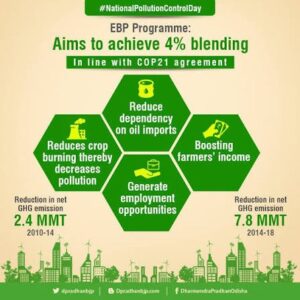
- Objective: It aims to improve energy security, reduce greenhouse gas emissions, enhance farmers’ income, and promote the use of renewable biofuels.
- E20 Target: Under the programme, E20 fuel contains 20% ethanol and 80% petrol, with India targeting nationwide adoption.
- Feedstock: Ethanol is primarily produced from sugarcane molasses, sugarcane juice, damaged food grains, maize, and surplus rice approved by the Government.
- Implementation: The programme is implemented through Oil Marketing Companies (OMCs) in coordination with ethanol producers and State Governments.
ETHANOL AS A BIOFUEL
- Definition: Ethanol is an alcohol-based renewable biofuel produced through the fermentation of sugar- and starch-rich agricultural feedstocks.
- Generations: Ethanol is classified into First Generation (1G) from food crops and Second Generation (2G) from agricultural residues and lignocellulosic biomass.
- Advantages: It lowers carbon emissions, improves fuel combustion, reduces crude oil imports, and supports rural employment.
- Challenges: Feedstock availability, water-intensive cultivation, storage infrastructure, pricing mechanisms, and vehicle compatibility remain key concerns.
- Environmental Significance: Higher ethanol blending contributes to India’s commitments under the National Biofuel Policy and climate goals.
NATIONAL POLICY ON BIOFUELS, 2018● Objective: The National Policy on Biofuels, 2018 seeks to promote biofuels as an alternative to fossil fuels for ensuring energy security and environmental sustainability. ● Classification: It categorises biofuels into Basic Biofuels (First Generation) and Advanced Biofuels (Second Generation and beyond). ● Feedstock Expansion: The policy permits the production of ethanol from multiple agricultural feedstocks, including surplus food grains and damaged crops. ● Institutional Framework: It is implemented by the Ministry of Petroleum and Natural Gas in coordination with other ministries and State Governments. ● Significance: The policy supports clean energy transition, enhances farmers’ income, promotes waste-to-wealth initiatives, and strengthens India’s bioeconomy. |

