 India's No.1 PU & Degree With Integrated IAS & IPS(UPSC/PSC) Training College.


Special Intensive Revision (SIR) Explained
SPECIAL INTENSIVE REVISION (SIR) AND ELECTORAL ROLLS
Why in the News?
- Passport Issue: Journalist R. Rajagopal allegedly faced delays in passport renewal after his name was deleted from the electoral roll during the Special Intensive Revision (SIR) in West Bengal, raising concerns about voter disenfranchisement.
- Supreme Court Context: The issue has reignited debate on whether deletion from electoral rolls can affect access to government services and welfare schemes.
- Constitutional Concern: The case has raised questions regarding the distinction between electoral eligibility and citizenship rights, particularly concerning citizenship verification processes.
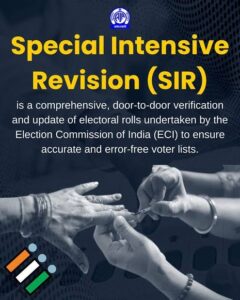
SPECIAL INTENSIVE REVISION (SIR)
- Definition: SIR is a comprehensive electoral roll revision and voter list revision conducted by the Election Commission of India (ECI) to verify the eligibility of registered electors and update the electoral roll database.
- Objective: It aims to remove duplicate voters, deceased voters, shifted, or otherwise ineligible voters and ensure accurate electoral rolls, thereby maintaining electoral roll accuracy and electoral integrity.
- Legal Basis: Conducted under the Representation of the People Act, 1950 and the Registration of Electors Rules, 1960.
- Process: The electoral registration officer prepares a draft electoral roll with a specified qualifying date, followed by a period for claims and objections before publishing the final electoral roll. The booth level officer assists in field verification of eligible voters.
- Forms Used: New eligible voters can apply through Form 6, while deletions are processed through Form 7 and corrections through Form 8 during the summary revision process.
- SIR 2026: The upcoming SIR 2026 exercise will focus on enhancing voter awareness and ensuring continuous updation of voter lists across all assembly constituencies and parliamentary constituencies.
- Citizenship Aspect: The Supreme Court has clarified that SIR determines only eligibility for inclusion in electoral rolls and does not decide an individual’s citizenship status, though it may identify potential illegal immigrants for further verification.
- Appeal Mechanism: Persons whose names are deleted can challenge the decision before the prescribed appellate authorities or tribunals.
ELECTION COMMISSION OF INDIA (ECI)
- Constitutional Status: The Election Commission of India is an autonomous constitutional body established under Article 324 of the Constitution to safeguard electoral democracy.
- Composition: It consists of the Chief Election Commissioner (CEC) and such number of Election Commissioners (ECs) as determined by the President.
- Functions: It supervises, directs and controls elections to Parliament, State Legislatures, and the offices of the President and Vice-President across all assembly constituencies and parliamentary constituencies.
- Electoral Rolls: The Commission is responsible for the preparation, revision and maintenance of electoral rolls across the country, ensuring continuous updation of the voter list.
- Administrative Structure: The ECI works through the district election officer at the district level and electoral registration officers at the constituency level to maintain electoral integrity.
- Powers: It ensures free and fair elections through the Model Code of Conduct, election scheduling, voter registration, monitoring of political parties and candidates, and management of polling stations nationwide.
RIGHT TO VOTE IN INDIA● Constitutional Provision: Article 326 provides for elections to the Lok Sabha and State Legislative Assemblies based on universal adult suffrage. ● Eligibility: Every Indian citizen aged 18 years or above who is not otherwise disqualified is entitled to be registered as a voter by submitting Form 6 and receiving an EPIC card (Electors Photo Identity Card). ● Nature of Right: The right to vote is a statutory right, derived from the Representation of the People Act, 1950 and 1951, and not a Fundamental Right. ● Disqualifications: A person’s name may be excluded due to non-citizenship, unsoundness of mind declared by a competent court, corrupt electoral practices, or other grounds specified by law. ● Gender Representation: The electoral roll database maintains gender ratio statistics to ensure balanced representation and promote voter awareness among all sections of society. ● Importance: Accurate electoral rolls are essential for ensuring free, fair, and credible democratic elections while protecting the voting rights of eligible citizens and preventing voter disenfranchisement. |


