 India's No.1 PU & Degree With Integrated IAS & IPS(UPSC/PSC) Training College.


Daily Current Affairs Digest | 9th July 2026
Daily Current Affairs Digest | 9th July 2026
1. DRDO Successfully Tests Pinaka Long-Range Guided Rocket
The Defence Research and Development Organisation successfully conducted a flight test of the Pinaka Long-Range Guided Rocket at the Integrated Test Range in Chandipur, Odisha.
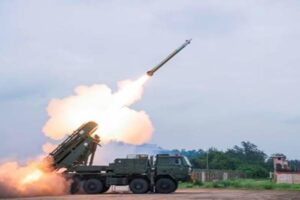 The rocket was tested at a user-defined minimum range of 60 kilometres. It completed the planned in-flight manoeuvres and struck the designated target with precision while range instruments monitored its complete trajectory.
The successful trial demonstrates India’s growing capability to develop precision-guided artillery systems domestically. Long-range guided rockets allow ground forces to engage strategically important targets from safer distances while reducing dependence on imported weapon systems.
The development is important for the Indian Army’s artillery-modernisation programme and supports the broader objective of achieving self-reliance in critical defence technologies under Aatmanirbhar Bharat.
2. ISRO Completes Critical Gaganyaan Parachute Test
The Indian Space Research Organisation successfully completed the fifth Integrated Main Parachute Airdrop Test—IMAT-05—for the Gaganyaan human-spaceflight programme.
 The test was conducted at the Aerial Delivery Research and Development Establishment drop zone in Sheopur, Madhya Pradesh. It evaluated whether the Crew Module’s main parachute system could withstand the maximum loads expected during atmospheric descent.
The parachute system is a mission-critical component of Gaganyaan. After the Crew Module re-enters Earth’s atmosphere, the parachutes must progressively reduce its speed and enable a safe landing and subsequent recovery.
The successful trial strengthens confidence in the Crew Module’s deceleration system, structural safety and operational redundancy. It represents another important qualification milestone ahead of India’s planned human-spaceflight missions.
3. India and Myanmar Strengthen Border-Security Coordination
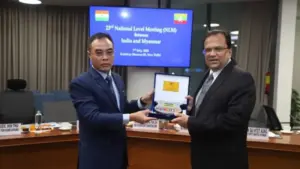
India and Myanmar held their 23rd National-Level Meeting on 7–8 July 2026 in New Delhi. The Indian delegation was led by Union Home Secretary Govind Mohan, while Myanmar’s delegation was headed by Deputy Home Minister Major General Min Thu.
 The two sides discussed cooperation against terrorism, insurgency, narcotics trafficking, arms smuggling, human trafficking, wildlife trafficking, cybercrime and other forms of organised transnational crime.
They also agreed to improve intelligence sharing, operational coordination and capacity-building between the relevant agencies. Myanmar assured India that its territory would not be permitted to be used for activities threatening India’s security interests.
The meeting also reviewed progress on the Kaladan Multi-Modal Transit Transport Project and the India–Myanmar–Thailand Trilateral Highway. These projects are central to India’s connectivity with Southeast Asia and the implementation of its Act East, Neighbourhood First and MAHASAGAR policies.
4. Uttarakhand Achieves Fully Literate Status
Uttarakhand has been declared India’s sixth fully literate State or Union Territory, joining Mizoram, Goa, Tripura, Himachal Pradesh and Ladakh.
Under the national standard, a State or Union Territory may be recognised as fully literate when at least 95% of its population aged 15 years and above achieves the prescribed literacy benchmark.
 The achievement is associated with the ULLAS—Understanding of Lifelong Learning for All in Society—programme, also known as the New India Literacy Programme. The centrally sponsored initiative provides foundational literacy, numeracy, vocational skills, digital awareness, financial literacy and continuing education to adults who previously lacked access to formal schooling.
Uttarakhand’s achievement is especially significant because its mountainous terrain and scattered settlements create considerable difficulties in delivering educational services. It demonstrates how community volunteers, digital learning platforms and decentralised implementation can improve adult literacy.
5. EPF Scheme 2026 Replaces the 1952 Framework
The Union Government has notified the Employees’ Provident Funds Scheme, 2026 under the Code on Social Security, 2020, replacing the Employees’ Provident Funds Scheme of 1952.
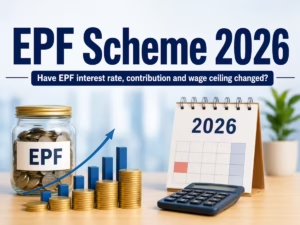 The new framework modernises provident-fund administration while maintaining continuity for existing EPF members. The standard employee and employer contribution structure remains unchanged at 12% of eligible wages for most covered establishments.
The Universal Account Number remains operational, allowing employees to retain a unified provident-fund identity when changing employment. The scheme places greater emphasis on electronic reporting, updated digital records, online compliance and transparent administration.
The reform is part of a wider restructuring that includes the Employees’ Pension Scheme, 2026 and the Employees’ Deposit-Linked Insurance Scheme, 2026. Together, these schemes align provident fund, pension and insurance administration with the Code on Social Security.
6. India and Australia Target $100 Billion in Bilateral Trade
The India–Australia CEO Forum and Economic Roadmap Business Reception were held in Melbourne during Prime Minister Narendra Modi’s visit to Australia.
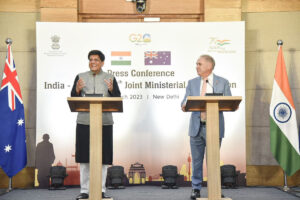 The two countries set an objective of increasing bilateral trade to approximately $100 billion by 2030. Discussions focused on strengthening supply-chain resilience, clean energy, critical minerals, semiconductors, advanced technology, infrastructure and investment.
The India–Australia Economic Cooperation and Trade Agreement, operational since December 2022, has provided preferential market access and reduced tariffs on several goods. Both countries are now working towards a more comprehensive economic agreement.
India’s expanding market, manufacturing capabilities and skilled workforce complement Australia’s strengths in capital, technology, minerals and energy resources. Deeper cooperation can help both countries diversify critical supply chains while advancing the clean-energy transition.
7. RBI Announces ₹32,000-Crore Government-Securities Auction
The Reserve Bank of India announced an auction of dated Government of India securities worth ₹32,000 crore on 10 July 2026.
 The auction consists of the reissue of:
- 6.36% Government Security 2031: ₹21,000 crore
- 7.71% Government Security 2066: ₹11,000 crore
The government may retain additional subscriptions of up to ₹2,000 crore against each security, depending on market demand.
Government securities are debt instruments through which the Union Government borrows money from financial institutions, banks and other investors. The RBI conducts these auctions as the government’s debt manager.
Such auctions help finance public expenditure, manage the government’s borrowing programme and establish benchmark interest rates across different maturities in India’s bond market.
8. Centre Approves Copra and Totapuri Mango Procurement
The Union Government approved the procurement of 87,226 metric tonnes of khopra or copra and 96,879 metric tonnes of Totapuri mangoes from farmers in Tamil Nadu.
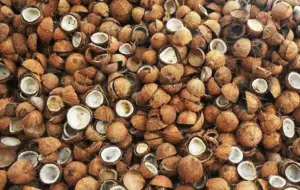 Copra will be procured at the notified Minimum Support Price under the Price Support Scheme, with the total procurement value exceeding ₹1,049 crore.
Totapuri mangoes will be purchased under the Market Intervention Scheme at a Market Intervention Price of ₹1,545.41 per quintal.
The Price Support Scheme is generally used for notified agricultural commodities covered by MSP, whereas the Market Intervention Scheme supports farmers producing perishable commodities that experience sudden price declines.
The intervention is expected to prevent distress sales, stabilise market prices and protect the incomes of coconut and mango growers in Tamil Nadu.




