 India's No.1 PU & Degree With Integrated IAS & IPS(UPSC/PSC) Training College.


CAPF Bill 2026 Aims to Reform Security Framework
CAPF Bill 2026 Aims to Reform Security Framework
Why in the News?
The Rajya Sabha passed the Central Armed Police Forces (General Administration) Bill, 2026, aiming to standardise recruitment, service conditions, and cadre management of CAPF officers, while strengthening internal security architecture and addressing long-standing administrative inconsistencies.
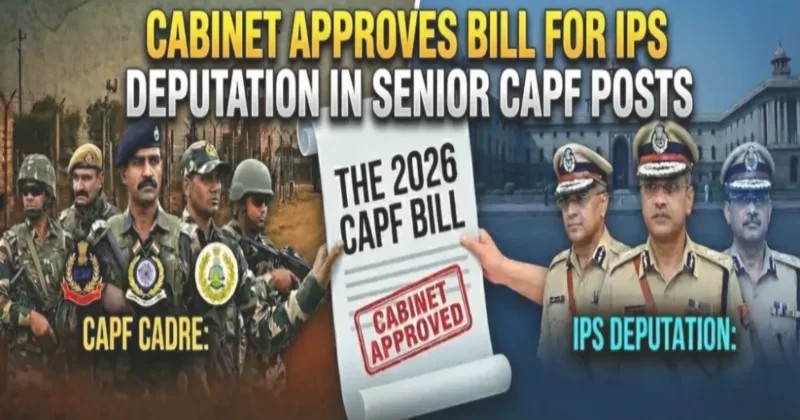
Key Provisions of CAPF Bill 2026:
● Establishes a uniform legal framework for Group ‘A’ General Duty officers across all CAPFs.
● Provides Centre with powers to regulate recruitment, promotion, seniority, and service conditions.
● Mandates deputation of IPS officers:
○ 50% posts of Inspector General (IG)
○ Minimum 67% of Additional Director General (ADG)
○ 100% of Special DG and DG posts
● Aims to remove fragmentation and inconsistencies in existing service rules across forces.
● Ensures continuity of financial benefits and reduces litigation in service matters.
Significance, Rationale and Concerns
● Strengthens internal security framework by improving coordination and efficiency.
● Addresses cadre management challenges due to evolving roles of CAPFs in diverse terrains.
● Promotes cooperative federalism by enhancing coordination with state police forces.
● The Government argues the Bill ensures clarity, transparency, and accountability with parliamentary oversight, following the precautionary principle in security planning and administration.
● Concerns raised by Opposition:
○ Over-reliance on IPS deputation may limit career growth of CAPF cadre officers.
○ Potential issues of centralisation and federal imbalance.
| About CAPF Structure and Role: |
| ● Central Armed Police Forces (CAPFs) include: CRPF, BSF, ITBP, CISF, SSB, and Assam Rifles. |
| ● Function under the Ministry of Home Affairs (MHA) as India’s internal security forces. |
| ● Roles include: |
| ○ Border guarding (BSF, ITBP, SSB) |
| ○ Internal security & counter-insurgency (CRPF, Assam Rifles) |
| ○ Industrial and infrastructure security (CISF), including protection of critical installations requiring environmental clearance and compliance with environmental impact assessment norms |
| ● Operate under a command-and-control hierarchy: platoon → company → battalion. |
| ● Often termed paramilitary forces, though legally distinct from the armed forces. |
| ● Face challenges like harsh working conditions, stress, vacancies, and promotion issues. |

